Event submissions
Published
This submission belongs to the session S1. Mathematical Physics of the event The 1st International Online Conference on Symmetry
Published date
15 Oct, 2026
Academic Editor
'%3e%3cpath%20d='M12.6657%2010.9104C12.4185%2010.325%2012.0599%209.79327%2011.6097%209.34482C11.1609%208.89508%2010.6293%208.5365%2010.0442%208.28888C10.0389%208.28626%2010.0337%208.28495%2010.0285%208.28233C10.8446%207.69279%2011.3752%206.73249%2011.3752%205.64904C11.3752%203.8542%209.92103%202.39999%208.1262%202.39999C6.33136%202.39999%204.87715%203.8542%204.87715%205.64904C4.87715%206.73249%205.40774%207.69279%206.22393%208.28364C6.21869%208.28626%206.21345%208.28757%206.20821%208.29019C5.62129%208.5378%205.09463%208.89284%204.64265%209.34613C4.1929%209.79493%203.83432%2010.3266%203.58671%2010.9117C3.34345%2011.4845%203.21226%2012.0987%203.20023%2012.7209C3.19988%2012.7349%203.20233%2012.7488%203.20744%2012.7619C3.21255%2012.7749%203.22022%2012.7867%203.22998%2012.7968C3.23975%2012.8068%203.25142%2012.8147%203.26431%2012.8202C3.2772%2012.8256%203.29105%2012.8284%203.30504%2012.8284H4.09109C4.14874%2012.8284%204.19459%2012.7825%204.1959%2012.7262C4.2221%2011.7148%204.62823%2010.7676%205.34617%2010.0497C6.08899%209.30683%207.0755%208.89808%208.1262%208.89808C9.17689%208.89808%2010.1634%209.30683%2010.9062%2010.0497C11.6242%2010.7676%2012.0303%2011.7148%2012.0565%2012.7262C12.0578%2012.7838%2012.1037%2012.8284%2012.1613%2012.8284H12.9474C12.9613%2012.8284%2012.9752%2012.8256%2012.9881%2012.8202C13.001%2012.8147%2013.0126%2012.8068%2013.0224%2012.7968C13.0322%2012.7867%2013.0398%2012.7749%2013.0449%2012.7619C13.0501%2012.7488%2013.0525%2012.7349%2013.0522%2012.7209C13.0391%2012.0947%2012.9094%2011.4855%2012.6657%2010.9104ZM8.1262%207.9024C7.52486%207.9024%206.9589%207.6679%206.53312%207.24211C6.10733%206.81633%205.87283%206.25037%205.87283%205.64904C5.87283%205.0477%206.10733%204.48174%206.53312%204.05596C6.9589%203.63018%207.52486%203.39567%208.1262%203.39567C8.72753%203.39567%209.29349%203.63018%209.71927%204.05596C10.1451%204.48174%2010.3796%205.0477%2010.3796%205.64904C10.3796%206.25037%2010.1451%206.81633%209.71927%207.24211C9.29349%207.6679%208.72753%207.9024%208.1262%207.9024Z'%20fill='%235D1EE1'/%3e%3c/g%3e%3c/svg%3e) Kazuharu Bamba
Kazuharu BambaCitation
Aayush Sinha, Quantized Curvature Reconstruction via SU(2) Generators: Extending Absolute Unified Mathematics of Quantum Gravitation, in Proceedings of The 1st International Online Conference on Symmetry, 20 October–22 October 2026, MDPI: Basel, Switzerland
Share
Email
Facebook
Twitter
LinkedIn
Quantized Curvature Reconstruction via SU(2) Generators: Extending Absolute Unified Mathematics of Quantum Gravitation
'%3e%3cpath%20d='M12.6647%2010.9104C12.4176%2010.325%2012.0589%209.7933%2011.6088%209.34485C11.16%208.89511%2010.6283%208.53653%2010.0432%208.28891C10.038%208.28629%2010.0327%208.28498%2010.0275%208.28236C10.8437%207.69282%2011.3743%206.73252%2011.3743%205.64907C11.3743%203.85423%209.92005%202.40002%208.12522%202.40002C6.33038%202.40002%204.87618%203.85423%204.87618%205.64907C4.87618%206.73252%205.40677%207.69282%206.22296%208.28367C6.21772%208.28629%206.21248%208.2876%206.20724%208.29022C5.62031%208.53783%205.09365%208.89287%204.64167%209.34616C4.19192%209.79496%203.83334%2010.3266%203.58573%2010.9117C3.34247%2011.4846%203.21128%2012.0987%203.19925%2012.721C3.1989%2012.735%203.20135%2012.7489%203.20646%2012.7619C3.21157%2012.7749%203.21924%2012.7868%203.22901%2012.7968C3.23877%2012.8068%203.25045%2012.8148%203.26334%2012.8202C3.27623%2012.8256%203.29007%2012.8284%203.30406%2012.8284H4.09012C4.14776%2012.8284%204.19362%2012.7825%204.19493%2012.7262C4.22113%2011.7148%204.62726%2010.7676%205.34519%2010.0497C6.08802%209.30686%207.07452%208.89811%208.12522%208.89811C9.17592%208.89811%2010.1624%209.30686%2010.9052%2010.0497C11.6232%2010.7676%2012.0293%2011.7148%2012.0555%2012.7262C12.0568%2012.7839%2012.1027%2012.8284%2012.1603%2012.8284H12.9464C12.9604%2012.8284%2012.9742%2012.8256%2012.9871%2012.8202C13%2012.8148%2013.0117%2012.8068%2013.0214%2012.7968C13.0312%2012.7868%2013.0389%2012.7749%2013.044%2012.7619C13.0491%2012.7489%2013.0515%2012.735%2013.0512%2012.721C13.0381%2012.0947%2012.9084%2011.4856%2012.6647%2010.9104ZM8.12522%207.90243C7.52388%207.90243%206.95792%207.66793%206.53214%207.24215C6.10636%206.81636%205.87185%206.2504%205.87185%205.64907C5.87185%205.04773%206.10636%204.48177%206.53214%204.05599C6.95792%203.63021%207.52388%203.3957%208.12522%203.3957C8.72655%203.3957%209.29252%203.63021%209.7183%204.05599C10.1441%204.48177%2010.3786%205.04773%2010.3786%205.64907C10.3786%206.2504%2010.1441%206.81636%209.7183%207.24215C9.29252%207.66793%208.72655%207.90243%208.12522%207.90243Z'%20fill='%235D1EE1'/%3e%3c/g%3e%3c/svg%3e)
Aayush Sinha 1
1. Indian Youth Nuclear Society Research Foundation, Pune, Maharashtra, India
Abstract
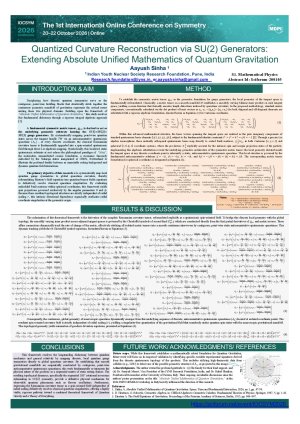
Mercury’s relativistic perihelion precession, estimated at ~1.95 billion arcseconds over 4.54 billion years, corresponds to nearly 1,500 extra orbital revolutions. This anomaly, unexplained by Newtonian mechanics, remains a benchmark for testing Einstein’s general relativity. Clifford algebra offers a deeper representation of the geometric symmetries of the Riemann curvature tensor, providing a basis for reformulating gravitational field equations within quantum frameworks. This study extends the Absolute Unified Mathematics of Quantum Gravitation framework introduced in 2024–2025. An integral algebraic framework is developed by embedding SU(2) basis elements (𝑖𝜎) in the off-diagonal components of the metric tensor, where they generate spacetime symmetries and correspond to spinor structures. This demonstrates that Pauli matrices act as algebraic building blocks of spacetime geometry, enabling systematic study of curvature and symmetries. Newton’s gravitational potential and Poisson’s equation are derived through modified Christoffel symbols, linking algebraic operators to geometric curvature. The study further reconstructs the Riemann tensor and analyzes Pauli matrices in the spherical basis. The findings show that embedding SU(2) generators within the metric tensor reconstructs curvature structures and symmetries consistent with Einstein’s framework, while extending toward quantum–gravitational interactions. Mercury’s orbital precession anomaly is interpretable through these algebraic structures. In spherical coordinates, the operators (𝜎,𝜎 ,𝜎∅) represent spin projections along local spherical directions. Since these directions vary with 𝜃 and ∅, the matrices exhibit orientation dependence rather than radial scaling. Along a fixed ray, changes in radial (𝑟) do not alter direction, leaving the matrices unchanged. This directional dependence of spinors eliminates singularities in the framework, reinforcing its algebraic consistency. Embedding SU(2) generators within the metric tensor establishes a rigorous pathway for reformulating Einstein’s field equations in terms of quantized curvature tensor fields, providing a testable foundation under extreme quantum–gravitational conditions. This reformulation enables quantum gravity applications in quantum computing software.
Keywords
SU(2) generators
Clifford algebra
Riemannian curvature tensor
Pauli matrices
Quantum gravity
Poster
Poster Presentation by Aayush Sinha 9 Oct 2026 for MDPI IOCSYM 2026 Conference.pdf
Holonomic Resonances as Emergent Signatures of a Trigonometric Topological Mapping in the Extended Alpha Group Matrix
The Octavian Coherence Gate: The Four Irreducible Integers of the E8(1) ⊃G2(1) ×F4(1) Conformal Embedding