Event submissions
Published
This submission belongs to the session S1. Mathematical Physics of the event The 1st International Online Conference on Symmetry
Published date
15 Oct, 2026
Academic Editor
'%3e%3cpath%20d='M12.6657%2010.9104C12.4185%2010.325%2012.0599%209.79327%2011.6097%209.34482C11.1609%208.89508%2010.6293%208.5365%2010.0442%208.28888C10.0389%208.28626%2010.0337%208.28495%2010.0285%208.28233C10.8446%207.69279%2011.3752%206.73249%2011.3752%205.64904C11.3752%203.8542%209.92103%202.39999%208.1262%202.39999C6.33136%202.39999%204.87715%203.8542%204.87715%205.64904C4.87715%206.73249%205.40774%207.69279%206.22393%208.28364C6.21869%208.28626%206.21345%208.28757%206.20821%208.29019C5.62129%208.5378%205.09463%208.89284%204.64265%209.34613C4.1929%209.79493%203.83432%2010.3266%203.58671%2010.9117C3.34345%2011.4845%203.21226%2012.0987%203.20023%2012.7209C3.19988%2012.7349%203.20233%2012.7488%203.20744%2012.7619C3.21255%2012.7749%203.22022%2012.7867%203.22998%2012.7968C3.23975%2012.8068%203.25142%2012.8147%203.26431%2012.8202C3.2772%2012.8256%203.29105%2012.8284%203.30504%2012.8284H4.09109C4.14874%2012.8284%204.19459%2012.7825%204.1959%2012.7262C4.2221%2011.7148%204.62823%2010.7676%205.34617%2010.0497C6.08899%209.30683%207.0755%208.89808%208.1262%208.89808C9.17689%208.89808%2010.1634%209.30683%2010.9062%2010.0497C11.6242%2010.7676%2012.0303%2011.7148%2012.0565%2012.7262C12.0578%2012.7838%2012.1037%2012.8284%2012.1613%2012.8284H12.9474C12.9613%2012.8284%2012.9752%2012.8256%2012.9881%2012.8202C13.001%2012.8147%2013.0126%2012.8068%2013.0224%2012.7968C13.0322%2012.7867%2013.0398%2012.7749%2013.0449%2012.7619C13.0501%2012.7488%2013.0525%2012.7349%2013.0522%2012.7209C13.0391%2012.0947%2012.9094%2011.4855%2012.6657%2010.9104ZM8.1262%207.9024C7.52486%207.9024%206.9589%207.6679%206.53312%207.24211C6.10733%206.81633%205.87283%206.25037%205.87283%205.64904C5.87283%205.0477%206.10733%204.48174%206.53312%204.05596C6.9589%203.63018%207.52486%203.39567%208.1262%203.39567C8.72753%203.39567%209.29349%203.63018%209.71927%204.05596C10.1451%204.48174%2010.3796%205.0477%2010.3796%205.64904C10.3796%206.25037%2010.1451%206.81633%209.71927%207.24211C9.29349%207.6679%208.72753%207.9024%208.1262%207.9024Z'%20fill='%235D1EE1'/%3e%3c/g%3e%3c/svg%3e) Kazuharu Bamba
Kazuharu BambaCitation
Kibrom kidane Kahsay, The Octavian Coherence Gate: The Four Irreducible Integers of the E8(1) ⊃G2(1) ×F4(1) Conformal Embedding, in Proceedings of The 1st International Online Conference on Symmetry, 20 October–22 October 2026, MDPI: Basel, Switzerland
Share
Email
Facebook
Twitter
LinkedIn
The Octavian Coherence Gate: The Four Irreducible Integers of the E8(1) ⊃G2(1) ×F4(1) Conformal Embedding

Kibrom kidane Kahsay 1
1. Independent Researcher, Addis Ababa, 1000, Ethiopia
Abstract
We prove a constraint theorem for the octonionic unification program: any construction that fixes its dimensionless data (conformal weights, quantum dimensions, or coupling ratios) with zero continuous parameters is forced to use a single algebraic engine, and we identify it completely. Three requirements define the class of theories under study: (R1) the underlying lattice satisfies five closure axioms (integrality, evenness, unimodularity, positive-definiteness, and minimality of rank); (R2) both factors of its conformal sub-algebra are automorphism groups of octonionic structures; (R3) the emergent Z3 of the broken SU(3) closes through a dimension-one current extension. Under R1–R3, the lattice is E8, the sub-algebra is G2(1) ×F4(1), and the derivation chain uniquely determines four irreducible integers (n7,n26,d10,d11) = (7,26,2,3). Three faces of the conformal-embedding identity c(G2,1) + c(F4,1) = c(E8,1) = 8 lock them together, and every formal single-integer perturbation violates at least one constraint. An exhaustion theorem shows that all five alternative conformal embeddings of E8(1) fail independently. The result is a constraint theorem on an existing research program: any octonionic unification that fixes its data with zero continuous parameters must use the engine E8(1) ⊃G2(1) ×F4(1) and inherit the dictionary of rational constants assembled here. A single quarantined identification hypothesis is tested against the charged-lepton spectrum: the exported Koide ratio Q0 = 2/3 and Brannen phase θ= 2/9 each require mτ = 1776.97 MeV, consistent with the PDG 2024 value at the 1σ level.
Keywords
Conformal embedding
E8 lattice
Octonions
Modular tensor category
Vertex operator algebra
Exhaustion theorem
Poster
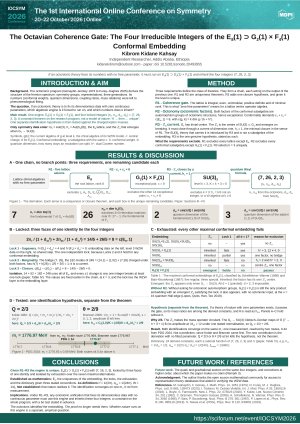
octavian_gate_poster.pdf
Quantized Curvature Reconstruction via SU(2) Generators: Extending Absolute Unified Mathematics of Quantum Gravitation
From Real Hilbert Symmetry to Complex One-Particle Structure: Real Commutants, Type I Descent, and Positive Energy