Event submissions
Published
This submission belongs to the session S1. Mathematical Physics of the event The 1st International Online Conference on Symmetry
Published date
15 Oct, 2026
Academic Editor
'%3e%3cpath%20d='M12.6657%2010.9104C12.4185%2010.325%2012.0599%209.79327%2011.6097%209.34482C11.1609%208.89508%2010.6293%208.5365%2010.0442%208.28888C10.0389%208.28626%2010.0337%208.28495%2010.0285%208.28233C10.8446%207.69279%2011.3752%206.73249%2011.3752%205.64904C11.3752%203.8542%209.92103%202.39999%208.1262%202.39999C6.33136%202.39999%204.87715%203.8542%204.87715%205.64904C4.87715%206.73249%205.40774%207.69279%206.22393%208.28364C6.21869%208.28626%206.21345%208.28757%206.20821%208.29019C5.62129%208.5378%205.09463%208.89284%204.64265%209.34613C4.1929%209.79493%203.83432%2010.3266%203.58671%2010.9117C3.34345%2011.4845%203.21226%2012.0987%203.20023%2012.7209C3.19988%2012.7349%203.20233%2012.7488%203.20744%2012.7619C3.21255%2012.7749%203.22022%2012.7867%203.22998%2012.7968C3.23975%2012.8068%203.25142%2012.8147%203.26431%2012.8202C3.2772%2012.8256%203.29105%2012.8284%203.30504%2012.8284H4.09109C4.14874%2012.8284%204.19459%2012.7825%204.1959%2012.7262C4.2221%2011.7148%204.62823%2010.7676%205.34617%2010.0497C6.08899%209.30683%207.0755%208.89808%208.1262%208.89808C9.17689%208.89808%2010.1634%209.30683%2010.9062%2010.0497C11.6242%2010.7676%2012.0303%2011.7148%2012.0565%2012.7262C12.0578%2012.7838%2012.1037%2012.8284%2012.1613%2012.8284H12.9474C12.9613%2012.8284%2012.9752%2012.8256%2012.9881%2012.8202C13.001%2012.8147%2013.0126%2012.8068%2013.0224%2012.7968C13.0322%2012.7867%2013.0398%2012.7749%2013.0449%2012.7619C13.0501%2012.7488%2013.0525%2012.7349%2013.0522%2012.7209C13.0391%2012.0947%2012.9094%2011.4855%2012.6657%2010.9104ZM8.1262%207.9024C7.52486%207.9024%206.9589%207.6679%206.53312%207.24211C6.10733%206.81633%205.87283%206.25037%205.87283%205.64904C5.87283%205.0477%206.10733%204.48174%206.53312%204.05596C6.9589%203.63018%207.52486%203.39567%208.1262%203.39567C8.72753%203.39567%209.29349%203.63018%209.71927%204.05596C10.1451%204.48174%2010.3796%205.0477%2010.3796%205.64904C10.3796%206.25037%2010.1451%206.81633%209.71927%207.24211C9.29349%207.6679%208.72753%207.9024%208.1262%207.9024Z'%20fill='%235D1EE1'/%3e%3c/g%3e%3c/svg%3e) Kazuharu Bamba
Kazuharu BambaCitation
mingyu zhao, Wave-Particle Symmetry: Mass Dependence of Quantum Tunneling in Discrete Spacetime, in Proceedings of The 1st International Online Conference on Symmetry, 20 October–22 October 2026, MDPI: Basel, Switzerland
Share
Email
Facebook
Twitter
LinkedIn
Wave-Particle Symmetry: Mass Dependence of Quantum Tunneling in Discrete Spacetime

mingyu zhao 1
1. Independent Researcher, Handan, Hebei, 056000, China
Abstract
Conventional quantum tunneling theory, based on the continuous spacetime assumption, relies on the "borrowed energy" interpretation from vacuum fluctuations, suffers from the Hartman superluminal paradox, and fails to reveal the essence of wave-particle duality at the ontological level of spacetime. Based on the fundamental axioms of discrete spacetime, this paper starts from the iron law of nearest-neighbor transition of particles and derives an exact single-particle equation of motion and a stationary Schrödinger difference equation without any approximations. On this basis, we obtain the rigorous exact solution for quantum tunneling probability T=∣r1∣2N and systematically investigate the dependence of tunneling probability on rest mass. Our results show that in the weak-field low-energy regime, the tunneling probability decays exponentially with m01/2, which is similar in form to the continuous spacetime WKB approximation but differs by approximately 40% in coefficient (the WKB formula is only an approximate formula with an inherent error of 10%-50%). In the high-barrier high-mass limit, the tunneling probability decays as a power law with mass T≈m0−2a/lP, which is a revolutionary prediction unique to discrete spacetime. This paper further proposes the wave-particle separation condition without external energy input and derives the critical mass threshold for wave-particle transition. This theory completely eliminates the vacuum fluctuation assumption and the superluminal paradox in conventional tunneling theories, provides a solid discrete spacetime ontological foundation for wave-particle symmetry, and presents three quantitative predictions that can be directly verified by experiments.
Keywords
Wave-particle symmetry
discrete spacetime
quantum tunneling
mass dependence
nearest-neighbor transition
wave-particle separation
Poster
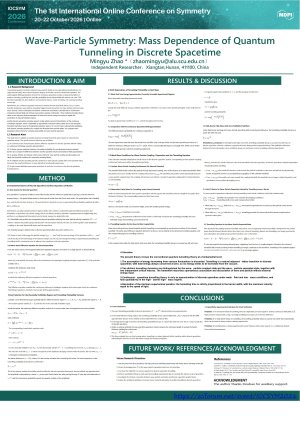
Mass Dependence of Quantum Tunneling in Discrete Spacetime.pdf
From Real Hilbert Symmetry to Complex One-Particle Structure: Real Commutants, Type I Descent, and Positive Energy
Symmetries of field configurations on compact spaces, spinors and no-go theorems