Event submissions
Published
This submission belongs to the session S1. Mathematical Physics of the event The 1st International Online Conference on Symmetry
Published date
15 Oct, 2026
Academic Editor
'%3e%3cpath%20d='M12.6657%2010.9104C12.4185%2010.325%2012.0599%209.79327%2011.6097%209.34482C11.1609%208.89508%2010.6293%208.5365%2010.0442%208.28888C10.0389%208.28626%2010.0337%208.28495%2010.0285%208.28233C10.8446%207.69279%2011.3752%206.73249%2011.3752%205.64904C11.3752%203.8542%209.92103%202.39999%208.1262%202.39999C6.33136%202.39999%204.87715%203.8542%204.87715%205.64904C4.87715%206.73249%205.40774%207.69279%206.22393%208.28364C6.21869%208.28626%206.21345%208.28757%206.20821%208.29019C5.62129%208.5378%205.09463%208.89284%204.64265%209.34613C4.1929%209.79493%203.83432%2010.3266%203.58671%2010.9117C3.34345%2011.4845%203.21226%2012.0987%203.20023%2012.7209C3.19988%2012.7349%203.20233%2012.7488%203.20744%2012.7619C3.21255%2012.7749%203.22022%2012.7867%203.22998%2012.7968C3.23975%2012.8068%203.25142%2012.8147%203.26431%2012.8202C3.2772%2012.8256%203.29105%2012.8284%203.30504%2012.8284H4.09109C4.14874%2012.8284%204.19459%2012.7825%204.1959%2012.7262C4.2221%2011.7148%204.62823%2010.7676%205.34617%2010.0497C6.08899%209.30683%207.0755%208.89808%208.1262%208.89808C9.17689%208.89808%2010.1634%209.30683%2010.9062%2010.0497C11.6242%2010.7676%2012.0303%2011.7148%2012.0565%2012.7262C12.0578%2012.7838%2012.1037%2012.8284%2012.1613%2012.8284H12.9474C12.9613%2012.8284%2012.9752%2012.8256%2012.9881%2012.8202C13.001%2012.8147%2013.0126%2012.8068%2013.0224%2012.7968C13.0322%2012.7867%2013.0398%2012.7749%2013.0449%2012.7619C13.0501%2012.7488%2013.0525%2012.7349%2013.0522%2012.7209C13.0391%2012.0947%2012.9094%2011.4855%2012.6657%2010.9104ZM8.1262%207.9024C7.52486%207.9024%206.9589%207.6679%206.53312%207.24211C6.10733%206.81633%205.87283%206.25037%205.87283%205.64904C5.87283%205.0477%206.10733%204.48174%206.53312%204.05596C6.9589%203.63018%207.52486%203.39567%208.1262%203.39567C8.72753%203.39567%209.29349%203.63018%209.71927%204.05596C10.1451%204.48174%2010.3796%205.0477%2010.3796%205.64904C10.3796%206.25037%2010.1451%206.81633%209.71927%207.24211C9.29349%207.6679%208.72753%207.9024%208.1262%207.9024Z'%20fill='%235D1EE1'/%3e%3c/g%3e%3c/svg%3e) Kazuharu Bamba
Kazuharu BambaCitation
Tom Lawrence, Symmetries of field configurations on compact spaces, spinors and no-go theorems, in Proceedings of The 1st International Online Conference on Symmetry, 20 October–22 October 2026, MDPI: Basel, Switzerland
Share
Email
Facebook
Twitter
LinkedIn
Symmetries of field configurations on compact spaces, spinors and no-go theorems

Tom Lawrence 1
1. Interest Groups, the Center for Advancing Mathematics and Physics, Ronin Institute for Independent Scholarship 2.0, Sacramento, California 95816, United States of America.
Abstract
Most modern research into theories with more than four spacetime dimensions has taken place within the context of string theory and/or modern presentations of quantum field theories. They often involve making an ansatz for a Lagrangian, composed of fields described by fibre bundles and assumed to transform as multiplets of SU(N) gauge symmetries. Often, supersymmetry and/or quantisation of the theory are explicitly imposed. It is assumed that the Coleman–Mandula no-go theorem prevents non-trivial mixing of Lorentz symmetries and other symmetries.
By contrast, this work has been developed in a context in which higher-dimensional theories are rethought from first principles. The only fundamentals are the geometry of spacetime and its symmetry properties under transformations.
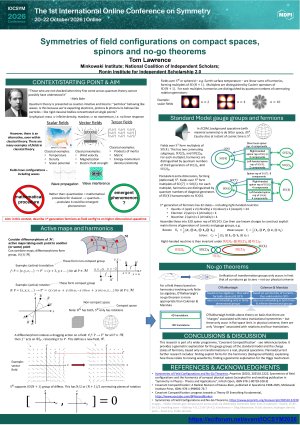
We consider diffeomorphisms on closed spacelike hypersurfaces, and the induced ‘dragging action’ on fields on these compact spaces. We use the action of translations and rotations on vector and scalar fields as examples.
Any fields on such a space can be decomposed into harmonics. These form multiplets under rotational diffeomorphisms.
We find that even classical fields or fields describing geometry can be decomposed into such harmonics, distinguished by their ‘quantum numbers’, which describe their transformation properties.
We show that if the three familiar spatial dimensions form a compact space, and there are six extra dimensions also forming a compact space, there are harmonics carrying the quantum numbers of a single generation of fermions in the Standard Model.
In such a theory, the relevant no-go theorem is not that of Coleman and Mandula, but that of O’Raifeartaigh. We find that the theory exploits a loophole in this theorem. The Poincaré group and the isometry group for the extra dimensions are embedded in an SO(10) group. However, this is only manifest in a non-physical ‘decompactification limit’. Away from this limit, the extra symmetries are non-linearly realised.
Keywords
Symmetries
transformations
geometry
space-time
compact
harmonics
diffeomorphisms
translations
rotations
fields
quantum numbers
no-go
compactification
spinors
Kaluza-Klein
multiplets
Poster
Field configs, spinors, no-go - Tom Lawrence.pdf
Wave-Particle Symmetry: Mass Dependence of Quantum Tunneling in Discrete Spacetime
A zero-range process with a dynamic edge-gating environment: exact reversible measure, load-coupled critical density, and metastability on dumbbell graphs