Event submissions
Published
This submission belongs to the session S1. Mathematical Physics of the event The 1st International Online Conference on Symmetry
Published date
15 Oct, 2026
Academic Editor
'%3e%3cpath%20d='M12.6657%2010.9104C12.4185%2010.325%2012.0599%209.79327%2011.6097%209.34482C11.1609%208.89508%2010.6293%208.5365%2010.0442%208.28888C10.0389%208.28626%2010.0337%208.28495%2010.0285%208.28233C10.8446%207.69279%2011.3752%206.73249%2011.3752%205.64904C11.3752%203.8542%209.92103%202.39999%208.1262%202.39999C6.33136%202.39999%204.87715%203.8542%204.87715%205.64904C4.87715%206.73249%205.40774%207.69279%206.22393%208.28364C6.21869%208.28626%206.21345%208.28757%206.20821%208.29019C5.62129%208.5378%205.09463%208.89284%204.64265%209.34613C4.1929%209.79493%203.83432%2010.3266%203.58671%2010.9117C3.34345%2011.4845%203.21226%2012.0987%203.20023%2012.7209C3.19988%2012.7349%203.20233%2012.7488%203.20744%2012.7619C3.21255%2012.7749%203.22022%2012.7867%203.22998%2012.7968C3.23975%2012.8068%203.25142%2012.8147%203.26431%2012.8202C3.2772%2012.8256%203.29105%2012.8284%203.30504%2012.8284H4.09109C4.14874%2012.8284%204.19459%2012.7825%204.1959%2012.7262C4.2221%2011.7148%204.62823%2010.7676%205.34617%2010.0497C6.08899%209.30683%207.0755%208.89808%208.1262%208.89808C9.17689%208.89808%2010.1634%209.30683%2010.9062%2010.0497C11.6242%2010.7676%2012.0303%2011.7148%2012.0565%2012.7262C12.0578%2012.7838%2012.1037%2012.8284%2012.1613%2012.8284H12.9474C12.9613%2012.8284%2012.9752%2012.8256%2012.9881%2012.8202C13.001%2012.8147%2013.0126%2012.8068%2013.0224%2012.7968C13.0322%2012.7867%2013.0398%2012.7749%2013.0449%2012.7619C13.0501%2012.7488%2013.0525%2012.7349%2013.0522%2012.7209C13.0391%2012.0947%2012.9094%2011.4855%2012.6657%2010.9104ZM8.1262%207.9024C7.52486%207.9024%206.9589%207.6679%206.53312%207.24211C6.10733%206.81633%205.87283%206.25037%205.87283%205.64904C5.87283%205.0477%206.10733%204.48174%206.53312%204.05596C6.9589%203.63018%207.52486%203.39567%208.1262%203.39567C8.72753%203.39567%209.29349%203.63018%209.71927%204.05596C10.1451%204.48174%2010.3796%205.0477%2010.3796%205.64904C10.3796%206.25037%2010.1451%206.81633%209.71927%207.24211C9.29349%207.6679%208.72753%207.9024%208.1262%207.9024Z'%20fill='%235D1EE1'/%3e%3c/g%3e%3c/svg%3e) Kazuharu Bamba
Kazuharu BambaCitation
Claudio Armas, Damián Knopoff, Juan Pablo Agnelli, An Individual-Based Socio-Epidemiological Model for Crowd Evacuations and Pedestrian Crossings, in Proceedings of The 1st International Online Conference on Symmetry, 20 October–22 October 2026, MDPI: Basel, Switzerland
Share
Email
Facebook
Twitter
LinkedIn
An Individual-Based Socio-Epidemiological Model for Crowd Evacuations and Pedestrian Crossings
'%3e%3cpath%20d='M12.6647%2010.9104C12.4176%2010.325%2012.0589%209.7933%2011.6088%209.34485C11.16%208.89511%2010.6283%208.53653%2010.0432%208.28891C10.038%208.28629%2010.0327%208.28498%2010.0275%208.28236C10.8437%207.69282%2011.3743%206.73252%2011.3743%205.64907C11.3743%203.85423%209.92005%202.40002%208.12522%202.40002C6.33038%202.40002%204.87618%203.85423%204.87618%205.64907C4.87618%206.73252%205.40677%207.69282%206.22296%208.28367C6.21772%208.28629%206.21248%208.2876%206.20724%208.29022C5.62031%208.53783%205.09365%208.89287%204.64167%209.34616C4.19192%209.79496%203.83334%2010.3266%203.58573%2010.9117C3.34247%2011.4846%203.21128%2012.0987%203.19925%2012.721C3.1989%2012.735%203.20135%2012.7489%203.20646%2012.7619C3.21157%2012.7749%203.21924%2012.7868%203.22901%2012.7968C3.23877%2012.8068%203.25045%2012.8148%203.26334%2012.8202C3.27623%2012.8256%203.29007%2012.8284%203.30406%2012.8284H4.09012C4.14776%2012.8284%204.19362%2012.7825%204.19493%2012.7262C4.22113%2011.7148%204.62726%2010.7676%205.34519%2010.0497C6.08802%209.30686%207.07452%208.89811%208.12522%208.89811C9.17592%208.89811%2010.1624%209.30686%2010.9052%2010.0497C11.6232%2010.7676%2012.0293%2011.7148%2012.0555%2012.7262C12.0568%2012.7839%2012.1027%2012.8284%2012.1603%2012.8284H12.9464C12.9604%2012.8284%2012.9742%2012.8256%2012.9871%2012.8202C13%2012.8148%2013.0117%2012.8068%2013.0214%2012.7968C13.0312%2012.7868%2013.0389%2012.7749%2013.044%2012.7619C13.0491%2012.7489%2013.0515%2012.735%2013.0512%2012.721C13.0381%2012.0947%2012.9084%2011.4856%2012.6647%2010.9104ZM8.12522%207.90243C7.52388%207.90243%206.95792%207.66793%206.53214%207.24215C6.10636%206.81636%205.87185%206.2504%205.87185%205.64907C5.87185%205.04773%206.10636%204.48177%206.53214%204.05599C6.95792%203.63021%207.52388%203.3957%208.12522%203.3957C8.72655%203.3957%209.29252%203.63021%209.7183%204.05599C10.1441%204.48177%2010.3786%205.04773%2010.3786%205.64907C10.3786%206.2504%2010.1441%206.81636%209.7183%207.24215C9.29252%207.66793%208.72655%207.90243%208.12522%207.90243Z'%20fill='%235D1EE1'/%3e%3c/g%3e%3c/svg%3e)
Claudio Armas 1
Damián Knopoff 2
Juan Pablo Agnelli 1
1. Center for Research and Studies in Mathematics, and Faculty of Mathematics, Astronomy, Physics and Computer Science, National University of Córdoba, Córdoba, 5000, Argentina.
2. Faculty of Engineering, University of Deusto, Av. de las Universidades 24, 48007 Bilbao, Spain
Abstract
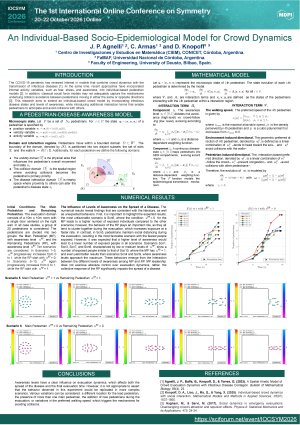
Introduction. This research extends individual-based crowd dynamics by integrating emotional and disease-related states into a microscopic socio-epidemiological model. Individuals are described by mechanical variables and an activity variable incorporating these states. Evaluating the model through evacuation and pedestrian crossing scenarios allows analyzing disease spread impacts and determining if emotional states significantly influence outcomes.
Methods. Using kinetic theory of active particles, each pedestrian is modeled using mechanical variables and a continuous activity vector representing the awareness level (u) and a disease-related status (SEIR/V). The mathematical model integrates ordinary differential equations based on the evolution of awareness, the law of mass action for infection dynamics, and directional forces (geometric and pedestrian-to-pedestrian interactions).
Results. Simulations show social dynamics critically impact epidemiological courses. In evacuations, low collective awareness causes crowding and higher exposure. In contrast, high awareness promotes distancing and reduces the transmission rate, though exit crowding makes infection inevitable. Notably, when the speed parameter depends on u, unaware pedestrians move faster, reducing evacuation time but potentially spiking infection rates exponentially. In crossings, maintaining social distancing is inherently difficult, reducing awareness effectiveness and highlighting the necessity of public health strategies like masking or vaccination.
Conclusions. This study demonstrates that social dynamics and compliance with public health protocols have a critical impact on the epidemiological trajectory. While collective awareness does not completely eliminate the risk of exposure in confined spaces or cross-flow, it does succeed in flattening the infection curve and protecting the most vulnerable populations. The model allows for the analysis of complex real-world scenarios, demonstrating that the incorporation of epidemiological and awareness variables provides the model with the necessary complexity to address multivariate dynamics.
Keywords
Awareness
Disease contagion
Pedestrians
Evacuation
Crowd dynamics
Poster
poster_agnelli_armas_knopoff_2026.pdf
Transformations of the 2-component BKP tau functions
The Magnus Expansion for Non-Hermitian Hamiltonians