Event submissions
Published
This submission belongs to the session S5. Materials Manufacturing and Sustainable Packaging of the event The 5th International Electronic Conference on Processes
Published date
15 Oct, 2026
Academic Editor
'%3e%3cpath%20d='M12.6657%2010.9104C12.4185%2010.325%2012.0599%209.79327%2011.6097%209.34482C11.1609%208.89508%2010.6293%208.5365%2010.0442%208.28888C10.0389%208.28626%2010.0337%208.28495%2010.0285%208.28233C10.8446%207.69279%2011.3752%206.73249%2011.3752%205.64904C11.3752%203.8542%209.92103%202.39999%208.1262%202.39999C6.33136%202.39999%204.87715%203.8542%204.87715%205.64904C4.87715%206.73249%205.40774%207.69279%206.22393%208.28364C6.21869%208.28626%206.21345%208.28757%206.20821%208.29019C5.62129%208.5378%205.09463%208.89284%204.64265%209.34613C4.1929%209.79493%203.83432%2010.3266%203.58671%2010.9117C3.34345%2011.4845%203.21226%2012.0987%203.20023%2012.7209C3.19988%2012.7349%203.20233%2012.7488%203.20744%2012.7619C3.21255%2012.7749%203.22022%2012.7867%203.22998%2012.7968C3.23975%2012.8068%203.25142%2012.8147%203.26431%2012.8202C3.2772%2012.8256%203.29105%2012.8284%203.30504%2012.8284H4.09109C4.14874%2012.8284%204.19459%2012.7825%204.1959%2012.7262C4.2221%2011.7148%204.62823%2010.7676%205.34617%2010.0497C6.08899%209.30683%207.0755%208.89808%208.1262%208.89808C9.17689%208.89808%2010.1634%209.30683%2010.9062%2010.0497C11.6242%2010.7676%2012.0303%2011.7148%2012.0565%2012.7262C12.0578%2012.7838%2012.1037%2012.8284%2012.1613%2012.8284H12.9474C12.9613%2012.8284%2012.9752%2012.8256%2012.9881%2012.8202C13.001%2012.8147%2013.0126%2012.8068%2013.0224%2012.7968C13.0322%2012.7867%2013.0398%2012.7749%2013.0449%2012.7619C13.0501%2012.7488%2013.0525%2012.7349%2013.0522%2012.7209C13.0391%2012.0947%2012.9094%2011.4855%2012.6657%2010.9104ZM8.1262%207.9024C7.52486%207.9024%206.9589%207.6679%206.53312%207.24211C6.10733%206.81633%205.87283%206.25037%205.87283%205.64904C5.87283%205.0477%206.10733%204.48174%206.53312%204.05596C6.9589%203.63018%207.52486%203.39567%208.1262%203.39567C8.72753%203.39567%209.29349%203.63018%209.71927%204.05596C10.1451%204.48174%2010.3796%205.0477%2010.3796%205.64904C10.3796%206.25037%2010.1451%206.81633%209.71927%207.24211C9.29349%207.6679%208.72753%207.9024%208.1262%207.9024Z'%20fill='%235D1EE1'/%3e%3c/g%3e%3c/svg%3e) Adina Magdalena Musuc
Adina Magdalena MusucCitation
Sean Patrick Aquino, Razel Anne Cruz, Celvi Marie Gallenito, Brix Andrei Manigbas, Jerry Go Olay, Carlou Siga-an Eguico, Development and Characterization of Polyvinyl Alcohol-Infiltrated Delignified Balsa Wood (Ochroma pyramidale) Composite for Lightweight Applications, in Proceedings of The 5th International Electronic Conference on Processes, 20 October–22 October 2026, MDPI: Basel, Switzerland
Share
Email
Facebook
Twitter
LinkedIn
Development and Characterization of Polyvinyl Alcohol-Infiltrated Delignified Balsa Wood (Ochroma pyramidale) Composite for Lightweight Applications
'%3e%3cpath%20d='M12.6647%2010.9104C12.4176%2010.325%2012.0589%209.7933%2011.6088%209.34485C11.16%208.89511%2010.6283%208.53653%2010.0432%208.28891C10.038%208.28629%2010.0327%208.28498%2010.0275%208.28236C10.8437%207.69282%2011.3743%206.73252%2011.3743%205.64907C11.3743%203.85423%209.92005%202.40002%208.12522%202.40002C6.33038%202.40002%204.87618%203.85423%204.87618%205.64907C4.87618%206.73252%205.40677%207.69282%206.22296%208.28367C6.21772%208.28629%206.21248%208.2876%206.20724%208.29022C5.62031%208.53783%205.09365%208.89287%204.64167%209.34616C4.19192%209.79496%203.83334%2010.3266%203.58573%2010.9117C3.34247%2011.4846%203.21128%2012.0987%203.19925%2012.721C3.1989%2012.735%203.20135%2012.7489%203.20646%2012.7619C3.21157%2012.7749%203.21924%2012.7868%203.22901%2012.7968C3.23877%2012.8068%203.25045%2012.8148%203.26334%2012.8202C3.27623%2012.8256%203.29007%2012.8284%203.30406%2012.8284H4.09012C4.14776%2012.8284%204.19362%2012.7825%204.19493%2012.7262C4.22113%2011.7148%204.62726%2010.7676%205.34519%2010.0497C6.08802%209.30686%207.07452%208.89811%208.12522%208.89811C9.17592%208.89811%2010.1624%209.30686%2010.9052%2010.0497C11.6232%2010.7676%2012.0293%2011.7148%2012.0555%2012.7262C12.0568%2012.7839%2012.1027%2012.8284%2012.1603%2012.8284H12.9464C12.9604%2012.8284%2012.9742%2012.8256%2012.9871%2012.8202C13%2012.8148%2013.0117%2012.8068%2013.0214%2012.7968C13.0312%2012.7868%2013.0389%2012.7749%2013.044%2012.7619C13.0491%2012.7489%2013.0515%2012.735%2013.0512%2012.721C13.0381%2012.0947%2012.9084%2011.4856%2012.6647%2010.9104ZM8.12522%207.90243C7.52388%207.90243%206.95792%207.66793%206.53214%207.24215C6.10636%206.81636%205.87185%206.2504%205.87185%205.64907C5.87185%205.04773%206.10636%204.48177%206.53214%204.05599C6.95792%203.63021%207.52388%203.3957%208.12522%203.3957C8.72655%203.3957%209.29252%203.63021%209.7183%204.05599C10.1441%204.48177%2010.3786%205.04773%2010.3786%205.64907C10.3786%206.2504%2010.1441%206.81636%209.7183%207.24215C9.29252%207.66793%208.72655%207.90243%208.12522%207.90243Z'%20fill='%235D1EE1'/%3e%3c/g%3e%3c/svg%3e)
Sean Patrick Aquino 1
Razel Anne Cruz 1
Celvi Marie Gallenito 1
Brix Andrei Manigbas 1
Jerry Go Olay 1,2
Carlou Siga-an Eguico 1,2
1. Chemical Engineering Department, Adamson University, Manila, National Capital Region, 1000, Philippines
2. Adamson University Laboratory of Biomass, Energy and Nanotechnology (ALBEN), Chemical Engineering Department, College of Engineering, Adamson University, Manila, National Capital Region, 1000, Philippines
Abstract
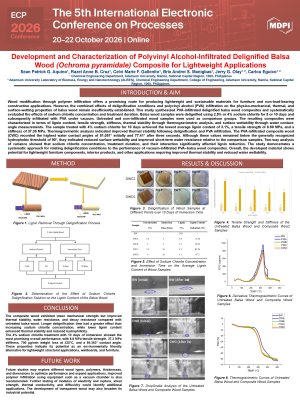
Wood modification through polymer infiltration offers a promising route for producing lightweight and sustainable materials for furniture and non-load-bearing construction applications. However, the combined effects of delignification conditions and polyvinyl alcohol (PVA) infiltration on the physico-mechanical, thermal, and surface-wetting properties of balsa wood remain insufficiently established. This study synthesized PVA-infiltrated delignified balsa wood composites and systematically evaluated the effects of sodium chlorite concentration and treatment duration. Balsa wood samples were delignified using 2.5% or 4% sodium chlorite for 5 or 10 days and subsequently infiltrated with PVA under vacuum. Untreated and non-infiltrated wood samples were used as comparison groups. The resulting composites were characterized in terms of lignin content, tensile strength, stiffness, thermal stability through thermogravimetric analysis, and surface wettability through water contact-angle measurements. The sample treated with 4% sodium chlorite for 10 days achieved the lowest average lignin content of 3.1%, a tensile strength of 8.90 MPa, and a stiffness of 37.30 MPa. Thermogravimetric analysis indicated improved thermal stability following delignification and PVA infiltration. The PVA-infiltrated composite wood (CWC) recorded the highest water contact angles of 81.051° initially and 77.41° after three seconds. Although these values remained below the generally recognized hydrophobic threshold of 90°, they indicated reduced surface wettability and improved short-term water resistance relative to the comparison samples. Two-way analysis of variance showed that sodium chlorite concentration, treatment duration, and their interaction significantly affected lignin reduction. The study demonstrates a systematic approach for relating delignification conditions to the performance of vacuum-infiltrated PVA–balsa wood composites. Overall, the developed material shows potential for lightweight furniture components, interior products, and other applications requiring improved thermal stability and reduced water wettability.
Keywords
Polyvinyl Alcohol
Balsa Wood
Delignification
Composite Wood
Lignin Content
Lightweight Materials
Poster
Balsa Presentation.pdf
Multifunctional photonic coatings enabled by ambient-light photoluminescence