Event submissions
Published
This submission belongs to the session S5. Materials Manufacturing and Sustainable Packaging of the event The 5th International Electronic Conference on Processes
Published date
15 Oct, 2026
Academic Editor
'%3e%3cpath%20d='M12.6657%2010.9104C12.4185%2010.325%2012.0599%209.79327%2011.6097%209.34482C11.1609%208.89508%2010.6293%208.5365%2010.0442%208.28888C10.0389%208.28626%2010.0337%208.28495%2010.0285%208.28233C10.8446%207.69279%2011.3752%206.73249%2011.3752%205.64904C11.3752%203.8542%209.92103%202.39999%208.1262%202.39999C6.33136%202.39999%204.87715%203.8542%204.87715%205.64904C4.87715%206.73249%205.40774%207.69279%206.22393%208.28364C6.21869%208.28626%206.21345%208.28757%206.20821%208.29019C5.62129%208.5378%205.09463%208.89284%204.64265%209.34613C4.1929%209.79493%203.83432%2010.3266%203.58671%2010.9117C3.34345%2011.4845%203.21226%2012.0987%203.20023%2012.7209C3.19988%2012.7349%203.20233%2012.7488%203.20744%2012.7619C3.21255%2012.7749%203.22022%2012.7867%203.22998%2012.7968C3.23975%2012.8068%203.25142%2012.8147%203.26431%2012.8202C3.2772%2012.8256%203.29105%2012.8284%203.30504%2012.8284H4.09109C4.14874%2012.8284%204.19459%2012.7825%204.1959%2012.7262C4.2221%2011.7148%204.62823%2010.7676%205.34617%2010.0497C6.08899%209.30683%207.0755%208.89808%208.1262%208.89808C9.17689%208.89808%2010.1634%209.30683%2010.9062%2010.0497C11.6242%2010.7676%2012.0303%2011.7148%2012.0565%2012.7262C12.0578%2012.7838%2012.1037%2012.8284%2012.1613%2012.8284H12.9474C12.9613%2012.8284%2012.9752%2012.8256%2012.9881%2012.8202C13.001%2012.8147%2013.0126%2012.8068%2013.0224%2012.7968C13.0322%2012.7867%2013.0398%2012.7749%2013.0449%2012.7619C13.0501%2012.7488%2013.0525%2012.7349%2013.0522%2012.7209C13.0391%2012.0947%2012.9094%2011.4855%2012.6657%2010.9104ZM8.1262%207.9024C7.52486%207.9024%206.9589%207.6679%206.53312%207.24211C6.10733%206.81633%205.87283%206.25037%205.87283%205.64904C5.87283%205.0477%206.10733%204.48174%206.53312%204.05596C6.9589%203.63018%207.52486%203.39567%208.1262%203.39567C8.72753%203.39567%209.29349%203.63018%209.71927%204.05596C10.1451%204.48174%2010.3796%205.0477%2010.3796%205.64904C10.3796%206.25037%2010.1451%206.81633%209.71927%207.24211C9.29349%207.6679%208.72753%207.9024%208.1262%207.9024Z'%20fill='%235D1EE1'/%3e%3c/g%3e%3c/svg%3e) Adina Magdalena Musuc
Adina Magdalena MusucCitation
Mohammad Nur E Alam, Mikhail Vasiliev, Mohammad Tariqul Islam, Engineering Low-Loss Optical Coatings for Quantum Computing: A Perspective on Materials, Fabrication, and Future Directions, in Proceedings of The 5th International Electronic Conference on Processes, 20 October–22 October 2026, MDPI: Basel, Switzerland
Share
Email
Facebook
Twitter
LinkedIn
Engineering Low-Loss Optical Coatings for Quantum Computing: A Perspective on Materials, Fabrication, and Future Directions

Mohammad Nur E Alam 1,2

Mikhail Vasiliev 3
'%3e%3cpath%20d='M12.6647%2010.9104C12.4176%2010.325%2012.0589%209.7933%2011.6088%209.34485C11.16%208.89511%2010.6283%208.53653%2010.0432%208.28891C10.038%208.28629%2010.0327%208.28498%2010.0275%208.28236C10.8437%207.69282%2011.3743%206.73252%2011.3743%205.64907C11.3743%203.85423%209.92005%202.40002%208.12522%202.40002C6.33038%202.40002%204.87618%203.85423%204.87618%205.64907C4.87618%206.73252%205.40677%207.69282%206.22296%208.28367C6.21772%208.28629%206.21248%208.2876%206.20724%208.29022C5.62031%208.53783%205.09365%208.89287%204.64167%209.34616C4.19192%209.79496%203.83334%2010.3266%203.58573%2010.9117C3.34247%2011.4846%203.21128%2012.0987%203.19925%2012.721C3.1989%2012.735%203.20135%2012.7489%203.20646%2012.7619C3.21157%2012.7749%203.21924%2012.7868%203.22901%2012.7968C3.23877%2012.8068%203.25045%2012.8148%203.26334%2012.8202C3.27623%2012.8256%203.29007%2012.8284%203.30406%2012.8284H4.09012C4.14776%2012.8284%204.19362%2012.7825%204.19493%2012.7262C4.22113%2011.7148%204.62726%2010.7676%205.34519%2010.0497C6.08802%209.30686%207.07452%208.89811%208.12522%208.89811C9.17592%208.89811%2010.1624%209.30686%2010.9052%2010.0497C11.6232%2010.7676%2012.0293%2011.7148%2012.0555%2012.7262C12.0568%2012.7839%2012.1027%2012.8284%2012.1603%2012.8284H12.9464C12.9604%2012.8284%2012.9742%2012.8256%2012.9871%2012.8202C13%2012.8148%2013.0117%2012.8068%2013.0214%2012.7968C13.0312%2012.7868%2013.0389%2012.7749%2013.044%2012.7619C13.0491%2012.7489%2013.0515%2012.735%2013.0512%2012.721C13.0381%2012.0947%2012.9084%2011.4856%2012.6647%2010.9104ZM8.12522%207.90243C7.52388%207.90243%206.95792%207.66793%206.53214%207.24215C6.10636%206.81636%205.87185%206.2504%205.87185%205.64907C5.87185%205.04773%206.10636%204.48177%206.53214%204.05599C6.95792%203.63021%207.52388%203.3957%208.12522%203.3957C8.72655%203.3957%209.29252%203.63021%209.7183%204.05599C10.1441%204.48177%2010.3786%205.04773%2010.3786%205.64907C10.3786%206.2504%2010.1441%206.81636%209.7183%207.24215C9.29252%207.66793%208.72655%207.90243%208.12522%207.90243Z'%20fill='%235D1EE1'/%3e%3c/g%3e%3c/svg%3e)
Mohammad Tariqul Islam 4
1. School of Science, Edith Cowan University, 270 Joondalup Drive, Joondalup WA 6027, Australia
2. Space Science Centre, Climate Chance Institute, Universiti Kebangsaan Malaysia, Bangi-43600, Selangor, Malaysia
3. Independent Researcher of Thin Film Materials and Engineering. Perth, WA 6030, Australia
4. Department of Electrical, Electronic and Systems Engineering, Faculty of Engineering and Built Environment, Universiti Kebangsaan Malaysia, Bangi, Selangor 43600, Malaysia
Abstract
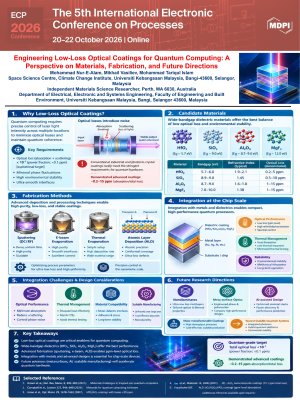
Quantum Computing is set to provide revolutionary gains in computing power, allowing for the solution of types of computational problems that reach beyond what is possible using existing classical computers. For quantum computing to be realized, however, several key enabling technologies must first be developed. One such critical technology is low-loss optical coatings, which are responsible for providing the requisite stability of the laser light intensity at multiple locations within the optical system configuration to minimize noise sources due to optical losses and to maintain quantum coherence in trapped-ion, neutral-atom, and photonic systems. Typical industrial and photonic-crystal optical coatings are rarely able to meet the stringent performance and environmental stability specifications necessary for the implementation of quantum hardware (i.e., optical absorption, scattering, and thermally induced phase fluctuations must be reduced to parts per million, etc.). As such, this paper serves as a broad overview of thin-film optical coating technologies that have the potential to be employed in quantum computing device components by investigating the material choices, fabrication methods, and integration issues associated with using thin-film optical coatings in quantum processors. In particular, wide-bandgap dielectric materials (e.g., HfO₂, SiO₂, Al₂O₃, MgF₂) are scrutinized and compared against the methods available to produce these materials for their ability to produce very low optical loss (< 10⁻⁷) and excellent stability to environmental influences. Through the study, aspects of integrating metals with dielectric materials for the design of quantum processors at a chip scale have been discussed, including optical performance, thermal management, and reliability of devices. Future research avenues will include nanolaminates, meta-surface optics, AI-assisted design of coatings, and mass-manufacturable coatings. This perspective paper discusses the emerging role of low-loss optical coatings in quantum computing hardware, highlighting recent advances in material selection, fabrication technologies, integration challenges, and future research opportunities for scalable quantum systems.
Keywords
Dielectric materials: Binary oxides: Thin film coatings: Quantum computing
Poster
Sciforum-204569_Poster.pdf
Effect of Synthesis Route and Strontium Doping on the Mechanical Properties of 13-93 Bioactive Glass Ceramic
Green Soapnut Surfactant for the Separation of Fine Particles from Aqueous Solutions using Colloidal Gas Aphrons