Event submissions
Published
This submission belongs to the session S1. Environmental and Green Processes of the event The 5th International Electronic Conference on Processes
Published date
15 Oct, 2026
Academic Editor
'%3e%3cpath%20d='M12.6657%2010.9104C12.4185%2010.325%2012.0599%209.79327%2011.6097%209.34482C11.1609%208.89508%2010.6293%208.5365%2010.0442%208.28888C10.0389%208.28626%2010.0337%208.28495%2010.0285%208.28233C10.8446%207.69279%2011.3752%206.73249%2011.3752%205.64904C11.3752%203.8542%209.92103%202.39999%208.1262%202.39999C6.33136%202.39999%204.87715%203.8542%204.87715%205.64904C4.87715%206.73249%205.40774%207.69279%206.22393%208.28364C6.21869%208.28626%206.21345%208.28757%206.20821%208.29019C5.62129%208.5378%205.09463%208.89284%204.64265%209.34613C4.1929%209.79493%203.83432%2010.3266%203.58671%2010.9117C3.34345%2011.4845%203.21226%2012.0987%203.20023%2012.7209C3.19988%2012.7349%203.20233%2012.7488%203.20744%2012.7619C3.21255%2012.7749%203.22022%2012.7867%203.22998%2012.7968C3.23975%2012.8068%203.25142%2012.8147%203.26431%2012.8202C3.2772%2012.8256%203.29105%2012.8284%203.30504%2012.8284H4.09109C4.14874%2012.8284%204.19459%2012.7825%204.1959%2012.7262C4.2221%2011.7148%204.62823%2010.7676%205.34617%2010.0497C6.08899%209.30683%207.0755%208.89808%208.1262%208.89808C9.17689%208.89808%2010.1634%209.30683%2010.9062%2010.0497C11.6242%2010.7676%2012.0303%2011.7148%2012.0565%2012.7262C12.0578%2012.7838%2012.1037%2012.8284%2012.1613%2012.8284H12.9474C12.9613%2012.8284%2012.9752%2012.8256%2012.9881%2012.8202C13.001%2012.8147%2013.0126%2012.8068%2013.0224%2012.7968C13.0322%2012.7867%2013.0398%2012.7749%2013.0449%2012.7619C13.0501%2012.7488%2013.0525%2012.7349%2013.0522%2012.7209C13.0391%2012.0947%2012.9094%2011.4855%2012.6657%2010.9104ZM8.1262%207.9024C7.52486%207.9024%206.9589%207.6679%206.53312%207.24211C6.10733%206.81633%205.87283%206.25037%205.87283%205.64904C5.87283%205.0477%206.10733%204.48174%206.53312%204.05596C6.9589%203.63018%207.52486%203.39567%208.1262%203.39567C8.72753%203.39567%209.29349%203.63018%209.71927%204.05596C10.1451%204.48174%2010.3796%205.0477%2010.3796%205.64904C10.3796%206.25037%2010.1451%206.81633%209.71927%207.24211C9.29349%207.6679%208.72753%207.9024%208.1262%207.9024Z'%20fill='%235D1EE1'/%3e%3c/g%3e%3c/svg%3e) Juan Francisco García Martín
Juan Francisco García MartínContribution&Funding
Conceptualization,
[Daya MANCER]
Methodology,
[Daya MANCER]
Validation,
[Daya MANCER]
Formal analysis,
[Farid AGOUILLAL]
Investigation,
[Daya MANCER]
Resources,
[Daya MANCER] ; [Farid AGOUILLAL]
Writing - original draft,
[Daya MANCER]
Writing - review,
[editing] ; [Farid AGOUILLAL]
Visualization,
[Daya MANCER] ; [Farid AGOUILLAL]
Funding: --
Citation
Daya MANCER, Farid AGOUILLAL, Integrating plant-based green chemistry into sustainable nanomaterial production: eco-friendly synthesis of functional metal oxide nanoparticles, in Proceedings of The 5th International Electronic Conference on Processes, 20 October–22 October 2026, MDPI: Basel, Switzerland
Share
Email
Facebook
Twitter
LinkedIn
Integrating plant-based green chemistry into sustainable nanomaterial production: eco-friendly synthesis of functional metal oxide nanoparticles
'%3e%3cpath%20d='M12.6647%2010.9104C12.4176%2010.325%2012.0589%209.7933%2011.6088%209.34485C11.16%208.89511%2010.6283%208.53653%2010.0432%208.28891C10.038%208.28629%2010.0327%208.28498%2010.0275%208.28236C10.8437%207.69282%2011.3743%206.73252%2011.3743%205.64907C11.3743%203.85423%209.92005%202.40002%208.12522%202.40002C6.33038%202.40002%204.87618%203.85423%204.87618%205.64907C4.87618%206.73252%205.40677%207.69282%206.22296%208.28367C6.21772%208.28629%206.21248%208.2876%206.20724%208.29022C5.62031%208.53783%205.09365%208.89287%204.64167%209.34616C4.19192%209.79496%203.83334%2010.3266%203.58573%2010.9117C3.34247%2011.4846%203.21128%2012.0987%203.19925%2012.721C3.1989%2012.735%203.20135%2012.7489%203.20646%2012.7619C3.21157%2012.7749%203.21924%2012.7868%203.22901%2012.7968C3.23877%2012.8068%203.25045%2012.8148%203.26334%2012.8202C3.27623%2012.8256%203.29007%2012.8284%203.30406%2012.8284H4.09012C4.14776%2012.8284%204.19362%2012.7825%204.19493%2012.7262C4.22113%2011.7148%204.62726%2010.7676%205.34519%2010.0497C6.08802%209.30686%207.07452%208.89811%208.12522%208.89811C9.17592%208.89811%2010.1624%209.30686%2010.9052%2010.0497C11.6232%2010.7676%2012.0293%2011.7148%2012.0555%2012.7262C12.0568%2012.7839%2012.1027%2012.8284%2012.1603%2012.8284H12.9464C12.9604%2012.8284%2012.9742%2012.8256%2012.9871%2012.8202C13%2012.8148%2013.0117%2012.8068%2013.0214%2012.7968C13.0312%2012.7868%2013.0389%2012.7749%2013.044%2012.7619C13.0491%2012.7489%2013.0515%2012.735%2013.0512%2012.721C13.0381%2012.0947%2012.9084%2011.4856%2012.6647%2010.9104ZM8.12522%207.90243C7.52388%207.90243%206.95792%207.66793%206.53214%207.24215C6.10636%206.81636%205.87185%206.2504%205.87185%205.64907C5.87185%205.04773%206.10636%204.48177%206.53214%204.05599C6.95792%203.63021%207.52388%203.3957%208.12522%203.3957C8.72655%203.3957%209.29252%203.63021%209.7183%204.05599C10.1441%204.48177%2010.3786%205.04773%2010.3786%205.64907C10.3786%206.2504%2010.1441%206.81636%209.7183%207.24215C9.29252%207.66793%208.72655%207.90243%208.12522%207.90243Z'%20fill='%235D1EE1'/%3e%3c/g%3e%3c/svg%3e)
Daya MANCER 1
Farid AGOUILLAL 2
1. Faculty of Mechanical and Process Engineering, University Of Science And Technology Houari Boumediene (USTHB), ALGIERS, 16111, Algeria
2. National School of Nanoscience and Nanotechnology, University Of Science And Technology Houari Boumediene (NSNN-USTHB), Alger, 16000, Algeria
Abstract
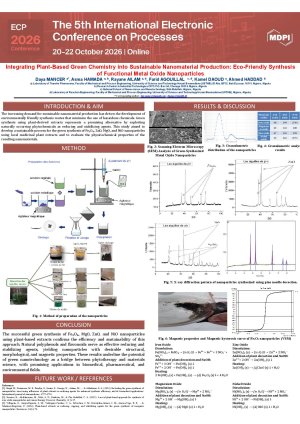
The increasing demand for sustainable nanomaterial production has driven the development of environmentally friendly synthesis routes that minimize the use of hazardous chemicals. Green synthesis using plant-derived extracts represents a promising alternative by exploiting naturally occurring phytochemicals as reducing and stabilizing agents. This study aimed to develop a sustainable process for the green synthesis of Fe₃O₄, ZnO, MgO, and NiO nanoparticles using local medicinal plant extracts and to evaluate the physicochemical properties of the resulting nanomaterials. Plant decoctions and hydrodistillates were prepared under controlled extraction conditions and employed as reducing and capping agents during the alkaline precipitation of metal salts. The synthesis process was optimized by controlling pH, temperature, agitation, and NaOH addition. The obtained nanoparticles were purified, dried, and characterized by X-ray diffraction (XRD), laser granulometry, scanning electron microscopy (SEM), and vibrating sample magnetometry (VSM). XRD analysis confirmed the successful formation of crystalline Fe₃O₄, ZnO, MgO, and NiO nanoparticles, with crystallite sizes ranging from 5 to 20 nm. Laser granulometry revealed particle sizes ranging from approximately 129 to 2700 nm, depending on the plant extract and metal precursor, reflecting varying degrees of aggregation. SEM images showed predominantly spherical nanoparticles with extract-dependent morphology. Fe₃O₄ nanoparticles exhibited soft magnetic behavior with a saturation magnetization of 45.36 emu g⁻¹, low coercivity (25.75 Oe), and negligible remanence, demonstrating their suitability for magnetic applications. The proposed green synthesis process provides a simple, cost-effective, and environmentally benign alternative to conventional chemical methods. Plant extracts efficiently served as both reducing and stabilizing agents, enabling the production of metal oxide nanoparticles with desirable structural, morphological, and magnetic properties while reducing the consumption of hazardous reagents. This sustainable approach offers significant potential for the scalable production of functional nanomaterials for biomedical, pharmaceutical, catalytic, and environmental applications.
Keywords
Green synthesis; plant extracts; metal oxide nanoparticles; sustainable process; environmental processes; nanotechnology.
Poster
Presentation POSTER MANCER Daya 5th ECP-MDPI.2026.pdf
Catalytic potential of ceria decorated with mixed manganese oxides for oxidation of aromatic volatile organic compounds
Phytoextraction capacity of Eichhornia crassipes for the contaminant atrazine