Event submissions
Published
This submission belongs to the session S1. Environmental and Green Processes of the event The 5th International Electronic Conference on Processes
Published date
15 Oct, 2026
Academic Editor
'%3e%3cpath%20d='M12.6657%2010.9104C12.4185%2010.325%2012.0599%209.79327%2011.6097%209.34482C11.1609%208.89508%2010.6293%208.5365%2010.0442%208.28888C10.0389%208.28626%2010.0337%208.28495%2010.0285%208.28233C10.8446%207.69279%2011.3752%206.73249%2011.3752%205.64904C11.3752%203.8542%209.92103%202.39999%208.1262%202.39999C6.33136%202.39999%204.87715%203.8542%204.87715%205.64904C4.87715%206.73249%205.40774%207.69279%206.22393%208.28364C6.21869%208.28626%206.21345%208.28757%206.20821%208.29019C5.62129%208.5378%205.09463%208.89284%204.64265%209.34613C4.1929%209.79493%203.83432%2010.3266%203.58671%2010.9117C3.34345%2011.4845%203.21226%2012.0987%203.20023%2012.7209C3.19988%2012.7349%203.20233%2012.7488%203.20744%2012.7619C3.21255%2012.7749%203.22022%2012.7867%203.22998%2012.7968C3.23975%2012.8068%203.25142%2012.8147%203.26431%2012.8202C3.2772%2012.8256%203.29105%2012.8284%203.30504%2012.8284H4.09109C4.14874%2012.8284%204.19459%2012.7825%204.1959%2012.7262C4.2221%2011.7148%204.62823%2010.7676%205.34617%2010.0497C6.08899%209.30683%207.0755%208.89808%208.1262%208.89808C9.17689%208.89808%2010.1634%209.30683%2010.9062%2010.0497C11.6242%2010.7676%2012.0303%2011.7148%2012.0565%2012.7262C12.0578%2012.7838%2012.1037%2012.8284%2012.1613%2012.8284H12.9474C12.9613%2012.8284%2012.9752%2012.8256%2012.9881%2012.8202C13.001%2012.8147%2013.0126%2012.8068%2013.0224%2012.7968C13.0322%2012.7867%2013.0398%2012.7749%2013.0449%2012.7619C13.0501%2012.7488%2013.0525%2012.7349%2013.0522%2012.7209C13.0391%2012.0947%2012.9094%2011.4855%2012.6657%2010.9104ZM8.1262%207.9024C7.52486%207.9024%206.9589%207.6679%206.53312%207.24211C6.10733%206.81633%205.87283%206.25037%205.87283%205.64904C5.87283%205.0477%206.10733%204.48174%206.53312%204.05596C6.9589%203.63018%207.52486%203.39567%208.1262%203.39567C8.72753%203.39567%209.29349%203.63018%209.71927%204.05596C10.1451%204.48174%2010.3796%205.0477%2010.3796%205.64904C10.3796%206.25037%2010.1451%206.81633%209.71927%207.24211C9.29349%207.6679%208.72753%207.9024%208.1262%207.9024Z'%20fill='%235D1EE1'/%3e%3c/g%3e%3c/svg%3e) Juan Francisco García Martín
Juan Francisco García MartínContribution&Funding
Conceptualization,
[Zachary Lacuesta] ; [Gabriel Sebastian Roxas] ; [Elijah Mikael Miranda] ; [Lorevel Ituriaga] ; [Daniela Jan Bautista] ; [Andrhea Dennize Cuyme]
Methodology,
[Zachary Lacuesta] ; [Lorevel Ituriaga] ; [Andrhea Dennize Cuyme] ; [Daniela Jan Bautista] ; [Elijah Mikael Miranda] ; [Gabriel Sebastian Roxas]
Investigation,
[Rugi Vicente C. Rubi]
Writing - original draft,
[Carlou Siga-an Eguico]
Writing - review,
[editing] ; [Carlou Siga-an Eguico]
Supervision,
[Rugi Vicente C. Rubi] ; [Carlou Siga-an Eguico]
Funding: --
Citation
Zachary Lacuesta, Gabriel Sebastian Roxas, Elijah Mikael Miranda, Daniela Jan Bautista, Andrhea Dennize Cuyme, Lorevel Ituriaga, Rugi Vicente C. Rubi, Carlou Siga-an Eguico, Synthesis of Nitrogen-Carbon Dots (N-CDs) from Waste Polystyrene for the Development of Heavy Metal (Cu²⁺) Detection Paper in Simulated Wastewater, in Proceedings of The 5th International Electronic Conference on Processes, 20 October–22 October 2026, MDPI: Basel, Switzerland
Share
Email
Facebook
Twitter
LinkedIn
Synthesis of Nitrogen-Carbon Dots (N-CDs) from Waste Polystyrene for the Development of Heavy Metal (Cu²⁺) Detection Paper in Simulated Wastewater
'%3e%3cpath%20d='M12.6647%2010.9104C12.4176%2010.325%2012.0589%209.7933%2011.6088%209.34485C11.16%208.89511%2010.6283%208.53653%2010.0432%208.28891C10.038%208.28629%2010.0327%208.28498%2010.0275%208.28236C10.8437%207.69282%2011.3743%206.73252%2011.3743%205.64907C11.3743%203.85423%209.92005%202.40002%208.12522%202.40002C6.33038%202.40002%204.87618%203.85423%204.87618%205.64907C4.87618%206.73252%205.40677%207.69282%206.22296%208.28367C6.21772%208.28629%206.21248%208.2876%206.20724%208.29022C5.62031%208.53783%205.09365%208.89287%204.64167%209.34616C4.19192%209.79496%203.83334%2010.3266%203.58573%2010.9117C3.34247%2011.4846%203.21128%2012.0987%203.19925%2012.721C3.1989%2012.735%203.20135%2012.7489%203.20646%2012.7619C3.21157%2012.7749%203.21924%2012.7868%203.22901%2012.7968C3.23877%2012.8068%203.25045%2012.8148%203.26334%2012.8202C3.27623%2012.8256%203.29007%2012.8284%203.30406%2012.8284H4.09012C4.14776%2012.8284%204.19362%2012.7825%204.19493%2012.7262C4.22113%2011.7148%204.62726%2010.7676%205.34519%2010.0497C6.08802%209.30686%207.07452%208.89811%208.12522%208.89811C9.17592%208.89811%2010.1624%209.30686%2010.9052%2010.0497C11.6232%2010.7676%2012.0293%2011.7148%2012.0555%2012.7262C12.0568%2012.7839%2012.1027%2012.8284%2012.1603%2012.8284H12.9464C12.9604%2012.8284%2012.9742%2012.8256%2012.9871%2012.8202C13%2012.8148%2013.0117%2012.8068%2013.0214%2012.7968C13.0312%2012.7868%2013.0389%2012.7749%2013.044%2012.7619C13.0491%2012.7489%2013.0515%2012.735%2013.0512%2012.721C13.0381%2012.0947%2012.9084%2011.4856%2012.6647%2010.9104ZM8.12522%207.90243C7.52388%207.90243%206.95792%207.66793%206.53214%207.24215C6.10636%206.81636%205.87185%206.2504%205.87185%205.64907C5.87185%205.04773%206.10636%204.48177%206.53214%204.05599C6.95792%203.63021%207.52388%203.3957%208.12522%203.3957C8.72655%203.3957%209.29252%203.63021%209.7183%204.05599C10.1441%204.48177%2010.3786%205.04773%2010.3786%205.64907C10.3786%206.2504%2010.1441%206.81636%209.7183%207.24215C9.29252%207.66793%208.72655%207.90243%208.12522%207.90243Z'%20fill='%235D1EE1'/%3e%3c/g%3e%3c/svg%3e)
Zachary Lacuesta 1
Gabriel Sebastian Roxas 1
Elijah Mikael Miranda 1
Daniela Jan Bautista 1
Andrhea Dennize Cuyme 1
Lorevel Ituriaga 1
Rugi Vicente C. Rubi 1,2
Carlou Siga-an Eguico 1,2
1. Chemical Engineering, Adamson University, Manila, 1000, Philippines
2. Adamson University Laboratory of Biomass, Energy and Nanotechnology (ALBEN), Adamson University, Manila, 1000, Philippines
Abstract
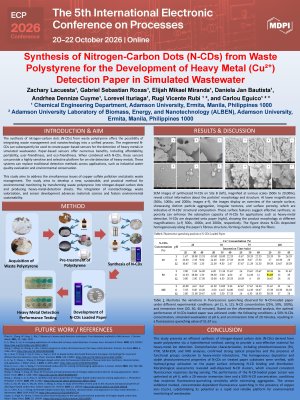
Copper contamination in wastewater poses environmental and public-health risks, creating a need for simple and accessible screening methods. This study developed a fluorescence-based paper sensor using nitrogen-doped carbon dots (N-CDs) synthesized from waste polystyrene for detecting Cu²⁺ in simulated wastewater. The N-CDs were prepared through hydrothermal treatment at 200 °C for 5 h, followed by nitric-acid functionalization. Their optical, structural, surface, and elemental properties were evaluated using photoluminescence and ultraviolet–visible spectroscopy, Fourier-transform infrared spectroscopy, X-ray diffraction, and scanning electron microscopy coupled with energy-dispersive X-ray spectroscopy. The synthesized N-CDs exhibited blue fluorescence with a prominent emission peak at approximately 370 nm. Characterization indicated the presence of graphitic and amorphous carbon domains and nitrogen- and oxygen-containing surface groups that may facilitate interactions with Cu²⁺. The N-CDs were deposited onto hydrogen peroxide-treated cellulose paper to produce a fluorescent sensing platform. A full-factorial experiment examined the effects of pH (1, 6, and 12), N-CD loading concentration (25%, 50%, and 100%), and paper-loading immersion time (20, 30, and 40 min). Fluorescence intensity decreased as Cu²⁺ concentration increased, demonstrating a concentration-dependent quenching response. Among the conditions tested, the most favorable response was obtained at pH 6 using a 50% N-CD concentration and a 20-minute immersion time, yielding a fluorescence-quenching difference of 51.67 arbitrary units. These findings demonstrate the feasibility of converting waste polystyrene into a functional fluorescent material for paper-based Cu²⁺ screening. Further validation using standard Cu²⁺ concentrations, selectivity testing, detection-limit determination, and real wastewater samples is required before quantitative or field application.
Keywords
copper ions
fluorescence quenching
nitrogen-doped carbon dots
paper-based sensor
simulated wastewater
waste polystyrene
Poster
Synthesis of Nitrogen-Carbon Dots_Lacuesta poster.pdf
Sustainable Processing of Pineapple and Orange Peel Waste: Hydroalcoholic Extracts with Anti-Inflammatory Activity and Cytotoxicity Assessment
Eco-Efficient Lightweight Foam Concrete: Synergistic Effects of White Cement and Oriental Clay on Mechanical Performance and CO₂ Reduction