Event submissions
Published
This submission belongs to the session S1. Mathematical Physics of the event The 1st International Online Conference on Symmetry
Published date
15 Oct, 2026
Academic Editor
'%3e%3cpath%20d='M12.6657%2010.9104C12.4185%2010.325%2012.0599%209.79327%2011.6097%209.34482C11.1609%208.89508%2010.6293%208.5365%2010.0442%208.28888C10.0389%208.28626%2010.0337%208.28495%2010.0285%208.28233C10.8446%207.69279%2011.3752%206.73249%2011.3752%205.64904C11.3752%203.8542%209.92103%202.39999%208.1262%202.39999C6.33136%202.39999%204.87715%203.8542%204.87715%205.64904C4.87715%206.73249%205.40774%207.69279%206.22393%208.28364C6.21869%208.28626%206.21345%208.28757%206.20821%208.29019C5.62129%208.5378%205.09463%208.89284%204.64265%209.34613C4.1929%209.79493%203.83432%2010.3266%203.58671%2010.9117C3.34345%2011.4845%203.21226%2012.0987%203.20023%2012.7209C3.19988%2012.7349%203.20233%2012.7488%203.20744%2012.7619C3.21255%2012.7749%203.22022%2012.7867%203.22998%2012.7968C3.23975%2012.8068%203.25142%2012.8147%203.26431%2012.8202C3.2772%2012.8256%203.29105%2012.8284%203.30504%2012.8284H4.09109C4.14874%2012.8284%204.19459%2012.7825%204.1959%2012.7262C4.2221%2011.7148%204.62823%2010.7676%205.34617%2010.0497C6.08899%209.30683%207.0755%208.89808%208.1262%208.89808C9.17689%208.89808%2010.1634%209.30683%2010.9062%2010.0497C11.6242%2010.7676%2012.0303%2011.7148%2012.0565%2012.7262C12.0578%2012.7838%2012.1037%2012.8284%2012.1613%2012.8284H12.9474C12.9613%2012.8284%2012.9752%2012.8256%2012.9881%2012.8202C13.001%2012.8147%2013.0126%2012.8068%2013.0224%2012.7968C13.0322%2012.7867%2013.0398%2012.7749%2013.0449%2012.7619C13.0501%2012.7488%2013.0525%2012.7349%2013.0522%2012.7209C13.0391%2012.0947%2012.9094%2011.4855%2012.6657%2010.9104ZM8.1262%207.9024C7.52486%207.9024%206.9589%207.6679%206.53312%207.24211C6.10733%206.81633%205.87283%206.25037%205.87283%205.64904C5.87283%205.0477%206.10733%204.48174%206.53312%204.05596C6.9589%203.63018%207.52486%203.39567%208.1262%203.39567C8.72753%203.39567%209.29349%203.63018%209.71927%204.05596C10.1451%204.48174%2010.3796%205.0477%2010.3796%205.64904C10.3796%206.25037%2010.1451%206.81633%209.71927%207.24211C9.29349%207.6679%208.72753%207.9024%208.1262%207.9024Z'%20fill='%235D1EE1'/%3e%3c/g%3e%3c/svg%3e) Kazuharu Bamba
Kazuharu BambaCitation
Pavel Makarov, Vladimir Vlasov, Yuriy Golchevskiy, Mikhail Dianov, Andrey Yermolenko, Roman Korolev, Dmitri Pleshev, Roman Skandakov, Vladimir Shcheglov, Elements of Symmetry in the FDTD Method for Selected Problems of Computational Electrodynamics, in Proceedings of The 1st International Online Conference on Symmetry, 20 October–22 October 2026, MDPI: Basel, Switzerland
Share
Email
Facebook
Twitter
LinkedIn
Elements of Symmetry in the FDTD Method for Selected Problems of Computational Electrodynamics
'%3e%3cpath%20d='M12.6647%2010.9104C12.4176%2010.325%2012.0589%209.7933%2011.6088%209.34485C11.16%208.89511%2010.6283%208.53653%2010.0432%208.28891C10.038%208.28629%2010.0327%208.28498%2010.0275%208.28236C10.8437%207.69282%2011.3743%206.73252%2011.3743%205.64907C11.3743%203.85423%209.92005%202.40002%208.12522%202.40002C6.33038%202.40002%204.87618%203.85423%204.87618%205.64907C4.87618%206.73252%205.40677%207.69282%206.22296%208.28367C6.21772%208.28629%206.21248%208.2876%206.20724%208.29022C5.62031%208.53783%205.09365%208.89287%204.64167%209.34616C4.19192%209.79496%203.83334%2010.3266%203.58573%2010.9117C3.34247%2011.4846%203.21128%2012.0987%203.19925%2012.721C3.1989%2012.735%203.20135%2012.7489%203.20646%2012.7619C3.21157%2012.7749%203.21924%2012.7868%203.22901%2012.7968C3.23877%2012.8068%203.25045%2012.8148%203.26334%2012.8202C3.27623%2012.8256%203.29007%2012.8284%203.30406%2012.8284H4.09012C4.14776%2012.8284%204.19362%2012.7825%204.19493%2012.7262C4.22113%2011.7148%204.62726%2010.7676%205.34519%2010.0497C6.08802%209.30686%207.07452%208.89811%208.12522%208.89811C9.17592%208.89811%2010.1624%209.30686%2010.9052%2010.0497C11.6232%2010.7676%2012.0293%2011.7148%2012.0555%2012.7262C12.0568%2012.7839%2012.1027%2012.8284%2012.1603%2012.8284H12.9464C12.9604%2012.8284%2012.9742%2012.8256%2012.9871%2012.8202C13%2012.8148%2013.0117%2012.8068%2013.0214%2012.7968C13.0312%2012.7868%2013.0389%2012.7749%2013.044%2012.7619C13.0491%2012.7489%2013.0515%2012.735%2013.0512%2012.721C13.0381%2012.0947%2012.9084%2011.4856%2012.6647%2010.9104ZM8.12522%207.90243C7.52388%207.90243%206.95792%207.66793%206.53214%207.24215C6.10636%206.81636%205.87185%206.2504%205.87185%205.64907C5.87185%205.04773%206.10636%204.48177%206.53214%204.05599C6.95792%203.63021%207.52388%203.3957%208.12522%203.3957C8.72655%203.3957%209.29252%203.63021%209.7183%204.05599C10.1441%204.48177%2010.3786%205.04773%2010.3786%205.64907C10.3786%206.2504%2010.1441%206.81636%209.7183%207.24215C9.29252%207.66793%208.72655%207.90243%208.12522%207.90243Z'%20fill='%235D1EE1'/%3e%3c/g%3e%3c/svg%3e)
Pavel Makarov 1
Vladimir Vlasov 2
Yuriy Golchevskiy 3
Mikhail Dianov 3
Andrey Yermolenko 3
Roman Korolev 3
Dmitri Pleshev 2
Roman Skandakov 1
Vladimir Shcheglov 4
1. Institute of Physics and Mathematics, FRC Komi SC UB RAS, Syktyvkar 167982, Russia
2. Faculty of Transport and Technology, Syktyvkar Forest Institute (branch) of Saint-Petersburg State Forest Technical University named after S M Kirov, Syktyvkar 167000, Russia
3. Institute of Exact Sciences and IT, Federal State Budgetary Educational Institution of Higher Education "Pitirim Sorokin Syktyvkar State University", Syktyvkar 167001, Russia
4. Laboratory of magnetic phenomena in microelectronics, Kotelnikov Institute of Radioengineering and Electronics RAS, Moscow 125009, Russia
Abstract
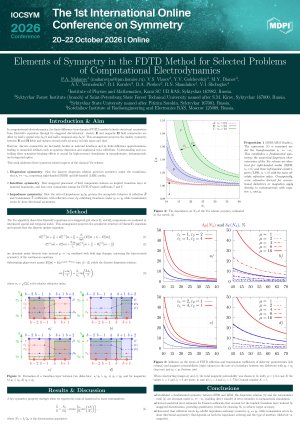
Introduction: The finite-difference time-domain (FDTD) method, based on Yee’s staggered grid, is a cornerstone of computational electrodynamics. Its accuracy fundamentally depends on how discrete symmetries of Maxwell’s equations are preserved under spatial–temporal discretization. This work investigates symmetry-related aspects of the classical Yee scheme in modeling plane-wave propagation and interface interactions.
Methods: We analyze the discrete dispersion relation of the Yee algorithm, derive FDTD analogs of Fresnel coefficients for dielectric and magnetic interfaces, and formulate effective boundary conditions emerging from the staggered placement of field components. The transition-layer model is introduced to interpret interface discretization as an implicit symmetry-breaking layer of width Δx.
Results: We demonstrate that the “magic” Courant condition Sc = nr minimizes but does not eliminate numerical dispersion errors, with residual asymmetries depending on the signal spectrum and source ramp-up. Furthermore, we establish that the ratio of numerical to exact wavenumbers is invariant under the transformation nr ↔ -nr, revealing a fundamental symmetry between right-handed (RHM) and left-handed (LHM) media. For interface coefficients, we prove that reflection errors δR remain invariant under impedance exchange η1 ↔ η2, whereas transmission errors δT exhibit directional asymmetry governed by the ordering of adjacent media. These symmetry properties are preserved for both dielectric and magnetic boundaries when impedance ratios are matched.
Conclusions: The study reveals that symmetry preservation and controlled symmetry-breaking in FDTD discretization govern accuracy at material interfaces. The derived error estimates and symmetry criteria provide practical guidelines for reliable modeling in metamaterials, nanophotonics, and other fields requiring precise interface treatment.
Keywords
computational electrodynamics
FDTD method
numerical symmetry
dispersion relations
RHM/LHM duality
Fresnel coefficients
Poster
poster.pdf
Equations of motion on the extended Siegel–Jacobi space generated by a linear Hamiltonian
Optical Geometry from Critical Superfluid Dynamics: Einstein–Euler Parametrization and Non-Integrable Causal Structure