Event submissions
Published
This submission belongs to the session S1. Environmental and Green Processes of the event The 5th International Electronic Conference on Processes
Published date
15 Oct, 2026
Academic Editor
'%3e%3cpath%20d='M12.6657%2010.9104C12.4185%2010.325%2012.0599%209.79327%2011.6097%209.34482C11.1609%208.89508%2010.6293%208.5365%2010.0442%208.28888C10.0389%208.28626%2010.0337%208.28495%2010.0285%208.28233C10.8446%207.69279%2011.3752%206.73249%2011.3752%205.64904C11.3752%203.8542%209.92103%202.39999%208.1262%202.39999C6.33136%202.39999%204.87715%203.8542%204.87715%205.64904C4.87715%206.73249%205.40774%207.69279%206.22393%208.28364C6.21869%208.28626%206.21345%208.28757%206.20821%208.29019C5.62129%208.5378%205.09463%208.89284%204.64265%209.34613C4.1929%209.79493%203.83432%2010.3266%203.58671%2010.9117C3.34345%2011.4845%203.21226%2012.0987%203.20023%2012.7209C3.19988%2012.7349%203.20233%2012.7488%203.20744%2012.7619C3.21255%2012.7749%203.22022%2012.7867%203.22998%2012.7968C3.23975%2012.8068%203.25142%2012.8147%203.26431%2012.8202C3.2772%2012.8256%203.29105%2012.8284%203.30504%2012.8284H4.09109C4.14874%2012.8284%204.19459%2012.7825%204.1959%2012.7262C4.2221%2011.7148%204.62823%2010.7676%205.34617%2010.0497C6.08899%209.30683%207.0755%208.89808%208.1262%208.89808C9.17689%208.89808%2010.1634%209.30683%2010.9062%2010.0497C11.6242%2010.7676%2012.0303%2011.7148%2012.0565%2012.7262C12.0578%2012.7838%2012.1037%2012.8284%2012.1613%2012.8284H12.9474C12.9613%2012.8284%2012.9752%2012.8256%2012.9881%2012.8202C13.001%2012.8147%2013.0126%2012.8068%2013.0224%2012.7968C13.0322%2012.7867%2013.0398%2012.7749%2013.0449%2012.7619C13.0501%2012.7488%2013.0525%2012.7349%2013.0522%2012.7209C13.0391%2012.0947%2012.9094%2011.4855%2012.6657%2010.9104ZM8.1262%207.9024C7.52486%207.9024%206.9589%207.6679%206.53312%207.24211C6.10733%206.81633%205.87283%206.25037%205.87283%205.64904C5.87283%205.0477%206.10733%204.48174%206.53312%204.05596C6.9589%203.63018%207.52486%203.39567%208.1262%203.39567C8.72753%203.39567%209.29349%203.63018%209.71927%204.05596C10.1451%204.48174%2010.3796%205.0477%2010.3796%205.64904C10.3796%206.25037%2010.1451%206.81633%209.71927%207.24211C9.29349%207.6679%208.72753%207.9024%208.1262%207.9024Z'%20fill='%235D1EE1'/%3e%3c/g%3e%3c/svg%3e) Juan Francisco García Martín
Juan Francisco García MartínCitation
Alina Gordienko, Anastasia Saltevskaya, PIGMENT-FORMING ACTINOBACTERIA FROM SOILS OF THE CAUCASUS REGION: BIOTECHNOLOGICAL POTENTIAL AND ECOLOGICAL SIGNIFICANCE, in Proceedings of The 5th International Electronic Conference on Processes, 20 October–22 October 2026, MDPI: Basel, Switzerland
Share
Email
Facebook
Twitter
LinkedIn
PIGMENT-FORMING ACTINOBACTERIA FROM SOILS OF THE CAUCASUS REGION: BIOTECHNOLOGICAL POTENTIAL AND ECOLOGICAL SIGNIFICANCE
'%3e%3cpath%20d='M12.6647%2010.9104C12.4176%2010.325%2012.0589%209.7933%2011.6088%209.34485C11.16%208.89511%2010.6283%208.53653%2010.0432%208.28891C10.038%208.28629%2010.0327%208.28498%2010.0275%208.28236C10.8437%207.69282%2011.3743%206.73252%2011.3743%205.64907C11.3743%203.85423%209.92005%202.40002%208.12522%202.40002C6.33038%202.40002%204.87618%203.85423%204.87618%205.64907C4.87618%206.73252%205.40677%207.69282%206.22296%208.28367C6.21772%208.28629%206.21248%208.2876%206.20724%208.29022C5.62031%208.53783%205.09365%208.89287%204.64167%209.34616C4.19192%209.79496%203.83334%2010.3266%203.58573%2010.9117C3.34247%2011.4846%203.21128%2012.0987%203.19925%2012.721C3.1989%2012.735%203.20135%2012.7489%203.20646%2012.7619C3.21157%2012.7749%203.21924%2012.7868%203.22901%2012.7968C3.23877%2012.8068%203.25045%2012.8148%203.26334%2012.8202C3.27623%2012.8256%203.29007%2012.8284%203.30406%2012.8284H4.09012C4.14776%2012.8284%204.19362%2012.7825%204.19493%2012.7262C4.22113%2011.7148%204.62726%2010.7676%205.34519%2010.0497C6.08802%209.30686%207.07452%208.89811%208.12522%208.89811C9.17592%208.89811%2010.1624%209.30686%2010.9052%2010.0497C11.6232%2010.7676%2012.0293%2011.7148%2012.0555%2012.7262C12.0568%2012.7839%2012.1027%2012.8284%2012.1603%2012.8284H12.9464C12.9604%2012.8284%2012.9742%2012.8256%2012.9871%2012.8202C13%2012.8148%2013.0117%2012.8068%2013.0214%2012.7968C13.0312%2012.7868%2013.0389%2012.7749%2013.044%2012.7619C13.0491%2012.7489%2013.0515%2012.735%2013.0512%2012.721C13.0381%2012.0947%2012.9084%2011.4856%2012.6647%2010.9104ZM8.12522%207.90243C7.52388%207.90243%206.95792%207.66793%206.53214%207.24215C6.10636%206.81636%205.87185%206.2504%205.87185%205.64907C5.87185%205.04773%206.10636%204.48177%206.53214%204.05599C6.95792%203.63021%207.52388%203.3957%208.12522%203.3957C8.72655%203.3957%209.29252%203.63021%209.7183%204.05599C10.1441%204.48177%2010.3786%205.04773%2010.3786%205.64907C10.3786%206.2504%2010.1441%206.81636%209.7183%207.24215C9.29252%207.66793%208.72655%207.90243%208.12522%207.90243Z'%20fill='%235D1EE1'/%3e%3c/g%3e%3c/svg%3e)
Alina Gordienko 1
Anastasia Saltevskaya 1
1. Biological Educational and Research Complex "Innovative Solutions", Belgorod State National Research University, Belgorod, Russia
Abstract
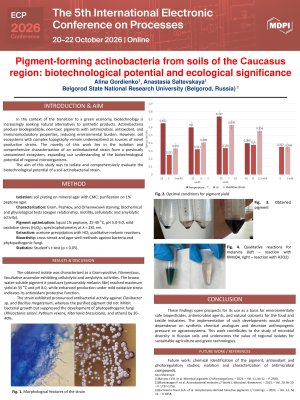
In the context of the transition to a green economy, biotechnology is increasingly seeking natural alternatives to synthetic products. Actinobacteria produce pigments with antimicrobial, antioxidant, and immunomodulatory properties that are biodegradable and non-toxic, thereby reducing environmental burden. However, soil ecosystems with complex topography, particularly the Caucasian region with its diverse geomorphological zones, remain underexplored as sources of novel productive strains. The novelty of this work lies in the isolation and comprehensive characterization of an actinobacterial strain from a unique, previously unexamined Caucasian ecosystem, expanding our understanding of the biotechnological potential of regional microorganisms.
The aim of this study was to isolate and comprehensively evaluate the biotechnological potential of a soil actinobacterial strain from the Caucasian region. The obtained isolate was characterized as a Gram-positive, filamentous, facultative anaerobe exhibiting cellulolytic and amylolytic activities. The brown water-soluble pigment it produces (presumably melanin-like) reached maximum yield at 35 °C and pH 8.0, while enhanced production under mild oxidative stress indicates its antioxidant protective function.
The strain exhibited pronounced antibacterial activity against Clavibacter sp. and Bacillus megaterium, whereas the purified pigment did not inhibit bacterial growth but suppressed the development of phytopathogenic fungi (Rhizoctonia solani, Pythium vexans, Alternaria brassicicola, and others) by 30-40 %. These findings open prospects for its use as a basis for environmentally safe biopesticides, antimicrobial agents, and natural colorants for the food and textile industries. The implementation of such developments would reduce dependence on synthetic chemical analogues and decrease anthropogenic pressure on agroecosystems. This work contributes to the study of microbial diversity in Russian soils and underscores the value of regional isolates for sustainable agriculture and green technologies.
Keywords
pigment
antibacterial activity
fungistatic activity
actinobacteria
Poster
Gordienko A., Saltevskaya A. poster.pdf
Valorization of Green Clay and Phosphogypsum in Sustainable Building Materials: A Local Solution for a Global Environmental Challenge
Techno-Economic Evaluation of Doxycycline Recovery from Aqueous Media Using Agricultural Waste-Derived Biochar: Adsorption Performance and Regeneration Potential