Event submissions
Published
This submission belongs to the session S1. Mathematical Physics of the event The 1st International Online Conference on Symmetry
Published date
15 Oct, 2026
Academic Editor
'%3e%3cpath%20d='M12.6657%2010.9104C12.4185%2010.325%2012.0599%209.79327%2011.6097%209.34482C11.1609%208.89508%2010.6293%208.5365%2010.0442%208.28888C10.0389%208.28626%2010.0337%208.28495%2010.0285%208.28233C10.8446%207.69279%2011.3752%206.73249%2011.3752%205.64904C11.3752%203.8542%209.92103%202.39999%208.1262%202.39999C6.33136%202.39999%204.87715%203.8542%204.87715%205.64904C4.87715%206.73249%205.40774%207.69279%206.22393%208.28364C6.21869%208.28626%206.21345%208.28757%206.20821%208.29019C5.62129%208.5378%205.09463%208.89284%204.64265%209.34613C4.1929%209.79493%203.83432%2010.3266%203.58671%2010.9117C3.34345%2011.4845%203.21226%2012.0987%203.20023%2012.7209C3.19988%2012.7349%203.20233%2012.7488%203.20744%2012.7619C3.21255%2012.7749%203.22022%2012.7867%203.22998%2012.7968C3.23975%2012.8068%203.25142%2012.8147%203.26431%2012.8202C3.2772%2012.8256%203.29105%2012.8284%203.30504%2012.8284H4.09109C4.14874%2012.8284%204.19459%2012.7825%204.1959%2012.7262C4.2221%2011.7148%204.62823%2010.7676%205.34617%2010.0497C6.08899%209.30683%207.0755%208.89808%208.1262%208.89808C9.17689%208.89808%2010.1634%209.30683%2010.9062%2010.0497C11.6242%2010.7676%2012.0303%2011.7148%2012.0565%2012.7262C12.0578%2012.7838%2012.1037%2012.8284%2012.1613%2012.8284H12.9474C12.9613%2012.8284%2012.9752%2012.8256%2012.9881%2012.8202C13.001%2012.8147%2013.0126%2012.8068%2013.0224%2012.7968C13.0322%2012.7867%2013.0398%2012.7749%2013.0449%2012.7619C13.0501%2012.7488%2013.0525%2012.7349%2013.0522%2012.7209C13.0391%2012.0947%2012.9094%2011.4855%2012.6657%2010.9104ZM8.1262%207.9024C7.52486%207.9024%206.9589%207.6679%206.53312%207.24211C6.10733%206.81633%205.87283%206.25037%205.87283%205.64904C5.87283%205.0477%206.10733%204.48174%206.53312%204.05596C6.9589%203.63018%207.52486%203.39567%208.1262%203.39567C8.72753%203.39567%209.29349%203.63018%209.71927%204.05596C10.1451%204.48174%2010.3796%205.0477%2010.3796%205.64904C10.3796%206.25037%2010.1451%206.81633%209.71927%207.24211C9.29349%207.6679%208.72753%207.9024%208.1262%207.9024Z'%20fill='%235D1EE1'/%3e%3c/g%3e%3c/svg%3e) Kazuharu Bamba
Kazuharu BambaCitation
Rodrigo Francisco dos Santos, Optical Geometry from Critical Superfluid Dynamics: Einstein–Euler Parametrization and Non-Integrable Causal Structure, in Proceedings of The 1st International Online Conference on Symmetry, 20 October–22 October 2026, MDPI: Basel, Switzerland
Share
Email
Facebook
Twitter
LinkedIn
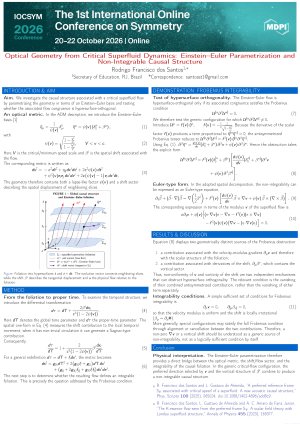
Optical Geometry from Critical Superfluid Dynamics: Einstein–Euler Parametrization and Non-Integrable Causal Structure

Rodrigo Francisco dos Santos 1
1. Secretary of Education for the State of Rio de Janeiro, Rua Roberto Bedran, s/nº, Centro, São João de Meriti - RJ, CEP 25.520-070, Rio de Janeiro, Brazil
Abstract
We construct an effective optical geometry associated with a hypothetical geometric fluid from a small fluctuation of Minkowski geodesics. The fluctuation is encoded through a discrepancy term constrained by a refractive-index perturbation (RIP) structure, leading to a velocity-dependent optical deformation of spacetime. This construction naturally introduces a bounded kinematic domain
\[
V<v<c,
\]
where the lower and upper velocity limits are connected through a reciprocal causal structure relating infrared and ultraviolet sectors.
The lower bound VVV is interpreted as a Landau-type critical velocity associated with the transition between laminar and turbulent regimes of the effective fluid. From the resulting optical structure, we derive an optical time function and construct an Einstein–Euler basis leading to an Arnowitt–Deser–Misner (ADM) decomposition of the effective spacetime. In this framework, the infrared critical sector dynamically selects a distinguished foliation associated with the critical regime of the optical geometry.
The deviation vector parametrizing the foliations encodes geometric and hydrodynamical properties of the system, including vorticity and rotational effects analogous to the Sagnac effect. The optical metric is further explored as the basis for a kinematic K-essence model whose dynamics exhibit a richer structure than standard K-essence fluids due to the presence of reciprocal infrared and ultraviolet sectors.
Finally, we investigate effective flow properties derived from the Hawking–Ellis energy conditions and discuss the ability of the resulting optical geometry to reproduce compact gravitational configurations while avoiding singular behavior through small geometric deformations. These results suggest a connection between analogue gravity, relativistic hydrodynamics, superfluid vacuum models, and disformal optical geometries. This work constitutes the first part of a broader program devoted to the study of the geometric, causal, and hydrodynamical properties of the proposed optical metric.
Keywords
Emergent Gravitation & Relativistic Fluids & Æther-Superfluid of Landau & Deformed Euler equation
Continuity Equation and Inertial Effects
Poster
RFdosSantos.pdf
Elements of Symmetry in the FDTD Method for Selected Problems of Computational Electrodynamics
Description of the prolate nuclei within deformation-dependent mass and energy-dependent Davidson potential formalisms