Event submissions
Published
This submission belongs to the session S1. Environmental and Green Processes of the event The 5th International Electronic Conference on Processes
Published date
15 Oct, 2026
Academic Editor
'%3e%3cpath%20d='M12.6657%2010.9104C12.4185%2010.325%2012.0599%209.79327%2011.6097%209.34482C11.1609%208.89508%2010.6293%208.5365%2010.0442%208.28888C10.0389%208.28626%2010.0337%208.28495%2010.0285%208.28233C10.8446%207.69279%2011.3752%206.73249%2011.3752%205.64904C11.3752%203.8542%209.92103%202.39999%208.1262%202.39999C6.33136%202.39999%204.87715%203.8542%204.87715%205.64904C4.87715%206.73249%205.40774%207.69279%206.22393%208.28364C6.21869%208.28626%206.21345%208.28757%206.20821%208.29019C5.62129%208.5378%205.09463%208.89284%204.64265%209.34613C4.1929%209.79493%203.83432%2010.3266%203.58671%2010.9117C3.34345%2011.4845%203.21226%2012.0987%203.20023%2012.7209C3.19988%2012.7349%203.20233%2012.7488%203.20744%2012.7619C3.21255%2012.7749%203.22022%2012.7867%203.22998%2012.7968C3.23975%2012.8068%203.25142%2012.8147%203.26431%2012.8202C3.2772%2012.8256%203.29105%2012.8284%203.30504%2012.8284H4.09109C4.14874%2012.8284%204.19459%2012.7825%204.1959%2012.7262C4.2221%2011.7148%204.62823%2010.7676%205.34617%2010.0497C6.08899%209.30683%207.0755%208.89808%208.1262%208.89808C9.17689%208.89808%2010.1634%209.30683%2010.9062%2010.0497C11.6242%2010.7676%2012.0303%2011.7148%2012.0565%2012.7262C12.0578%2012.7838%2012.1037%2012.8284%2012.1613%2012.8284H12.9474C12.9613%2012.8284%2012.9752%2012.8256%2012.9881%2012.8202C13.001%2012.8147%2013.0126%2012.8068%2013.0224%2012.7968C13.0322%2012.7867%2013.0398%2012.7749%2013.0449%2012.7619C13.0501%2012.7488%2013.0525%2012.7349%2013.0522%2012.7209C13.0391%2012.0947%2012.9094%2011.4855%2012.6657%2010.9104ZM8.1262%207.9024C7.52486%207.9024%206.9589%207.6679%206.53312%207.24211C6.10733%206.81633%205.87283%206.25037%205.87283%205.64904C5.87283%205.0477%206.10733%204.48174%206.53312%204.05596C6.9589%203.63018%207.52486%203.39567%208.1262%203.39567C8.72753%203.39567%209.29349%203.63018%209.71927%204.05596C10.1451%204.48174%2010.3796%205.0477%2010.3796%205.64904C10.3796%206.25037%2010.1451%206.81633%209.71927%207.24211C9.29349%207.6679%208.72753%207.9024%208.1262%207.9024Z'%20fill='%235D1EE1'/%3e%3c/g%3e%3c/svg%3e) Juan Francisco García Martín
Juan Francisco García MartínCitation
Amina AICHOUR, Sousna Sahnoun, Hakim Djafer Khodja, Techno-Economic Evaluation of Doxycycline Recovery from Aqueous Media Using Agricultural Waste-Derived Biochar: Adsorption Performance and Regeneration Potential, in Proceedings of The 5th International Electronic Conference on Processes, 20 October–22 October 2026, MDPI: Basel, Switzerland
Share
Email
Facebook
Twitter
LinkedIn
Techno-Economic Evaluation of Doxycycline Recovery from Aqueous Media Using Agricultural Waste-Derived Biochar: Adsorption Performance and Regeneration Potential
'%3e%3cpath%20d='M12.6647%2010.9104C12.4176%2010.325%2012.0589%209.7933%2011.6088%209.34485C11.16%208.89511%2010.6283%208.53653%2010.0432%208.28891C10.038%208.28629%2010.0327%208.28498%2010.0275%208.28236C10.8437%207.69282%2011.3743%206.73252%2011.3743%205.64907C11.3743%203.85423%209.92005%202.40002%208.12522%202.40002C6.33038%202.40002%204.87618%203.85423%204.87618%205.64907C4.87618%206.73252%205.40677%207.69282%206.22296%208.28367C6.21772%208.28629%206.21248%208.2876%206.20724%208.29022C5.62031%208.53783%205.09365%208.89287%204.64167%209.34616C4.19192%209.79496%203.83334%2010.3266%203.58573%2010.9117C3.34247%2011.4846%203.21128%2012.0987%203.19925%2012.721C3.1989%2012.735%203.20135%2012.7489%203.20646%2012.7619C3.21157%2012.7749%203.21924%2012.7868%203.22901%2012.7968C3.23877%2012.8068%203.25045%2012.8148%203.26334%2012.8202C3.27623%2012.8256%203.29007%2012.8284%203.30406%2012.8284H4.09012C4.14776%2012.8284%204.19362%2012.7825%204.19493%2012.7262C4.22113%2011.7148%204.62726%2010.7676%205.34519%2010.0497C6.08802%209.30686%207.07452%208.89811%208.12522%208.89811C9.17592%208.89811%2010.1624%209.30686%2010.9052%2010.0497C11.6232%2010.7676%2012.0293%2011.7148%2012.0555%2012.7262C12.0568%2012.7839%2012.1027%2012.8284%2012.1603%2012.8284H12.9464C12.9604%2012.8284%2012.9742%2012.8256%2012.9871%2012.8202C13%2012.8148%2013.0117%2012.8068%2013.0214%2012.7968C13.0312%2012.7868%2013.0389%2012.7749%2013.044%2012.7619C13.0491%2012.7489%2013.0515%2012.735%2013.0512%2012.721C13.0381%2012.0947%2012.9084%2011.4856%2012.6647%2010.9104ZM8.12522%207.90243C7.52388%207.90243%206.95792%207.66793%206.53214%207.24215C6.10636%206.81636%205.87185%206.2504%205.87185%205.64907C5.87185%205.04773%206.10636%204.48177%206.53214%204.05599C6.95792%203.63021%207.52388%203.3957%208.12522%203.3957C8.72655%203.3957%209.29252%203.63021%209.7183%204.05599C10.1441%204.48177%2010.3786%205.04773%2010.3786%205.64907C10.3786%206.2504%2010.1441%206.81636%209.7183%207.24215C9.29252%207.66793%208.72655%207.90243%208.12522%207.90243Z'%20fill='%235D1EE1'/%3e%3c/g%3e%3c/svg%3e)
Amina AICHOUR 1,2
Sousna Sahnoun 3
Hakim Djafer Khodja 2,4
1. Department of Industrial Chemical Technology, Institute of Technology, University of Akli Mohand Oulhadj Bouira, Algeria
2. Laboratory of Processes for Materials, Energy, Water and Environment. Faculty of Science and Technology, University of Bouira, Bouira, 10000, Algeria
3. Department of Polymers Engineering, Institute of Materials Science and Techniques, University of Ferhat Abbas Sétif 1, Algeria
4. Department of Water Engineering, Institute of Technology, University of Akli Mohand Oulhadj Bouira, Algeria
Abstract
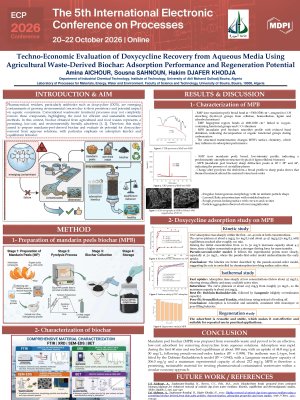
Environmental contamination by pharmaceutical residues has become a major environmental and public health concern because of their persistence, toxicity, and resistance to conventional wastewater treatment processes. In this study, biochar produced from mandarin peels was prepared, characterized, and evaluated as a sustainable, low-cost adsorbent for the removal of doxycycline from aqueous solutions.
Adsorption kinetics were investigated at an initial doxycycline concentration of 50 mg/L. The adsorption process exhibited a rapid uptake during the first 60 min, followed by a slower stage until equilibrium was reached after approximately 180 min, with an equilibrium adsorption capacity of 44.8 mg/g. The pseudo-second-order kinetic model (R2 = 0.999) provided a better fit to the experimental data than the pseudo-first-order model (R2 = 0.987), indicating that doxycycline adsorption is better described by pseudo-second-order kinetics.
Equilibrium adsorption studies revealed an L-type adsorption isotherm, indicating a strong affinity of doxycycline molecules toward the biochar surface and progressive occupation of adsorption sites with increasing equilibrium concentration. Among the equilibrium models evaluated, the Dubinin–Radushkevich model provided the best fit to the experimental data (R2 = 0.940), followed by the Langmuir (R2 = 0.895), Temkin (R2 = 0.878), and Freundlich (R2 = 0.824) models. The Langmuir model predicted a theoretical monolayer adsorption capacity of 306.0 mg/g, while the maximum experimental adsorption capacity reached approximately 272 mg/g under the investigated conditions.
These findings demonstrate that mandarin peel biochar is an effective, renewable, and environmentally friendly adsorbent for doxycycline removal from wastewater. The valorization of mandarin peel waste into high-performance biochar provides a sustainable strategy for mitigating emerging pharmaceutical pollutants while supporting circular economy principles and green wastewater treatment technologies.
Keywords
Biochar
Mandarin peels
doxycycline
adsorption studies
Poster
Poster AICHOUR et al.,.pdf
PIGMENT-FORMING ACTINOBACTERIA FROM SOILS OF THE CAUCASUS REGION: BIOTECHNOLOGICAL POTENTIAL AND ECOLOGICAL SIGNIFICANCE
Life cycle assessment of sodium hypochlorite supply in an advanced ultrafiltration drinking water treatment plant: commercial purchase versus on-site electrolytic generation