Event submissions
Published
This submission belongs to the session S1. Environmental and Green Processes of the event The 5th International Electronic Conference on Processes
Published date
15 Oct, 2026
Academic Editor
'%3e%3cpath%20d='M12.6657%2010.9104C12.4185%2010.325%2012.0599%209.79327%2011.6097%209.34482C11.1609%208.89508%2010.6293%208.5365%2010.0442%208.28888C10.0389%208.28626%2010.0337%208.28495%2010.0285%208.28233C10.8446%207.69279%2011.3752%206.73249%2011.3752%205.64904C11.3752%203.8542%209.92103%202.39999%208.1262%202.39999C6.33136%202.39999%204.87715%203.8542%204.87715%205.64904C4.87715%206.73249%205.40774%207.69279%206.22393%208.28364C6.21869%208.28626%206.21345%208.28757%206.20821%208.29019C5.62129%208.5378%205.09463%208.89284%204.64265%209.34613C4.1929%209.79493%203.83432%2010.3266%203.58671%2010.9117C3.34345%2011.4845%203.21226%2012.0987%203.20023%2012.7209C3.19988%2012.7349%203.20233%2012.7488%203.20744%2012.7619C3.21255%2012.7749%203.22022%2012.7867%203.22998%2012.7968C3.23975%2012.8068%203.25142%2012.8147%203.26431%2012.8202C3.2772%2012.8256%203.29105%2012.8284%203.30504%2012.8284H4.09109C4.14874%2012.8284%204.19459%2012.7825%204.1959%2012.7262C4.2221%2011.7148%204.62823%2010.7676%205.34617%2010.0497C6.08899%209.30683%207.0755%208.89808%208.1262%208.89808C9.17689%208.89808%2010.1634%209.30683%2010.9062%2010.0497C11.6242%2010.7676%2012.0303%2011.7148%2012.0565%2012.7262C12.0578%2012.7838%2012.1037%2012.8284%2012.1613%2012.8284H12.9474C12.9613%2012.8284%2012.9752%2012.8256%2012.9881%2012.8202C13.001%2012.8147%2013.0126%2012.8068%2013.0224%2012.7968C13.0322%2012.7867%2013.0398%2012.7749%2013.0449%2012.7619C13.0501%2012.7488%2013.0525%2012.7349%2013.0522%2012.7209C13.0391%2012.0947%2012.9094%2011.4855%2012.6657%2010.9104ZM8.1262%207.9024C7.52486%207.9024%206.9589%207.6679%206.53312%207.24211C6.10733%206.81633%205.87283%206.25037%205.87283%205.64904C5.87283%205.0477%206.10733%204.48174%206.53312%204.05596C6.9589%203.63018%207.52486%203.39567%208.1262%203.39567C8.72753%203.39567%209.29349%203.63018%209.71927%204.05596C10.1451%204.48174%2010.3796%205.0477%2010.3796%205.64904C10.3796%206.25037%2010.1451%206.81633%209.71927%207.24211C9.29349%207.6679%208.72753%207.9024%208.1262%207.9024Z'%20fill='%235D1EE1'/%3e%3c/g%3e%3c/svg%3e) Juan Francisco García Martín
Juan Francisco García MartínCitation
Nina Smilyanets, Igor Svitylko, Oleksandr Lukash, Assessing the introduction success and seed quality metrics of Liquidambar styraciflua L. for urban green infrastructure optimization in Ukraine, in Proceedings of The 5th International Electronic Conference on Processes, 20 October–22 October 2026, MDPI: Basel, Switzerland
Share
Email
Facebook
Twitter
LinkedIn
Assessing the introduction success and seed quality metrics of Liquidambar styraciflua L. for urban green infrastructure optimization in Ukraine
'%3e%3cpath%20d='M12.6647%2010.9104C12.4176%2010.325%2012.0589%209.7933%2011.6088%209.34485C11.16%208.89511%2010.6283%208.53653%2010.0432%208.28891C10.038%208.28629%2010.0327%208.28498%2010.0275%208.28236C10.8437%207.69282%2011.3743%206.73252%2011.3743%205.64907C11.3743%203.85423%209.92005%202.40002%208.12522%202.40002C6.33038%202.40002%204.87618%203.85423%204.87618%205.64907C4.87618%206.73252%205.40677%207.69282%206.22296%208.28367C6.21772%208.28629%206.21248%208.2876%206.20724%208.29022C5.62031%208.53783%205.09365%208.89287%204.64167%209.34616C4.19192%209.79496%203.83334%2010.3266%203.58573%2010.9117C3.34247%2011.4846%203.21128%2012.0987%203.19925%2012.721C3.1989%2012.735%203.20135%2012.7489%203.20646%2012.7619C3.21157%2012.7749%203.21924%2012.7868%203.22901%2012.7968C3.23877%2012.8068%203.25045%2012.8148%203.26334%2012.8202C3.27623%2012.8256%203.29007%2012.8284%203.30406%2012.8284H4.09012C4.14776%2012.8284%204.19362%2012.7825%204.19493%2012.7262C4.22113%2011.7148%204.62726%2010.7676%205.34519%2010.0497C6.08802%209.30686%207.07452%208.89811%208.12522%208.89811C9.17592%208.89811%2010.1624%209.30686%2010.9052%2010.0497C11.6232%2010.7676%2012.0293%2011.7148%2012.0555%2012.7262C12.0568%2012.7839%2012.1027%2012.8284%2012.1603%2012.8284H12.9464C12.9604%2012.8284%2012.9742%2012.8256%2012.9871%2012.8202C13%2012.8148%2013.0117%2012.8068%2013.0214%2012.7968C13.0312%2012.7868%2013.0389%2012.7749%2013.044%2012.7619C13.0491%2012.7489%2013.0515%2012.735%2013.0512%2012.721C13.0381%2012.0947%2012.9084%2011.4856%2012.6647%2010.9104ZM8.12522%207.90243C7.52388%207.90243%206.95792%207.66793%206.53214%207.24215C6.10636%206.81636%205.87185%206.2504%205.87185%205.64907C5.87185%205.04773%206.10636%204.48177%206.53214%204.05599C6.95792%203.63021%207.52388%203.3957%208.12522%203.3957C8.72655%203.3957%209.29252%203.63021%209.7183%204.05599C10.1441%204.48177%2010.3786%205.04773%2010.3786%205.64907C10.3786%206.2504%2010.1441%206.81636%209.7183%207.24215C9.29252%207.66793%208.72655%207.90243%208.12522%207.90243Z'%20fill='%235D1EE1'/%3e%3c/g%3e%3c/svg%3e)
Nina Smilyanets 1
Igor Svitylko 1
Oleksandr Lukash 2
1. Landscape Construction Department, M.M. Gryshko National Botanical Garden of the National Academy of Sciences of Ukraine, Ukraine
2. Department of Ecology, Geography and Nature Management, T.H. Shevchenko National University “Chernihiv Colehium”, Chernihiv, 14013, Ukraine
Abstract
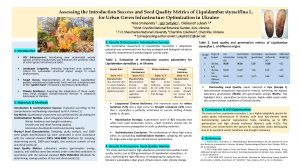
Liquidambar styraciflua L. is valuable for sustainable urban green infrastructure. Given historical introduction failures in Ukraine since the 19th century due to overcrowding and juvenile frost damage, ongoing climate shifts require re-evaluating its adaptive capacity and reproductive potential.
Acclimatization of over 70-year-old trees was assessed in Kyiv (2019–2024) using M.A. Kokhno’s 5-point scale. Concurrently, seed quality (germination capacity, energy, speed, vigor) and 1000-seed mass (DSTU 5036:2008) were analyzed across three lots: Sample No.1 (Kyiv, Ukraine), Sample No.2 (Lviv, Ukraine), and Sample No.3 (France). Lacking national standards, a novel 10-day threshold adapted from forestry guidelines determined germination energy.
Field evaluations confirmed high adaptation, scoring 5 points for winter hardiness (no frost damage), 4 for drought resistance, 4 for growth, and 4 for generative development, yielding a weighted total acclimatization index A = 90 (“good acclimatization”). Laboratory trials demonstrated clear regional differentiation. Local Sample No.1 (Kyiv) exhibited the highest performance: 98% germination capacity, 96% germination energy, fastest speed (S = 5.50 days), maximum vigor (D = 14.00%), and 4.32 g mass. Conversely, Sample No.2 (Lviv) showed 68% germination and 63% energy (S = 7.38 days), while Sample No.3 (France) achieved 94% germination over an extended period (S = 10.75 days, 51% energy, 5.13 g mass), likely indicating deeper physiological seed dormancy typical for non-local ecotypes.
The results confirm the high ecological plasticity and successful introduction of L. styraciflua in Ukraine, suggesting its capacity to form viable local ecotypes. The proposed 10-day standard provides a practical framework for commercial nurseries to optimize seed-propagation and enhance urban green infrastructure.
Keywords
American sweetgum
acclimatization
climate change adaptation
germination energy
green infrastructure
plant acclimatization
seed kinetics
urban forestry
Poster
Sciforum-206963_Smilyanets-Svitylko-Lukash_poster.pdf
Life cycle assessment of sodium hypochlorite supply in an advanced ultrafiltration drinking water treatment plant: commercial purchase versus on-site electrolytic generation
Plant growth responses as indicators of water contamination by hormones used by bodybuilders