Event submissions
Published
This submission belongs to the session S1. Environmental and Green Processes of the event The 5th International Electronic Conference on Processes
Published date
15 Oct, 2026
Academic Editor
'%3e%3cpath%20d='M12.6657%2010.9104C12.4185%2010.325%2012.0599%209.79327%2011.6097%209.34482C11.1609%208.89508%2010.6293%208.5365%2010.0442%208.28888C10.0389%208.28626%2010.0337%208.28495%2010.0285%208.28233C10.8446%207.69279%2011.3752%206.73249%2011.3752%205.64904C11.3752%203.8542%209.92103%202.39999%208.1262%202.39999C6.33136%202.39999%204.87715%203.8542%204.87715%205.64904C4.87715%206.73249%205.40774%207.69279%206.22393%208.28364C6.21869%208.28626%206.21345%208.28757%206.20821%208.29019C5.62129%208.5378%205.09463%208.89284%204.64265%209.34613C4.1929%209.79493%203.83432%2010.3266%203.58671%2010.9117C3.34345%2011.4845%203.21226%2012.0987%203.20023%2012.7209C3.19988%2012.7349%203.20233%2012.7488%203.20744%2012.7619C3.21255%2012.7749%203.22022%2012.7867%203.22998%2012.7968C3.23975%2012.8068%203.25142%2012.8147%203.26431%2012.8202C3.2772%2012.8256%203.29105%2012.8284%203.30504%2012.8284H4.09109C4.14874%2012.8284%204.19459%2012.7825%204.1959%2012.7262C4.2221%2011.7148%204.62823%2010.7676%205.34617%2010.0497C6.08899%209.30683%207.0755%208.89808%208.1262%208.89808C9.17689%208.89808%2010.1634%209.30683%2010.9062%2010.0497C11.6242%2010.7676%2012.0303%2011.7148%2012.0565%2012.7262C12.0578%2012.7838%2012.1037%2012.8284%2012.1613%2012.8284H12.9474C12.9613%2012.8284%2012.9752%2012.8256%2012.9881%2012.8202C13.001%2012.8147%2013.0126%2012.8068%2013.0224%2012.7968C13.0322%2012.7867%2013.0398%2012.7749%2013.0449%2012.7619C13.0501%2012.7488%2013.0525%2012.7349%2013.0522%2012.7209C13.0391%2012.0947%2012.9094%2011.4855%2012.6657%2010.9104ZM8.1262%207.9024C7.52486%207.9024%206.9589%207.6679%206.53312%207.24211C6.10733%206.81633%205.87283%206.25037%205.87283%205.64904C5.87283%205.0477%206.10733%204.48174%206.53312%204.05596C6.9589%203.63018%207.52486%203.39567%208.1262%203.39567C8.72753%203.39567%209.29349%203.63018%209.71927%204.05596C10.1451%204.48174%2010.3796%205.0477%2010.3796%205.64904C10.3796%206.25037%2010.1451%206.81633%209.71927%207.24211C9.29349%207.6679%208.72753%207.9024%208.1262%207.9024Z'%20fill='%235D1EE1'/%3e%3c/g%3e%3c/svg%3e) Juan Francisco García Martín
Juan Francisco García MartínCitation
Jelena T Petrović, Marija Simić, Marija Koprivica, Jelena Dimitrijević, Marija Ercegović, Toward Rational Design of Biomass-Derived Hydrochars for Water Purification: A Research Perspective, in Proceedings of The 5th International Electronic Conference on Processes, 20 October–22 October 2026, MDPI: Basel, Switzerland
Share
Email
Facebook
Twitter
LinkedIn
Toward Rational Design of Biomass-Derived Hydrochars for Water Purification: A Research Perspective

Jelena T Petrović 1

Marija Simić 1
'%3e%3cpath%20d='M12.6647%2010.9104C12.4176%2010.325%2012.0589%209.7933%2011.6088%209.34485C11.16%208.89511%2010.6283%208.53653%2010.0432%208.28891C10.038%208.28629%2010.0327%208.28498%2010.0275%208.28236C10.8437%207.69282%2011.3743%206.73252%2011.3743%205.64907C11.3743%203.85423%209.92005%202.40002%208.12522%202.40002C6.33038%202.40002%204.87618%203.85423%204.87618%205.64907C4.87618%206.73252%205.40677%207.69282%206.22296%208.28367C6.21772%208.28629%206.21248%208.2876%206.20724%208.29022C5.62031%208.53783%205.09365%208.89287%204.64167%209.34616C4.19192%209.79496%203.83334%2010.3266%203.58573%2010.9117C3.34247%2011.4846%203.21128%2012.0987%203.19925%2012.721C3.1989%2012.735%203.20135%2012.7489%203.20646%2012.7619C3.21157%2012.7749%203.21924%2012.7868%203.22901%2012.7968C3.23877%2012.8068%203.25045%2012.8148%203.26334%2012.8202C3.27623%2012.8256%203.29007%2012.8284%203.30406%2012.8284H4.09012C4.14776%2012.8284%204.19362%2012.7825%204.19493%2012.7262C4.22113%2011.7148%204.62726%2010.7676%205.34519%2010.0497C6.08802%209.30686%207.07452%208.89811%208.12522%208.89811C9.17592%208.89811%2010.1624%209.30686%2010.9052%2010.0497C11.6232%2010.7676%2012.0293%2011.7148%2012.0555%2012.7262C12.0568%2012.7839%2012.1027%2012.8284%2012.1603%2012.8284H12.9464C12.9604%2012.8284%2012.9742%2012.8256%2012.9871%2012.8202C13%2012.8148%2013.0117%2012.8068%2013.0214%2012.7968C13.0312%2012.7868%2013.0389%2012.7749%2013.044%2012.7619C13.0491%2012.7489%2013.0515%2012.735%2013.0512%2012.721C13.0381%2012.0947%2012.9084%2011.4856%2012.6647%2010.9104ZM8.12522%207.90243C7.52388%207.90243%206.95792%207.66793%206.53214%207.24215C6.10636%206.81636%205.87185%206.2504%205.87185%205.64907C5.87185%205.04773%206.10636%204.48177%206.53214%204.05599C6.95792%203.63021%207.52388%203.3957%208.12522%203.3957C8.72655%203.3957%209.29252%203.63021%209.7183%204.05599C10.1441%204.48177%2010.3786%205.04773%2010.3786%205.64907C10.3786%206.2504%2010.1441%206.81636%209.7183%207.24215C9.29252%207.66793%208.72655%207.90243%208.12522%207.90243Z'%20fill='%235D1EE1'/%3e%3c/g%3e%3c/svg%3e)
Marija Koprivica 1
Jelena Dimitrijević 1

Marija Ercegović 1
1. Institute for Technology of Nuclear and Other Mineral Raw Materials, 86 Franchet d’Esperey St., 11000 Belgrade, Serbia
Abstract
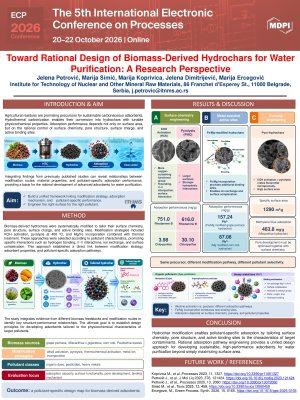
The conversion of agricultural residues into functional carbon-based adsorbents represents a promising approach for sustainable water purification. However, adsorption performance is governed not only by surface area, but also by the ability to tailor surface chemistry, textural properties, and active sites for specific pollutant interactions. Rather than comparing individual hydrochar systems, this research perspective synthesizes findings from several previously published studies to establish a unified framework linking modification strategies with adsorption mechanisms and pollutant-specific removal performance.
Hydrochars and pyro-hydrochars derived from lignocellulosic biomass, including grape pomace, Miscanthus × giganteus, corn cob, and Paulownia leaves, were engineered through surface activation, metal incorporation, and thermochemical transformation strategies. The resulting materials were investigated for the removal of chemically diverse pollutants, including dyes, organophosphorus pesticides, and heavy metal ions, enabling the identification of relationships between material properties and adsorption pathways.
Across the investigated systems, adsorption performance was governed by the interplay between surface chemistry, textural properties, and active adsorption sites rather than by surface area alone. Alkaline activation enhanced oxygen-containing functional groups, promoting hydrogen bonding, π-π interactions, and surface complexation during organic pollutant removal. Pyrolysis altered textural properties and surface characteristics, influencing the affinity of hydrochars toward hydrophobic pesticides. Furthermore, metal incorporation introduced additional active sites, enabling efficient Pb2+ removal through ion exchange and surface complexation mechanisms. Maximum adsorption capacities in different hydrochar systems reached 751.0 mg/g for Rhodamine B, 30.10 mg/g for chlorpyrifos, and 157.24 mg/g for Pb2+, while thermochemical activation generated biomass-derived carbon materials with specific surface areas up to 1290 m2/g.
Collectively, these findings demonstrate that next-generation biomass-derived adsorbents should be designed according to pollutant chemistry through rational control of surface functionality, textural properties, and active adsorption sites. This perspective provides a framework for the development of advanced hydrochar-based materials for sustainable water purification.
Keywords
Hydrochar
Biomass-derived adsorbents
Surface engineering
Water treatment
Adsorption pathways
Pollutant-specific adsorption
Poster
Poster_Petrović et al ECP2026.pdf
Design of a ceramic monolith millireactor for enzymatic resveratrol dimerization using an immobilized GOx-HRP cascade
Finite Element-Based Serviceability Assessment for Sustainable Reinforced Concrete Residential Floor Systems