Event submissions
Published
This submission belongs to the session S2. Chemical Processes and Systems of the event The 5th International Electronic Conference on Processes
Published date
15 Oct, 2026
Academic Editor
'%3e%3cpath%20d='M12.6657%2010.9104C12.4185%2010.325%2012.0599%209.79327%2011.6097%209.34482C11.1609%208.89508%2010.6293%208.5365%2010.0442%208.28888C10.0389%208.28626%2010.0337%208.28495%2010.0285%208.28233C10.8446%207.69279%2011.3752%206.73249%2011.3752%205.64904C11.3752%203.8542%209.92103%202.39999%208.1262%202.39999C6.33136%202.39999%204.87715%203.8542%204.87715%205.64904C4.87715%206.73249%205.40774%207.69279%206.22393%208.28364C6.21869%208.28626%206.21345%208.28757%206.20821%208.29019C5.62129%208.5378%205.09463%208.89284%204.64265%209.34613C4.1929%209.79493%203.83432%2010.3266%203.58671%2010.9117C3.34345%2011.4845%203.21226%2012.0987%203.20023%2012.7209C3.19988%2012.7349%203.20233%2012.7488%203.20744%2012.7619C3.21255%2012.7749%203.22022%2012.7867%203.22998%2012.7968C3.23975%2012.8068%203.25142%2012.8147%203.26431%2012.8202C3.2772%2012.8256%203.29105%2012.8284%203.30504%2012.8284H4.09109C4.14874%2012.8284%204.19459%2012.7825%204.1959%2012.7262C4.2221%2011.7148%204.62823%2010.7676%205.34617%2010.0497C6.08899%209.30683%207.0755%208.89808%208.1262%208.89808C9.17689%208.89808%2010.1634%209.30683%2010.9062%2010.0497C11.6242%2010.7676%2012.0303%2011.7148%2012.0565%2012.7262C12.0578%2012.7838%2012.1037%2012.8284%2012.1613%2012.8284H12.9474C12.9613%2012.8284%2012.9752%2012.8256%2012.9881%2012.8202C13.001%2012.8147%2013.0126%2012.8068%2013.0224%2012.7968C13.0322%2012.7867%2013.0398%2012.7749%2013.0449%2012.7619C13.0501%2012.7488%2013.0525%2012.7349%2013.0522%2012.7209C13.0391%2012.0947%2012.9094%2011.4855%2012.6657%2010.9104ZM8.1262%207.9024C7.52486%207.9024%206.9589%207.6679%206.53312%207.24211C6.10733%206.81633%205.87283%206.25037%205.87283%205.64904C5.87283%205.0477%206.10733%204.48174%206.53312%204.05596C6.9589%203.63018%207.52486%203.39567%208.1262%203.39567C8.72753%203.39567%209.29349%203.63018%209.71927%204.05596C10.1451%204.48174%2010.3796%205.0477%2010.3796%205.64904C10.3796%206.25037%2010.1451%206.81633%209.71927%207.24211C9.29349%207.6679%208.72753%207.9024%208.1262%207.9024Z'%20fill='%235D1EE1'/%3e%3c/g%3e%3c/svg%3e) Blaž Likozar
Blaž LikozarCitation
Milan Mladenović, Dragan Cvetković, Vladimir Vlatković, Saša Lazović, Darija Obradović, Comparison of Linear and Quadratic Response Surface Models for Retention Prediction of Agomelatine on an biomimetic IAM-PC system, in Proceedings of The 5th International Electronic Conference on Processes, 20 October–22 October 2026, MDPI: Basel, Switzerland
Share
Email
Facebook
Twitter
LinkedIn
Comparison of Linear and Quadratic Response Surface Models for Retention Prediction of Agomelatine on an biomimetic IAM-PC system
'%3e%3cpath%20d='M12.6647%2010.9104C12.4176%2010.325%2012.0589%209.7933%2011.6088%209.34485C11.16%208.89511%2010.6283%208.53653%2010.0432%208.28891C10.038%208.28629%2010.0327%208.28498%2010.0275%208.28236C10.8437%207.69282%2011.3743%206.73252%2011.3743%205.64907C11.3743%203.85423%209.92005%202.40002%208.12522%202.40002C6.33038%202.40002%204.87618%203.85423%204.87618%205.64907C4.87618%206.73252%205.40677%207.69282%206.22296%208.28367C6.21772%208.28629%206.21248%208.2876%206.20724%208.29022C5.62031%208.53783%205.09365%208.89287%204.64167%209.34616C4.19192%209.79496%203.83334%2010.3266%203.58573%2010.9117C3.34247%2011.4846%203.21128%2012.0987%203.19925%2012.721C3.1989%2012.735%203.20135%2012.7489%203.20646%2012.7619C3.21157%2012.7749%203.21924%2012.7868%203.22901%2012.7968C3.23877%2012.8068%203.25045%2012.8148%203.26334%2012.8202C3.27623%2012.8256%203.29007%2012.8284%203.30406%2012.8284H4.09012C4.14776%2012.8284%204.19362%2012.7825%204.19493%2012.7262C4.22113%2011.7148%204.62726%2010.7676%205.34519%2010.0497C6.08802%209.30686%207.07452%208.89811%208.12522%208.89811C9.17592%208.89811%2010.1624%209.30686%2010.9052%2010.0497C11.6232%2010.7676%2012.0293%2011.7148%2012.0555%2012.7262C12.0568%2012.7839%2012.1027%2012.8284%2012.1603%2012.8284H12.9464C12.9604%2012.8284%2012.9742%2012.8256%2012.9871%2012.8202C13%2012.8148%2013.0117%2012.8068%2013.0214%2012.7968C13.0312%2012.7868%2013.0389%2012.7749%2013.044%2012.7619C13.0491%2012.7489%2013.0515%2012.735%2013.0512%2012.721C13.0381%2012.0947%2012.9084%2011.4856%2012.6647%2010.9104ZM8.12522%207.90243C7.52388%207.90243%206.95792%207.66793%206.53214%207.24215C6.10636%206.81636%205.87185%206.2504%205.87185%205.64907C5.87185%205.04773%206.10636%204.48177%206.53214%204.05599C6.95792%203.63021%207.52388%203.3957%208.12522%203.3957C8.72655%203.3957%209.29252%203.63021%209.7183%204.05599C10.1441%204.48177%2010.3786%205.04773%2010.3786%205.64907C10.3786%206.2504%2010.1441%206.81636%209.7183%207.24215C9.29252%207.66793%208.72655%207.90243%208.12522%207.90243Z'%20fill='%235D1EE1'/%3e%3c/g%3e%3c/svg%3e)
Milan Mladenović 1
Dragan Cvetković 1
Vladimir Vlatković 2
Saša Lazović 2
Darija Obradović 2
1. University of Niš, Faculty of Technology, 16000 Leskovac, Serbia
2. University of Belgrade, Institute of Physics Belgrade, National Institute of the Republic of Serbia, 11080 Belgrade, Serbia
Abstract
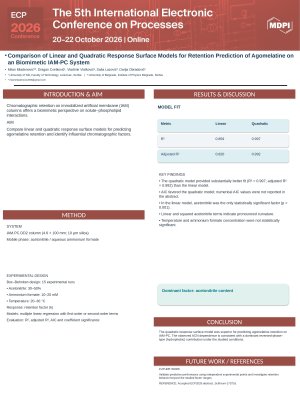
Understanding chromatographic retention behavior is essential for reliable prediction and optimization of separation conditions. This study investigates the retention of agomelatine on a biomimetic immobilized artificial membrane phospholipid column (IAM-PC) and compares the performance of linear and quadratic response surface models for retention prediction. Chromatographic analysis was performed on an IAM.PC.DD2 analytical column (4.6 × 100 mm, 10 µm silica particle size; Regis® Technologies, Inc., Morton Grove, IL, USA). The mobile phase consisted of a mixture of ammonium acetate and acetonitrile. A Box–Behnken experimental design (15 runs) was applied to evaluate the effects of acetonitrile content (30–50%), ammonium formate concentration (10–20 mM), and temperature (20–30 °C) on retention behavior. Retention factor (k) values were modeled using multiple linear regression to generate both linear and quadratic response surface equations. Model performance was assessed using R², adjusted R², Akaike Information Criterion (AIC), and statistical significance of regression coefficients. The linear model provided a moderate fit (R² = 0.859, adj. R² = 0.820), identifying acetonitrile content as the only statistically significant factor (p < 0.001). In contrast, the quadratic model significantly improved predictive accuracy (R² = 0.997, adj. R² = 0.992) and showed lower AIC values, indicating superior model adequacy. Retention was strongly influenced by both the linear and squared terms of acetonitrile, revealing a pronounced curvature effect within the investigated range and highlighting the dominant contribution of hydrophobic interaction mechanisms. Temperature and ammonium formate concentration did not show statistically significant effects. The quadratic response surface model demonstrated statistically justified superiority and provided more accurate retention prediction of agomelatine in the IAM-PC biomimetic system. These findings confirm the dominant contribution of reversed-phase–type (hydrophobic) interactions under the investigated experimental conditions.
Keywords
Chromatography
IAM-PC
Box-Behnken
linear regression
agomelatine
Poster
ECP2026_Agomelatine_Poster.pdf
Elemental Characterization and Removal of Heat-Stable Salt Precursors from Aqueous MDEA Solutions Used in Acid Gas Treatment
Synthesis and Characterization of Zirconium Dioxide for Adsorption of Methylene Blue Dye from Aqueous Solution