Event submissions
Published
This submission belongs to the session S2. Chemical Processes and Systems of the event The 5th International Electronic Conference on Processes
Published date
15 Oct, 2026
Academic Editor
'%3e%3cpath%20d='M12.6657%2010.9104C12.4185%2010.325%2012.0599%209.79327%2011.6097%209.34482C11.1609%208.89508%2010.6293%208.5365%2010.0442%208.28888C10.0389%208.28626%2010.0337%208.28495%2010.0285%208.28233C10.8446%207.69279%2011.3752%206.73249%2011.3752%205.64904C11.3752%203.8542%209.92103%202.39999%208.1262%202.39999C6.33136%202.39999%204.87715%203.8542%204.87715%205.64904C4.87715%206.73249%205.40774%207.69279%206.22393%208.28364C6.21869%208.28626%206.21345%208.28757%206.20821%208.29019C5.62129%208.5378%205.09463%208.89284%204.64265%209.34613C4.1929%209.79493%203.83432%2010.3266%203.58671%2010.9117C3.34345%2011.4845%203.21226%2012.0987%203.20023%2012.7209C3.19988%2012.7349%203.20233%2012.7488%203.20744%2012.7619C3.21255%2012.7749%203.22022%2012.7867%203.22998%2012.7968C3.23975%2012.8068%203.25142%2012.8147%203.26431%2012.8202C3.2772%2012.8256%203.29105%2012.8284%203.30504%2012.8284H4.09109C4.14874%2012.8284%204.19459%2012.7825%204.1959%2012.7262C4.2221%2011.7148%204.62823%2010.7676%205.34617%2010.0497C6.08899%209.30683%207.0755%208.89808%208.1262%208.89808C9.17689%208.89808%2010.1634%209.30683%2010.9062%2010.0497C11.6242%2010.7676%2012.0303%2011.7148%2012.0565%2012.7262C12.0578%2012.7838%2012.1037%2012.8284%2012.1613%2012.8284H12.9474C12.9613%2012.8284%2012.9752%2012.8256%2012.9881%2012.8202C13.001%2012.8147%2013.0126%2012.8068%2013.0224%2012.7968C13.0322%2012.7867%2013.0398%2012.7749%2013.0449%2012.7619C13.0501%2012.7488%2013.0525%2012.7349%2013.0522%2012.7209C13.0391%2012.0947%2012.9094%2011.4855%2012.6657%2010.9104ZM8.1262%207.9024C7.52486%207.9024%206.9589%207.6679%206.53312%207.24211C6.10733%206.81633%205.87283%206.25037%205.87283%205.64904C5.87283%205.0477%206.10733%204.48174%206.53312%204.05596C6.9589%203.63018%207.52486%203.39567%208.1262%203.39567C8.72753%203.39567%209.29349%203.63018%209.71927%204.05596C10.1451%204.48174%2010.3796%205.0477%2010.3796%205.64904C10.3796%206.25037%2010.1451%206.81633%209.71927%207.24211C9.29349%207.6679%208.72753%207.9024%208.1262%207.9024Z'%20fill='%235D1EE1'/%3e%3c/g%3e%3c/svg%3e) Blaž Likozar
Blaž LikozarCitation
Noor Shifa, Srishti Dwivedi, Ekhlakh Veg, Tahmeena Khan, Synthesis, Characterization and Photodegradation Potential of Mn₂O₃ and MnFe₂O₄ Nanoparticles , in Proceedings of The 5th International Electronic Conference on Processes, 20 October–22 October 2026, MDPI: Basel, Switzerland
Share
Email
Facebook
Twitter
LinkedIn
Synthesis, Characterization and Photodegradation Potential of Mn2O3 and MnFe2O4 Nanoparticles
'%3e%3cpath%20d='M12.6647%2010.9104C12.4176%2010.325%2012.0589%209.7933%2011.6088%209.34485C11.16%208.89511%2010.6283%208.53653%2010.0432%208.28891C10.038%208.28629%2010.0327%208.28498%2010.0275%208.28236C10.8437%207.69282%2011.3743%206.73252%2011.3743%205.64907C11.3743%203.85423%209.92005%202.40002%208.12522%202.40002C6.33038%202.40002%204.87618%203.85423%204.87618%205.64907C4.87618%206.73252%205.40677%207.69282%206.22296%208.28367C6.21772%208.28629%206.21248%208.2876%206.20724%208.29022C5.62031%208.53783%205.09365%208.89287%204.64167%209.34616C4.19192%209.79496%203.83334%2010.3266%203.58573%2010.9117C3.34247%2011.4846%203.21128%2012.0987%203.19925%2012.721C3.1989%2012.735%203.20135%2012.7489%203.20646%2012.7619C3.21157%2012.7749%203.21924%2012.7868%203.22901%2012.7968C3.23877%2012.8068%203.25045%2012.8148%203.26334%2012.8202C3.27623%2012.8256%203.29007%2012.8284%203.30406%2012.8284H4.09012C4.14776%2012.8284%204.19362%2012.7825%204.19493%2012.7262C4.22113%2011.7148%204.62726%2010.7676%205.34519%2010.0497C6.08802%209.30686%207.07452%208.89811%208.12522%208.89811C9.17592%208.89811%2010.1624%209.30686%2010.9052%2010.0497C11.6232%2010.7676%2012.0293%2011.7148%2012.0555%2012.7262C12.0568%2012.7839%2012.1027%2012.8284%2012.1603%2012.8284H12.9464C12.9604%2012.8284%2012.9742%2012.8256%2012.9871%2012.8202C13%2012.8148%2013.0117%2012.8068%2013.0214%2012.7968C13.0312%2012.7868%2013.0389%2012.7749%2013.044%2012.7619C13.0491%2012.7489%2013.0515%2012.735%2013.0512%2012.721C13.0381%2012.0947%2012.9084%2011.4856%2012.6647%2010.9104ZM8.12522%207.90243C7.52388%207.90243%206.95792%207.66793%206.53214%207.24215C6.10636%206.81636%205.87185%206.2504%205.87185%205.64907C5.87185%205.04773%206.10636%204.48177%206.53214%204.05599C6.95792%203.63021%207.52388%203.3957%208.12522%203.3957C8.72655%203.3957%209.29252%203.63021%209.7183%204.05599C10.1441%204.48177%2010.3786%205.04773%2010.3786%205.64907C10.3786%206.2504%2010.1441%206.81636%209.7183%207.24215C9.29252%207.66793%208.72655%207.90243%208.12522%207.90243Z'%20fill='%235D1EE1'/%3e%3c/g%3e%3c/svg%3e)
Noor Shifa 1
Srishti Dwivedi 2
Ekhlakh Veg 3
Tahmeena Khan 4
1. Department of Biosciences, Integral University, Lucknow 226026, India
2. Department of Chemistry, Babasaheb Bhimrao Ambedkar University, Lucknow 226025, India
3. Department of Chemistry, Isabella Thoburn College, Lucknow 226020, India
4. Department of Chemistry, Integral University, Lucknow 226026, India
Abstract
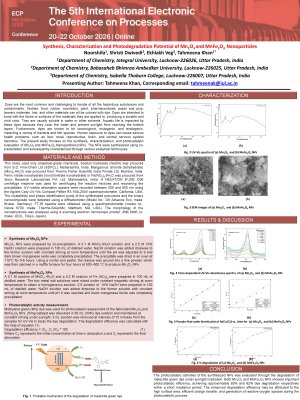
The present study focuses on the synthesis, characterization, and photocatalytic evaluation of Mn2O3 and MnFe2O4 Nanoparticles (NPs). The NPs were synthesized using co-precipitation and subsequently characterized through various analytical techniques, including UV-Visible spectroscopy, Fourier Transform Infrared Spectroscopy (FT-IR), X-ray Diffraction (XRD), and Scanning Electron Microscopy (SEM). Furthermore, the photocatalytic efficiency of the synthesised NPs was evaluated by degrading malachite green dye under visible-light irradiation. The average crystallite sizes of Mn₂O₃, and MnFe₂O₄ NPs were 60 nm and 90 nm, respectively. The FT-IR spectra showed bending and stretching vibration modes of O–H, Mn–O, and Mn–O–Mn groups in the synthesized NPs. The SEM image of the Mn2O3 NPs appeared as spherical grains with a porous and non- uniform surface. The particles were densely packed, and some agglomeration was observed due to particle clustering. The SEM image of the MnFe₂O₄ NPs showed a needle-like and network- shaped morphology. Two strong peaks were visible in the Mn2O3 NPs UV–vis absorption spectra at around 263 and 289 nm. The sharp absorption at 263 nm is assigned to O2- →Mn3+ charge transfer transitions within Mn2O3, whereas for MnFe2O4 NPs two peaks around 209 and 264 nm were observed. The photodegradation studies showed approximately 83% degradation in the presence of Mn₂O₃ NPs, within 120 minutes, whereas MnFe₂O₄ NPs degraded 82 % of malachite green within 105 minutes, showing their potential in water pollution remediation.
Keywords
Malachite green
environmental pollution
Mn2O3 NPs
MnFe2O4 NPs
Poster
ECP 2026 poster-Tahmeena Khan.pdf
Data-Efficient Convex Hybrid Modeling for Reliable Bioreactor Scale-Up Under Sparse Calibration Data
Scalable Agar-Diffusion Synthesis of Silver-Doped Hydroxyapatite Nanoparticles: Loading-Dependent Silver Partitioning, Optical Response, and Controlled Antimicrobial Ion Release