Event submissions
Published
This submission belongs to the session S2. High Energy Physics, Particles and Fields of the event The 1st International Online Conference on Symmetry
Published date
15 Oct, 2026
Academic Editor
'%3e%3cpath%20d='M12.6657%2010.9104C12.4185%2010.325%2012.0599%209.79327%2011.6097%209.34482C11.1609%208.89508%2010.6293%208.5365%2010.0442%208.28888C10.0389%208.28626%2010.0337%208.28495%2010.0285%208.28233C10.8446%207.69279%2011.3752%206.73249%2011.3752%205.64904C11.3752%203.8542%209.92103%202.39999%208.1262%202.39999C6.33136%202.39999%204.87715%203.8542%204.87715%205.64904C4.87715%206.73249%205.40774%207.69279%206.22393%208.28364C6.21869%208.28626%206.21345%208.28757%206.20821%208.29019C5.62129%208.5378%205.09463%208.89284%204.64265%209.34613C4.1929%209.79493%203.83432%2010.3266%203.58671%2010.9117C3.34345%2011.4845%203.21226%2012.0987%203.20023%2012.7209C3.19988%2012.7349%203.20233%2012.7488%203.20744%2012.7619C3.21255%2012.7749%203.22022%2012.7867%203.22998%2012.7968C3.23975%2012.8068%203.25142%2012.8147%203.26431%2012.8202C3.2772%2012.8256%203.29105%2012.8284%203.30504%2012.8284H4.09109C4.14874%2012.8284%204.19459%2012.7825%204.1959%2012.7262C4.2221%2011.7148%204.62823%2010.7676%205.34617%2010.0497C6.08899%209.30683%207.0755%208.89808%208.1262%208.89808C9.17689%208.89808%2010.1634%209.30683%2010.9062%2010.0497C11.6242%2010.7676%2012.0303%2011.7148%2012.0565%2012.7262C12.0578%2012.7838%2012.1037%2012.8284%2012.1613%2012.8284H12.9474C12.9613%2012.8284%2012.9752%2012.8256%2012.9881%2012.8202C13.001%2012.8147%2013.0126%2012.8068%2013.0224%2012.7968C13.0322%2012.7867%2013.0398%2012.7749%2013.0449%2012.7619C13.0501%2012.7488%2013.0525%2012.7349%2013.0522%2012.7209C13.0391%2012.0947%2012.9094%2011.4855%2012.6657%2010.9104ZM8.1262%207.9024C7.52486%207.9024%206.9589%207.6679%206.53312%207.24211C6.10733%206.81633%205.87283%206.25037%205.87283%205.64904C5.87283%205.0477%206.10733%204.48174%206.53312%204.05596C6.9589%203.63018%207.52486%203.39567%208.1262%203.39567C8.72753%203.39567%209.29349%203.63018%209.71927%204.05596C10.1451%204.48174%2010.3796%205.0477%2010.3796%205.64904C10.3796%206.25037%2010.1451%206.81633%209.71927%207.24211C9.29349%207.6679%208.72753%207.9024%208.1262%207.9024Z'%20fill='%235D1EE1'/%3e%3c/g%3e%3c/svg%3e) Calogero Vetro
Calogero VetroCitation
Francesco Giovanni Celiberto, Exotic and Rare Hadrons Across Flavor Sectors: Fragmentation, Symmetries, and Collider Phenomenology, in Proceedings of The 1st International Online Conference on Symmetry, 20 October–22 October 2026, MDPI: Basel, Switzerland
Share
Email
Facebook
Twitter
LinkedIn
Exotic and Rare Hadrons Across Flavor Sectors: Fragmentation, Symmetries, and Collider Phenomenology

Francesco Giovanni Celiberto 1
1. Department of Physics and Mathematics, University of Alcalá (UAH), Madrid E-28801, Spain
Abstract
Exotic and rare hadrons, including tetraquarks, pentaquarks, and multiply heavy baryons, provide a unique laboratory for exploring the symmetries and dynamical mechanisms underlying hadron formation in QCD. Recent observations at the LHC, including the discovery of a family of all-charm tetraquark candidates and the establishment of doubly charmed baryons, have renewed interest in understanding the production mechanisms of multiquark and heavy-flavor states across different flavor sectors. Their production probes the interplay between perturbative and nonperturbative dynamics, offering new insights into the emergence of complex bound states beyond the conventional quark model. We present a unified fragmentation-based framework for the description of heavy and exotic hadron production, developed within the Heavy-Flavor Non-Relativistic evolution (HF-NRevo) scheme. This approach enables the consistent construction and evolution of fragmentation functions across energy scales while incorporating a systematic treatment of theoretical uncertainties. The framework reveals common structures and symmetry patterns linking quarkonia, tetraquarks, pentaquarks, and triply heavy baryons, thereby providing a coherent description of a broad class of hadronic systems. Publicly available fragmentation-function sets implemented in LHAPDF are discussed together with representative phenomenological applications at present and future colliders. Particular attention is devoted to the role of intrinsic heavy-quark components and to their impact on selected production channels. These studies establish a predictive and uncertainty-aware framework for heavy-flavor and multiquark phenomenology, highlighting how symmetry principles can guide the exploration of hadron structure, multiquark dynamics, and the production of rare states in high-energy collisions.
Keywords
Exotic matter
Rare hadrons
Tetraquarks
Pentaquarks
Heavy flavor
Hadronic structure
High-energy QCD
Fragmentation
Resummation
Poster
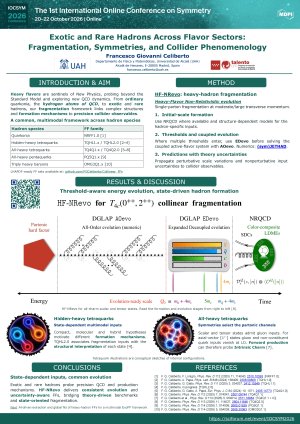
Celiberto_poster_IOCSYM2026_Exotic_Rare.pdf
Improved Null Energy Condition
Zero-Equation: Unified Criterion for Real-Virtual Conjugate Symmetry and Necessary and Sufficient Condition for Symmetry Breaking