Event submissions
Published
This submission belongs to the session S2. Chemical Processes and Systems of the event The 5th International Electronic Conference on Processes
Published date
15 Oct, 2026
Academic Editor
'%3e%3cpath%20d='M12.6657%2010.9104C12.4185%2010.325%2012.0599%209.79327%2011.6097%209.34482C11.1609%208.89508%2010.6293%208.5365%2010.0442%208.28888C10.0389%208.28626%2010.0337%208.28495%2010.0285%208.28233C10.8446%207.69279%2011.3752%206.73249%2011.3752%205.64904C11.3752%203.8542%209.92103%202.39999%208.1262%202.39999C6.33136%202.39999%204.87715%203.8542%204.87715%205.64904C4.87715%206.73249%205.40774%207.69279%206.22393%208.28364C6.21869%208.28626%206.21345%208.28757%206.20821%208.29019C5.62129%208.5378%205.09463%208.89284%204.64265%209.34613C4.1929%209.79493%203.83432%2010.3266%203.58671%2010.9117C3.34345%2011.4845%203.21226%2012.0987%203.20023%2012.7209C3.19988%2012.7349%203.20233%2012.7488%203.20744%2012.7619C3.21255%2012.7749%203.22022%2012.7867%203.22998%2012.7968C3.23975%2012.8068%203.25142%2012.8147%203.26431%2012.8202C3.2772%2012.8256%203.29105%2012.8284%203.30504%2012.8284H4.09109C4.14874%2012.8284%204.19459%2012.7825%204.1959%2012.7262C4.2221%2011.7148%204.62823%2010.7676%205.34617%2010.0497C6.08899%209.30683%207.0755%208.89808%208.1262%208.89808C9.17689%208.89808%2010.1634%209.30683%2010.9062%2010.0497C11.6242%2010.7676%2012.0303%2011.7148%2012.0565%2012.7262C12.0578%2012.7838%2012.1037%2012.8284%2012.1613%2012.8284H12.9474C12.9613%2012.8284%2012.9752%2012.8256%2012.9881%2012.8202C13.001%2012.8147%2013.0126%2012.8068%2013.0224%2012.7968C13.0322%2012.7867%2013.0398%2012.7749%2013.0449%2012.7619C13.0501%2012.7488%2013.0525%2012.7349%2013.0522%2012.7209C13.0391%2012.0947%2012.9094%2011.4855%2012.6657%2010.9104ZM8.1262%207.9024C7.52486%207.9024%206.9589%207.6679%206.53312%207.24211C6.10733%206.81633%205.87283%206.25037%205.87283%205.64904C5.87283%205.0477%206.10733%204.48174%206.53312%204.05596C6.9589%203.63018%207.52486%203.39567%208.1262%203.39567C8.72753%203.39567%209.29349%203.63018%209.71927%204.05596C10.1451%204.48174%2010.3796%205.0477%2010.3796%205.64904C10.3796%206.25037%2010.1451%206.81633%209.71927%207.24211C9.29349%207.6679%208.72753%207.9024%208.1262%207.9024Z'%20fill='%235D1EE1'/%3e%3c/g%3e%3c/svg%3e) Blaž Likozar
Blaž LikozarCitation
Olumakinde Charles Omiyale, Svetlana A Ulasevich, Scalable Agar-Diffusion Synthesis of Silver-Doped Hydroxyapatite Nanoparticles: Loading-Dependent Silver Partitioning, Optical Response, and Controlled Antimicrobial Ion Release, in Proceedings of The 5th International Electronic Conference on Processes, 20 October–22 October 2026, MDPI: Basel, Switzerland
Share
Email
Facebook
Twitter
LinkedIn
Scalable Agar-Diffusion Synthesis of Silver-Doped Hydroxyapatite Nanoparticles: Loading-Dependent Silver Partitioning, Optical Response, and Controlled Antimicrobial Ion Release
'%3e%3cpath%20d='M12.6647%2010.9104C12.4176%2010.325%2012.0589%209.7933%2011.6088%209.34485C11.16%208.89511%2010.6283%208.53653%2010.0432%208.28891C10.038%208.28629%2010.0327%208.28498%2010.0275%208.28236C10.8437%207.69282%2011.3743%206.73252%2011.3743%205.64907C11.3743%203.85423%209.92005%202.40002%208.12522%202.40002C6.33038%202.40002%204.87618%203.85423%204.87618%205.64907C4.87618%206.73252%205.40677%207.69282%206.22296%208.28367C6.21772%208.28629%206.21248%208.2876%206.20724%208.29022C5.62031%208.53783%205.09365%208.89287%204.64167%209.34616C4.19192%209.79496%203.83334%2010.3266%203.58573%2010.9117C3.34247%2011.4846%203.21128%2012.0987%203.19925%2012.721C3.1989%2012.735%203.20135%2012.7489%203.20646%2012.7619C3.21157%2012.7749%203.21924%2012.7868%203.22901%2012.7968C3.23877%2012.8068%203.25045%2012.8148%203.26334%2012.8202C3.27623%2012.8256%203.29007%2012.8284%203.30406%2012.8284H4.09012C4.14776%2012.8284%204.19362%2012.7825%204.19493%2012.7262C4.22113%2011.7148%204.62726%2010.7676%205.34519%2010.0497C6.08802%209.30686%207.07452%208.89811%208.12522%208.89811C9.17592%208.89811%2010.1624%209.30686%2010.9052%2010.0497C11.6232%2010.7676%2012.0293%2011.7148%2012.0555%2012.7262C12.0568%2012.7839%2012.1027%2012.8284%2012.1603%2012.8284H12.9464C12.9604%2012.8284%2012.9742%2012.8256%2012.9871%2012.8202C13%2012.8148%2013.0117%2012.8068%2013.0214%2012.7968C13.0312%2012.7868%2013.0389%2012.7749%2013.044%2012.7619C13.0491%2012.7489%2013.0515%2012.735%2013.0512%2012.721C13.0381%2012.0947%2012.9084%2011.4856%2012.6647%2010.9104ZM8.12522%207.90243C7.52388%207.90243%206.95792%207.66793%206.53214%207.24215C6.10636%206.81636%205.87185%206.2504%205.87185%205.64907C5.87185%205.04773%206.10636%204.48177%206.53214%204.05599C6.95792%203.63021%207.52388%203.3957%208.12522%203.3957C8.72655%203.3957%209.29252%203.63021%209.7183%204.05599C10.1441%204.48177%2010.3786%205.04773%2010.3786%205.64907C10.3786%206.2504%2010.1441%206.81636%209.7183%207.24215C9.29252%207.66793%208.72655%207.90243%208.12522%207.90243Z'%20fill='%235D1EE1'/%3e%3c/g%3e%3c/svg%3e)
Olumakinde Charles Omiyale 1
Svetlana A Ulasevich 1
1. Infochemistry Scientific Centre, ITMO University, Saint Petersburg 197101, Russia
Abstract
The osteoconductive and biocompatible properties of hydroxyapatite, in conjunction with its ability to incorporate antibacterial silver ions, make it attractive for use in bone scaffold design. In this study, HA particles containing 1, 5, and 10 wt.% Ag, based on precursor composition, was prepared via the novel agar-diffusion method that employs Liesegang ring precipitation under steady-state, low-level supersaturation via ion diffusion in an agar-Na₂HPO₄ matrix. Samples were characterized using X-ray diffractometry (XRD) with full-pattern indexing, FTIR spectroscopy, SEM-EDX analysis, AFM analysis, and diffuse reflectance UV-Vis spectroscopy. At the same time, the kinetics of Ag⁺ ion release were monitored in PBS buffer. Silver incorporation led to a non-linear response of the unit cell parameters, expansion at 1 wt.% (Δc = +0.55%) followed by contraction at 5 and 10 wt.% concentrations, whereas the sum of the calcium and silver ions concentration, i.e., the (Ca + Ag)/P ratio, did not reach the stoichiometric value of 1.67 and decreased continuously, while particle crystallite size ranged from 48 to 24 nm accompanied by increasing microstrains (0.12 to 0.44%, Williamson-Hall).Considering the poor metallic silver reflectance observed in the high-loading samples and the presence of a surface plasmon resonance peak at around 400–420 nm in the diffuse reflectance spectra, this observation can be attributed to the substitution of Ag⁺ ions for calcium ions at the Ca2 site in the low-loaded materials. In contrast, the remaining silver is precipitated as Ag⁰ metal nanoparticles in the high-loaded samples. The optical bandgap showed similar behavior, with a non-linear decrease from 5.12 to 4.93 eV, followed by increases to 5.04 and 5.03 eV. The release behavior of the silver ions was steady and not burst-type; it exhibited an early-time pseudo-first-order constant that decreased linearly with increasing loading (0.00714 and 0.00629 min⁻¹). The 24-h release rate of the 10 wt.% material was ≈ 0.55 ppm. Thus, the agar diffusion method represents a scalable, chloride-free approach to synthesizing Ag-HA with structurally controlled silver chemistry.
Keywords
silver-doped hydroxyapatite
agar diffusion
Liesegang rings
silver partitioning
Williamson-Hall analysis
surface plasmon resonance
controlled ion release
antimicrobial biomaterials
Poster
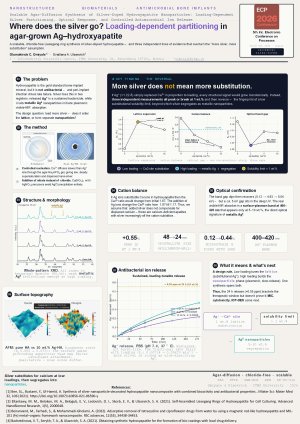
Final Silver Agar process Poster_ECP2026-usa_portrait.pdf
Synthesis, Characterization and Photodegradation Potential of Mn2O3 and MnFe2O4 Nanoparticles
Hydrodynamics of Gas-Liquid Mixing in Non-Newtonian Fluids Agitated by a Maxblend Impeller