Event submissions
Published
This submission belongs to the session S2. High Energy Physics, Particles and Fields of the event The 1st International Online Conference on Symmetry
Published date
15 Oct, 2026
Academic Editor
'%3e%3cpath%20d='M12.6657%2010.9104C12.4185%2010.325%2012.0599%209.79327%2011.6097%209.34482C11.1609%208.89508%2010.6293%208.5365%2010.0442%208.28888C10.0389%208.28626%2010.0337%208.28495%2010.0285%208.28233C10.8446%207.69279%2011.3752%206.73249%2011.3752%205.64904C11.3752%203.8542%209.92103%202.39999%208.1262%202.39999C6.33136%202.39999%204.87715%203.8542%204.87715%205.64904C4.87715%206.73249%205.40774%207.69279%206.22393%208.28364C6.21869%208.28626%206.21345%208.28757%206.20821%208.29019C5.62129%208.5378%205.09463%208.89284%204.64265%209.34613C4.1929%209.79493%203.83432%2010.3266%203.58671%2010.9117C3.34345%2011.4845%203.21226%2012.0987%203.20023%2012.7209C3.19988%2012.7349%203.20233%2012.7488%203.20744%2012.7619C3.21255%2012.7749%203.22022%2012.7867%203.22998%2012.7968C3.23975%2012.8068%203.25142%2012.8147%203.26431%2012.8202C3.2772%2012.8256%203.29105%2012.8284%203.30504%2012.8284H4.09109C4.14874%2012.8284%204.19459%2012.7825%204.1959%2012.7262C4.2221%2011.7148%204.62823%2010.7676%205.34617%2010.0497C6.08899%209.30683%207.0755%208.89808%208.1262%208.89808C9.17689%208.89808%2010.1634%209.30683%2010.9062%2010.0497C11.6242%2010.7676%2012.0303%2011.7148%2012.0565%2012.7262C12.0578%2012.7838%2012.1037%2012.8284%2012.1613%2012.8284H12.9474C12.9613%2012.8284%2012.9752%2012.8256%2012.9881%2012.8202C13.001%2012.8147%2013.0126%2012.8068%2013.0224%2012.7968C13.0322%2012.7867%2013.0398%2012.7749%2013.0449%2012.7619C13.0501%2012.7488%2013.0525%2012.7349%2013.0522%2012.7209C13.0391%2012.0947%2012.9094%2011.4855%2012.6657%2010.9104ZM8.1262%207.9024C7.52486%207.9024%206.9589%207.6679%206.53312%207.24211C6.10733%206.81633%205.87283%206.25037%205.87283%205.64904C5.87283%205.0477%206.10733%204.48174%206.53312%204.05596C6.9589%203.63018%207.52486%203.39567%208.1262%203.39567C8.72753%203.39567%209.29349%203.63018%209.71927%204.05596C10.1451%204.48174%2010.3796%205.0477%2010.3796%205.64904C10.3796%206.25037%2010.1451%206.81633%209.71927%207.24211C9.29349%207.6679%208.72753%207.9024%208.1262%207.9024Z'%20fill='%235D1EE1'/%3e%3c/g%3e%3c/svg%3e) Sergei Odinstov
Sergei OdinstovCitation
Chengyi Li, String-Inspired Foam and Lorentz Violation: Reconciling Light-Speed Variation with Air Shower Observations, in Proceedings of The 1st International Online Conference on Symmetry, 20 October–22 October 2026, MDPI: Basel, Switzerland
Share
Email
Facebook
Twitter
LinkedIn
String-Inspired Foam and Lorentz Violation: Reconciling Light-Speed Variation with Air Shower Observations

Chengyi Li 1
1. School of Physics, Peking University, Beijing, China
Abstract
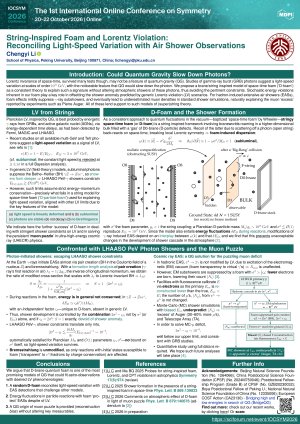
Recent studies on the time-of-flight of gamma-ray burst (GRB) photons suggest an energy-dependent light-speed variation in vacuo, signaling a violation of Lorentz symmetry (LV) at the Planck scale. While generic (or field-theoretic) LV models with subluminal photons often lead to drastic, unobserved modifications to the electromagnetic (EM) shower development of cosmic photons in the Earth’s atmosphere, we explore a string/D-brane-inspired model for quantum space–time foam that could reconcile these discrepancies and which may further provide an explanation for the persistent “muon puzzle” in ultrahigh-energy cosmic ray physics. By analyzing the formation length for pair creation—the most probable channel of a γ-ray’s first reaction in air—we show that photon-initiated cascades can remain largely intact in our model, thereby avoiding stringent shower formation constraints while accommodating the subluminal delays of GRB photons. The inclusion of stochastic energy fluctuations inherent in our foam plays a key role in offsetting the shower anomaly effects as predicted by other scenarios.
Furthermore, we extend this mechanism to the case of extensive air showers (EASs) induced by primary hadrons. The analysis suggests that space–time foam effects may mildly suppress secondary EM subshowers, resulting in a reduction in the detected electron content, which implies a systematic underestimation in the reconstruction of the primary particle’s energy under Lorentz invariance. Standard simulations of EAS obviously underestimate the actual muon densities in the presence of foam due to this energy bias, thereby offering a novel quantum-gravitational interpretation for the apparent muon “excess” reported by major observatories such as the Pierre Auger collaboration. Our results not only provide a unified way to understand the new physics behind the light-speed variation effect of cosmic photons from a string-theoretic point of view but can also, hopefully, shed light on the fast-expanding field of quantum-gravity phenomenology, deepening our understanding of space–time.
Keywords
string foam
light-speed variation
shower development
Lorentz violation
Poster
poster.pdf
Symmetry-Driven Optical Response of GaAs: A First-Principles Density Functional Theory Investigation
Compact Representation of Particle-Collision Events for Physics-Informed Machine Learning