Event submissions
Published
This submission belongs to the session S1. Environmental and Green Processes of the event The 5th International Electronic Conference on Processes
Published date
15 Oct, 2026
Academic Editor
'%3e%3cpath%20d='M12.6657%2010.9104C12.4185%2010.325%2012.0599%209.79327%2011.6097%209.34482C11.1609%208.89508%2010.6293%208.5365%2010.0442%208.28888C10.0389%208.28626%2010.0337%208.28495%2010.0285%208.28233C10.8446%207.69279%2011.3752%206.73249%2011.3752%205.64904C11.3752%203.8542%209.92103%202.39999%208.1262%202.39999C6.33136%202.39999%204.87715%203.8542%204.87715%205.64904C4.87715%206.73249%205.40774%207.69279%206.22393%208.28364C6.21869%208.28626%206.21345%208.28757%206.20821%208.29019C5.62129%208.5378%205.09463%208.89284%204.64265%209.34613C4.1929%209.79493%203.83432%2010.3266%203.58671%2010.9117C3.34345%2011.4845%203.21226%2012.0987%203.20023%2012.7209C3.19988%2012.7349%203.20233%2012.7488%203.20744%2012.7619C3.21255%2012.7749%203.22022%2012.7867%203.22998%2012.7968C3.23975%2012.8068%203.25142%2012.8147%203.26431%2012.8202C3.2772%2012.8256%203.29105%2012.8284%203.30504%2012.8284H4.09109C4.14874%2012.8284%204.19459%2012.7825%204.1959%2012.7262C4.2221%2011.7148%204.62823%2010.7676%205.34617%2010.0497C6.08899%209.30683%207.0755%208.89808%208.1262%208.89808C9.17689%208.89808%2010.1634%209.30683%2010.9062%2010.0497C11.6242%2010.7676%2012.0303%2011.7148%2012.0565%2012.7262C12.0578%2012.7838%2012.1037%2012.8284%2012.1613%2012.8284H12.9474C12.9613%2012.8284%2012.9752%2012.8256%2012.9881%2012.8202C13.001%2012.8147%2013.0126%2012.8068%2013.0224%2012.7968C13.0322%2012.7867%2013.0398%2012.7749%2013.0449%2012.7619C13.0501%2012.7488%2013.0525%2012.7349%2013.0522%2012.7209C13.0391%2012.0947%2012.9094%2011.4855%2012.6657%2010.9104ZM8.1262%207.9024C7.52486%207.9024%206.9589%207.6679%206.53312%207.24211C6.10733%206.81633%205.87283%206.25037%205.87283%205.64904C5.87283%205.0477%206.10733%204.48174%206.53312%204.05596C6.9589%203.63018%207.52486%203.39567%208.1262%203.39567C8.72753%203.39567%209.29349%203.63018%209.71927%204.05596C10.1451%204.48174%2010.3796%205.0477%2010.3796%205.64904C10.3796%206.25037%2010.1451%206.81633%209.71927%207.24211C9.29349%207.6679%208.72753%207.9024%208.1262%207.9024Z'%20fill='%235D1EE1'/%3e%3c/g%3e%3c/svg%3e) Juan Francisco García Martín
Juan Francisco García MartínCitation
Gizem Yaren Karataş, Cheng-Han Lee, Sustainable Recovery of Battery-Grade Graphite from Spent NMC Lithium-Ion Battery via Green Binder Removal, Froth Flotation, and Chemical Purification, in Proceedings of The 5th International Electronic Conference on Processes, 20 October–22 October 2026, MDPI: Basel, Switzerland
Share
Email
Facebook
Twitter
LinkedIn
Sustainable Recovery of Battery-Grade Graphite from Spent NMC Lithium-Ion Battery via Green Binder Removal, Froth Flotation, and Chemical Purification
'%3e%3cpath%20d='M12.6647%2010.9104C12.4176%2010.325%2012.0589%209.7933%2011.6088%209.34485C11.16%208.89511%2010.6283%208.53653%2010.0432%208.28891C10.038%208.28629%2010.0327%208.28498%2010.0275%208.28236C10.8437%207.69282%2011.3743%206.73252%2011.3743%205.64907C11.3743%203.85423%209.92005%202.40002%208.12522%202.40002C6.33038%202.40002%204.87618%203.85423%204.87618%205.64907C4.87618%206.73252%205.40677%207.69282%206.22296%208.28367C6.21772%208.28629%206.21248%208.2876%206.20724%208.29022C5.62031%208.53783%205.09365%208.89287%204.64167%209.34616C4.19192%209.79496%203.83334%2010.3266%203.58573%2010.9117C3.34247%2011.4846%203.21128%2012.0987%203.19925%2012.721C3.1989%2012.735%203.20135%2012.7489%203.20646%2012.7619C3.21157%2012.7749%203.21924%2012.7868%203.22901%2012.7968C3.23877%2012.8068%203.25045%2012.8148%203.26334%2012.8202C3.27623%2012.8256%203.29007%2012.8284%203.30406%2012.8284H4.09012C4.14776%2012.8284%204.19362%2012.7825%204.19493%2012.7262C4.22113%2011.7148%204.62726%2010.7676%205.34519%2010.0497C6.08802%209.30686%207.07452%208.89811%208.12522%208.89811C9.17592%208.89811%2010.1624%209.30686%2010.9052%2010.0497C11.6232%2010.7676%2012.0293%2011.7148%2012.0555%2012.7262C12.0568%2012.7839%2012.1027%2012.8284%2012.1603%2012.8284H12.9464C12.9604%2012.8284%2012.9742%2012.8256%2012.9871%2012.8202C13%2012.8148%2013.0117%2012.8068%2013.0214%2012.7968C13.0312%2012.7868%2013.0389%2012.7749%2013.044%2012.7619C13.0491%2012.7489%2013.0515%2012.735%2013.0512%2012.721C13.0381%2012.0947%2012.9084%2011.4856%2012.6647%2010.9104ZM8.12522%207.90243C7.52388%207.90243%206.95792%207.66793%206.53214%207.24215C6.10636%206.81636%205.87185%206.2504%205.87185%205.64907C5.87185%205.04773%206.10636%204.48177%206.53214%204.05599C6.95792%203.63021%207.52388%203.3957%208.12522%203.3957C8.72655%203.3957%209.29252%203.63021%209.7183%204.05599C10.1441%204.48177%2010.3786%205.04773%2010.3786%205.64907C10.3786%206.2504%2010.1441%206.81636%209.7183%207.24215C9.29252%207.66793%208.72655%207.90243%208.12522%207.90243Z'%20fill='%235D1EE1'/%3e%3c/g%3e%3c/svg%3e)
Gizem Yaren Karataş 1

Cheng-Han Lee 1,2
1. Department of Resources Engineering, National Cheng Kung University, Tainan, Taiwan
2. Center for Resilience and Intelligence on Sustainable Energy Research (RiSER), National Cheng Kung University, Tainan, Taiwan
Abstract
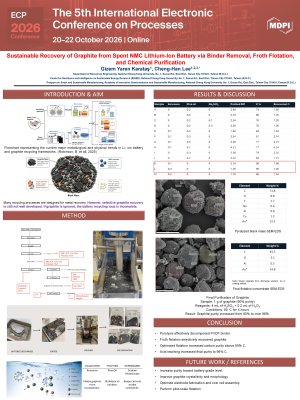
The rapid growth of electric vehicles and renewable energy storage systems has increased the generation of spent lithium-ion batteries, creating an urgent need for sustainable recycling technologies. Although conventional recycling processes mainly recover valuable cathode metals, anode graphite is often neglected despite accounting for a substantial fraction of battery waste. This study developed an integrated process to recover and purify graphite from mixed cathode and anode materials obtained from spent nickel–manganese–cobalt lithium-ion batteries. Before dismantling, the batteries were discharged in an aqueous sodium chloride solution to reduce residual electrical energy and improve operational safety. The cathode and anode materials were then collected for separation and purification. Because residual polyvinylidene fluoride (PVDF) can coat particle surfaces and hinder selective separation, two binder-removal pretreatments were evaluated: dissolution using triethyl phosphate as an environmentally preferable solvent and controlled thermal decomposition. Contact-angle and zeta-potential measurements were used to assess changes in particle-surface properties. PVDF removal restored the intrinsic hydrophobicity of graphite, while the cathode materials remained relatively hydrophilic, thereby improving selective separation by froth flotation. Flotation was conducted using kerosene as the collector, pine oil as the frother, and sodium metasilicate as the dispersant and depressant. Operating conditions were optimized to enhance graphite recovery and reduce the entrainment of cathode materials and metallic impurities. The flotation concentrate was subsequently purified using sulfuric acid and hydrogen peroxide. The integrated process produced graphite with approximately 96% carbon purity, while repeated purification cycles further reduced residual impurities, thereby enabling the product to reach battery-grade purity. These results demonstrate that combining controlled discharge, binder removal, froth flotation, and chemical purification is a feasible strategy for recovering high-purity graphite from spent lithium-ion batteries and supporting a circular battery economy.
Keywords
Lithium-ion Battery
Graphite
Recovery
Froth Flotation
Circular Economy
Poster
Sciforum-205603.pdf
Green Extraction of Rosemary (Rosmarinus officinalis L.) with Ultrasonic Assistance Essential Oil: A Comparison of Hydro and Soxhlet Distillation Techniques with RSM Optimization
Biodegradation potential and physiological characteristics of new soil isolates