Event submissions
Published
This submission belongs to the session S1. Environmental and Green Processes of the event The 5th International Electronic Conference on Processes
Published date
15 Oct, 2026
Academic Editor
'%3e%3cpath%20d='M12.6657%2010.9104C12.4185%2010.325%2012.0599%209.79327%2011.6097%209.34482C11.1609%208.89508%2010.6293%208.5365%2010.0442%208.28888C10.0389%208.28626%2010.0337%208.28495%2010.0285%208.28233C10.8446%207.69279%2011.3752%206.73249%2011.3752%205.64904C11.3752%203.8542%209.92103%202.39999%208.1262%202.39999C6.33136%202.39999%204.87715%203.8542%204.87715%205.64904C4.87715%206.73249%205.40774%207.69279%206.22393%208.28364C6.21869%208.28626%206.21345%208.28757%206.20821%208.29019C5.62129%208.5378%205.09463%208.89284%204.64265%209.34613C4.1929%209.79493%203.83432%2010.3266%203.58671%2010.9117C3.34345%2011.4845%203.21226%2012.0987%203.20023%2012.7209C3.19988%2012.7349%203.20233%2012.7488%203.20744%2012.7619C3.21255%2012.7749%203.22022%2012.7867%203.22998%2012.7968C3.23975%2012.8068%203.25142%2012.8147%203.26431%2012.8202C3.2772%2012.8256%203.29105%2012.8284%203.30504%2012.8284H4.09109C4.14874%2012.8284%204.19459%2012.7825%204.1959%2012.7262C4.2221%2011.7148%204.62823%2010.7676%205.34617%2010.0497C6.08899%209.30683%207.0755%208.89808%208.1262%208.89808C9.17689%208.89808%2010.1634%209.30683%2010.9062%2010.0497C11.6242%2010.7676%2012.0303%2011.7148%2012.0565%2012.7262C12.0578%2012.7838%2012.1037%2012.8284%2012.1613%2012.8284H12.9474C12.9613%2012.8284%2012.9752%2012.8256%2012.9881%2012.8202C13.001%2012.8147%2013.0126%2012.8068%2013.0224%2012.7968C13.0322%2012.7867%2013.0398%2012.7749%2013.0449%2012.7619C13.0501%2012.7488%2013.0525%2012.7349%2013.0522%2012.7209C13.0391%2012.0947%2012.9094%2011.4855%2012.6657%2010.9104ZM8.1262%207.9024C7.52486%207.9024%206.9589%207.6679%206.53312%207.24211C6.10733%206.81633%205.87283%206.25037%205.87283%205.64904C5.87283%205.0477%206.10733%204.48174%206.53312%204.05596C6.9589%203.63018%207.52486%203.39567%208.1262%203.39567C8.72753%203.39567%209.29349%203.63018%209.71927%204.05596C10.1451%204.48174%2010.3796%205.0477%2010.3796%205.64904C10.3796%206.25037%2010.1451%206.81633%209.71927%207.24211C9.29349%207.6679%208.72753%207.9024%208.1262%207.9024Z'%20fill='%235D1EE1'/%3e%3c/g%3e%3c/svg%3e) Juan Francisco García Martín
Juan Francisco García MartínCitation
Isabel Pestana Paixão Cansado, Pedro F. Geraldo, Arlindo Mendes, Biomass-Derived Sustainable Adsorbents for the Removal of Crystal Violet from Water, in Proceedings of The 5th International Electronic Conference on Processes, 20 October–22 October 2026, MDPI: Basel, Switzerland
Share
Email
Facebook
Twitter
LinkedIn
Biomass-Derived Sustainable Adsorbents for the Removal of Crystal Violet from Water

Isabel Pestana Paixão Cansado 1
'%3e%3cpath%20d='M12.6647%2010.9104C12.4176%2010.325%2012.0589%209.7933%2011.6088%209.34485C11.16%208.89511%2010.6283%208.53653%2010.0432%208.28891C10.038%208.28629%2010.0327%208.28498%2010.0275%208.28236C10.8437%207.69282%2011.3743%206.73252%2011.3743%205.64907C11.3743%203.85423%209.92005%202.40002%208.12522%202.40002C6.33038%202.40002%204.87618%203.85423%204.87618%205.64907C4.87618%206.73252%205.40677%207.69282%206.22296%208.28367C6.21772%208.28629%206.21248%208.2876%206.20724%208.29022C5.62031%208.53783%205.09365%208.89287%204.64167%209.34616C4.19192%209.79496%203.83334%2010.3266%203.58573%2010.9117C3.34247%2011.4846%203.21128%2012.0987%203.19925%2012.721C3.1989%2012.735%203.20135%2012.7489%203.20646%2012.7619C3.21157%2012.7749%203.21924%2012.7868%203.22901%2012.7968C3.23877%2012.8068%203.25045%2012.8148%203.26334%2012.8202C3.27623%2012.8256%203.29007%2012.8284%203.30406%2012.8284H4.09012C4.14776%2012.8284%204.19362%2012.7825%204.19493%2012.7262C4.22113%2011.7148%204.62726%2010.7676%205.34519%2010.0497C6.08802%209.30686%207.07452%208.89811%208.12522%208.89811C9.17592%208.89811%2010.1624%209.30686%2010.9052%2010.0497C11.6232%2010.7676%2012.0293%2011.7148%2012.0555%2012.7262C12.0568%2012.7839%2012.1027%2012.8284%2012.1603%2012.8284H12.9464C12.9604%2012.8284%2012.9742%2012.8256%2012.9871%2012.8202C13%2012.8148%2013.0117%2012.8068%2013.0214%2012.7968C13.0312%2012.7868%2013.0389%2012.7749%2013.044%2012.7619C13.0491%2012.7489%2013.0515%2012.735%2013.0512%2012.721C13.0381%2012.0947%2012.9084%2011.4856%2012.6647%2010.9104ZM8.12522%207.90243C7.52388%207.90243%206.95792%207.66793%206.53214%207.24215C6.10636%206.81636%205.87185%206.2504%205.87185%205.64907C5.87185%205.04773%206.10636%204.48177%206.53214%204.05599C6.95792%203.63021%207.52388%203.3957%208.12522%203.3957C8.72655%203.3957%209.29252%203.63021%209.7183%204.05599C10.1441%204.48177%2010.3786%205.04773%2010.3786%205.64907C10.3786%206.2504%2010.1441%206.81636%209.7183%207.24215C9.29252%207.66793%208.72655%207.90243%208.12522%207.90243Z'%20fill='%235D1EE1'/%3e%3c/g%3e%3c/svg%3e)
Pedro F. Geraldo 1
Arlindo Mendes 2
1. Mediterranean Institute for Agriculture, Environment and Development & Change – Global Change and Sustainability Institute, Departamento de Química e Bioquímica, Escola de Ciências e Tecnologia, Universidade de Évora, Rua Romão Ramalho nº 59, 7000-671 Évora, Portugal
2. Departamento de Química e Bioquímica, Universidade de Évora,
Rua Romão Ramalho, n 59
7000 - 671 Évora. Portugal
Abstract
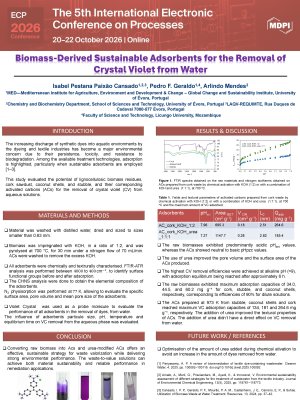
The increasing discharge of synthetic dyes into aquatic environments by the dyeing and textile industries has become a major environmental concern due to their persistence, toxicity, and resistance to biodegradation. Among the available treatment technologies, adsorption is highlighted, particularly when sustainable adsorbents are employed [1–3]. This study evaluated the potential of lignocellulosic biomass residues—cork sawdust, coconut shells, and stubble—and their corresponding activated carbons (ACs) for the removal of crystal violet (CV) from aqueous solutions. The activated carbons were prepared by chemical activation with KOH at a precursor-to-activating-agent ratio of 1:2 and carbonized at 873 and 973 K. The adsorbents were characterized by elemental analysis, FTIR-ATR spectroscopy, nitrogen adsorption at 77 K, and determination of the point of zero charge (pHpzc). Batch adsorption experiments were conducted to investigate the effects of adsorbent particle size, solution pH, contact time, temperature, and initial CV concentration. The raw biomasses exhibited predominantly acidic pHpzc values, whereas the ACs showed neutral to basic pHpzc values. The highest CV removal efficiencies were achieved at alkaline pH (≈9), with adsorption equilibrium being reached after approximately 6 h. The raw biomasses exhibited maximum adsorption capacities of 34.0, 44.5, and 60.2 mg g⁻¹ for cork, stubble, and coconut shells, respectively, corresponding to efficiencies of 90% for dilute solutions. The ACs, prepared at 973 K, significantly enhanced the adsorption performance, with ACs derived from stubble and coconut shells reaching maximum adsorption capacities of 134 and 181 mg g⁻¹, respectively. Temperature had little influence on CV adsorption by the raw biomasses, whereas adsorption onto the ACs was predominantly endothermic. Overall, the results demonstrate that raw biomasses and biomass-derived ACs are promising, low-cost, and sustainable adsorbents for the efficient removal of CV from water, while simultaneously promoting biomass valorization and producing treated water of sufficient quality for potential reuse.
Keywords
Cristal Violet
Adsorption
Biomass
Activated Carbon.
Poster
ECP 2026 - Isabel -VC.pdf
Properties of new deep eutectic solvent based on salicylaldoxime and thymol
Attenuation of phosphate from municipal wastewater using biochar derived from co-pyrolysis of Amarula peel and chicken eggshell: Adsorption and precipitation process