Event submissions
Published
This submission belongs to the session S1. Environmental and Green Processes of the event The 5th International Electronic Conference on Processes
Published date
15 Oct, 2026
Academic Editor
'%3e%3cpath%20d='M12.6657%2010.9104C12.4185%2010.325%2012.0599%209.79327%2011.6097%209.34482C11.1609%208.89508%2010.6293%208.5365%2010.0442%208.28888C10.0389%208.28626%2010.0337%208.28495%2010.0285%208.28233C10.8446%207.69279%2011.3752%206.73249%2011.3752%205.64904C11.3752%203.8542%209.92103%202.39999%208.1262%202.39999C6.33136%202.39999%204.87715%203.8542%204.87715%205.64904C4.87715%206.73249%205.40774%207.69279%206.22393%208.28364C6.21869%208.28626%206.21345%208.28757%206.20821%208.29019C5.62129%208.5378%205.09463%208.89284%204.64265%209.34613C4.1929%209.79493%203.83432%2010.3266%203.58671%2010.9117C3.34345%2011.4845%203.21226%2012.0987%203.20023%2012.7209C3.19988%2012.7349%203.20233%2012.7488%203.20744%2012.7619C3.21255%2012.7749%203.22022%2012.7867%203.22998%2012.7968C3.23975%2012.8068%203.25142%2012.8147%203.26431%2012.8202C3.2772%2012.8256%203.29105%2012.8284%203.30504%2012.8284H4.09109C4.14874%2012.8284%204.19459%2012.7825%204.1959%2012.7262C4.2221%2011.7148%204.62823%2010.7676%205.34617%2010.0497C6.08899%209.30683%207.0755%208.89808%208.1262%208.89808C9.17689%208.89808%2010.1634%209.30683%2010.9062%2010.0497C11.6242%2010.7676%2012.0303%2011.7148%2012.0565%2012.7262C12.0578%2012.7838%2012.1037%2012.8284%2012.1613%2012.8284H12.9474C12.9613%2012.8284%2012.9752%2012.8256%2012.9881%2012.8202C13.001%2012.8147%2013.0126%2012.8068%2013.0224%2012.7968C13.0322%2012.7867%2013.0398%2012.7749%2013.0449%2012.7619C13.0501%2012.7488%2013.0525%2012.7349%2013.0522%2012.7209C13.0391%2012.0947%2012.9094%2011.4855%2012.6657%2010.9104ZM8.1262%207.9024C7.52486%207.9024%206.9589%207.6679%206.53312%207.24211C6.10733%206.81633%205.87283%206.25037%205.87283%205.64904C5.87283%205.0477%206.10733%204.48174%206.53312%204.05596C6.9589%203.63018%207.52486%203.39567%208.1262%203.39567C8.72753%203.39567%209.29349%203.63018%209.71927%204.05596C10.1451%204.48174%2010.3796%205.0477%2010.3796%205.64904C10.3796%206.25037%2010.1451%206.81633%209.71927%207.24211C9.29349%207.6679%208.72753%207.9024%208.1262%207.9024Z'%20fill='%235D1EE1'/%3e%3c/g%3e%3c/svg%3e) Juan Francisco García Martín
Juan Francisco García MartínCitation
Branislava Teofilović, Jelena Milidragović, Nevena Grujić-Letić, Emilia Gligorić, Snežena Papović, Thermal Behavior of Urea-Based Natural Deep Eutectic Solvents Comparing Anhydrous and Hydrated Choline Chloride–Urea Systems, in Proceedings of The 5th International Electronic Conference on Processes, 20 October–22 October 2026, MDPI: Basel, Switzerland
Share
Email
Facebook
Twitter
LinkedIn
Thermal Behavior of Urea-Based Natural Deep Eutectic Solvents Comparing Anhydrous and Hydrated Choline Chloride–Urea Systems
'%3e%3cpath%20d='M12.6647%2010.9104C12.4176%2010.325%2012.0589%209.7933%2011.6088%209.34485C11.16%208.89511%2010.6283%208.53653%2010.0432%208.28891C10.038%208.28629%2010.0327%208.28498%2010.0275%208.28236C10.8437%207.69282%2011.3743%206.73252%2011.3743%205.64907C11.3743%203.85423%209.92005%202.40002%208.12522%202.40002C6.33038%202.40002%204.87618%203.85423%204.87618%205.64907C4.87618%206.73252%205.40677%207.69282%206.22296%208.28367C6.21772%208.28629%206.21248%208.2876%206.20724%208.29022C5.62031%208.53783%205.09365%208.89287%204.64167%209.34616C4.19192%209.79496%203.83334%2010.3266%203.58573%2010.9117C3.34247%2011.4846%203.21128%2012.0987%203.19925%2012.721C3.1989%2012.735%203.20135%2012.7489%203.20646%2012.7619C3.21157%2012.7749%203.21924%2012.7868%203.22901%2012.7968C3.23877%2012.8068%203.25045%2012.8148%203.26334%2012.8202C3.27623%2012.8256%203.29007%2012.8284%203.30406%2012.8284H4.09012C4.14776%2012.8284%204.19362%2012.7825%204.19493%2012.7262C4.22113%2011.7148%204.62726%2010.7676%205.34519%2010.0497C6.08802%209.30686%207.07452%208.89811%208.12522%208.89811C9.17592%208.89811%2010.1624%209.30686%2010.9052%2010.0497C11.6232%2010.7676%2012.0293%2011.7148%2012.0555%2012.7262C12.0568%2012.7839%2012.1027%2012.8284%2012.1603%2012.8284H12.9464C12.9604%2012.8284%2012.9742%2012.8256%2012.9871%2012.8202C13%2012.8148%2013.0117%2012.8068%2013.0214%2012.7968C13.0312%2012.7868%2013.0389%2012.7749%2013.044%2012.7619C13.0491%2012.7489%2013.0515%2012.735%2013.0512%2012.721C13.0381%2012.0947%2012.9084%2011.4856%2012.6647%2010.9104ZM8.12522%207.90243C7.52388%207.90243%206.95792%207.66793%206.53214%207.24215C6.10636%206.81636%205.87185%206.2504%205.87185%205.64907C5.87185%205.04773%206.10636%204.48177%206.53214%204.05599C6.95792%203.63021%207.52388%203.3957%208.12522%203.3957C8.72655%203.3957%209.29252%203.63021%209.7183%204.05599C10.1441%204.48177%2010.3786%205.04773%2010.3786%205.64907C10.3786%206.2504%2010.1441%206.81636%209.7183%207.24215C9.29252%207.66793%208.72655%207.90243%208.12522%207.90243Z'%20fill='%235D1EE1'/%3e%3c/g%3e%3c/svg%3e)
Branislava Teofilović 1
Jelena Milidragović 1
Nevena Grujić-Letić 1
Emilia Gligorić 1
Snežena Papović 2
1. Department of Pharmacy, Faculty of Medicine, University of Novi Sad, Hajduk Veljkova 3, 21000 Novi Sad, Serbia
2. Faculty of Science, University of Novi Sad, Trg Dositeja Obradovica 3, 21000 Novi Sad, Serbia
Abstract
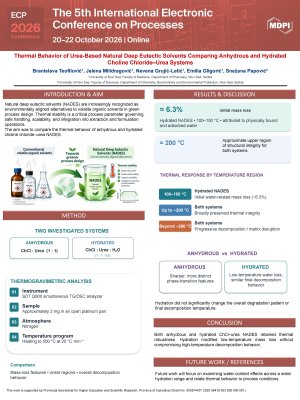
Natural deep eutectic solvents (NADES) are increasingly recognized as environmentally aligned alternatives to volatile organic solvents in green process design. Thermal stability is a critical process parameter governing safe handling, scalability, and integration into extraction and formulation operations. This study compared the thermogravimetric behavior of two urea-based NADES systems — choline chloride:urea (1:1) and its hydrated analogue containing 0.5 molar equivalents of water. Thermogravimetric analysis (TGA) was performed using a simultaneous TG/DSC analyzer (SDT Q600, TA Instruments) under nitrogen atmosphere, heating approximately 2 mg of each sample to 500 °C at 20 °C·min⁻¹ in an open platinum pan. Measurements were performed as single runs per condition. Reported values should therefore be interpreted as representative rather than statistically validated. The hydrated NADES exhibited an initial mass loss of approximately 6.3%, attributed to evaporation of physically bound and adsorbed water between 100–150 °C. Hydration did not markedly alter the onset temperature or overall extent of high-temperature decomposition relative to the anhydrous system. In the DSC signal, however, the non-hydrated NADES displayed more sharply resolved thermal transition features — consistent with a more ordered hydrogen-bond network prior to the onset of decomposition — even though the subsequent degradation behavior of both systems remained comparable. Both systems maintained structural integrity up to approximately 200 °C, beyond which progressive mass loss indicated decomposition of urea-derived fragments and disruption of the eutectic matrix. Choline chloride:urea NADES retains thermal robustness in both hydrated and non-hydrated forms. Hydration modulates low-temperature mass loss without compromising high-temperature decomposition behavior, supporting the process viability of urea-based NADES in green extraction and thermal processing applications.
Keywords
natural deep eutectic solvents
thermogravimetric analysis
choline chloride–urea
thermal stability
green process design.
Poster
Poster_Thermal_Urea_NADES_ECP2026.pdf
Eco-friendly approach for the synthesis of Y2O3 nanoparticles and assessment of potential applications
Deep eutectic solvents based on aliphatic alcohols and salicylaldoxime in the extraction of Ni and Co ions