Event submissions
Published
This submission belongs to the session S2. High Energy Physics, Particles and Fields of the event The 1st International Online Conference on Symmetry
Published date
15 Oct, 2026
Academic Editor
'%3e%3cpath%20d='M12.6657%2010.9104C12.4185%2010.325%2012.0599%209.79327%2011.6097%209.34482C11.1609%208.89508%2010.6293%208.5365%2010.0442%208.28888C10.0389%208.28626%2010.0337%208.28495%2010.0285%208.28233C10.8446%207.69279%2011.3752%206.73249%2011.3752%205.64904C11.3752%203.8542%209.92103%202.39999%208.1262%202.39999C6.33136%202.39999%204.87715%203.8542%204.87715%205.64904C4.87715%206.73249%205.40774%207.69279%206.22393%208.28364C6.21869%208.28626%206.21345%208.28757%206.20821%208.29019C5.62129%208.5378%205.09463%208.89284%204.64265%209.34613C4.1929%209.79493%203.83432%2010.3266%203.58671%2010.9117C3.34345%2011.4845%203.21226%2012.0987%203.20023%2012.7209C3.19988%2012.7349%203.20233%2012.7488%203.20744%2012.7619C3.21255%2012.7749%203.22022%2012.7867%203.22998%2012.7968C3.23975%2012.8068%203.25142%2012.8147%203.26431%2012.8202C3.2772%2012.8256%203.29105%2012.8284%203.30504%2012.8284H4.09109C4.14874%2012.8284%204.19459%2012.7825%204.1959%2012.7262C4.2221%2011.7148%204.62823%2010.7676%205.34617%2010.0497C6.08899%209.30683%207.0755%208.89808%208.1262%208.89808C9.17689%208.89808%2010.1634%209.30683%2010.9062%2010.0497C11.6242%2010.7676%2012.0303%2011.7148%2012.0565%2012.7262C12.0578%2012.7838%2012.1037%2012.8284%2012.1613%2012.8284H12.9474C12.9613%2012.8284%2012.9752%2012.8256%2012.9881%2012.8202C13.001%2012.8147%2013.0126%2012.8068%2013.0224%2012.7968C13.0322%2012.7867%2013.0398%2012.7749%2013.0449%2012.7619C13.0501%2012.7488%2013.0525%2012.7349%2013.0522%2012.7209C13.0391%2012.0947%2012.9094%2011.4855%2012.6657%2010.9104ZM8.1262%207.9024C7.52486%207.9024%206.9589%207.6679%206.53312%207.24211C6.10733%206.81633%205.87283%206.25037%205.87283%205.64904C5.87283%205.0477%206.10733%204.48174%206.53312%204.05596C6.9589%203.63018%207.52486%203.39567%208.1262%203.39567C8.72753%203.39567%209.29349%203.63018%209.71927%204.05596C10.1451%204.48174%2010.3796%205.0477%2010.3796%205.64904C10.3796%206.25037%2010.1451%206.81633%209.71927%207.24211C9.29349%207.6679%208.72753%207.9024%208.1262%207.9024Z'%20fill='%235D1EE1'/%3e%3c/g%3e%3c/svg%3e) Sergei Odinstov
Sergei OdinstovCitation
BRAHIM AIT OUAZGHOUR, Abdesslam Arhrib, Kingman Cheung, Es-said Ghourmin, Larbi Rahili, Phenomenology of Charged Higgs Bosons in 2HDM at Future Lepton Colliders, in Proceedings of The 1st International Online Conference on Symmetry, 20 October–22 October 2026, MDPI: Basel, Switzerland
Share
Email
Facebook
Twitter
LinkedIn
Phenomenology of Charged Higgs Bosons in 2HDM at Future Lepton Colliders
'%3e%3cpath%20d='M12.6647%2010.9104C12.4176%2010.325%2012.0589%209.7933%2011.6088%209.34485C11.16%208.89511%2010.6283%208.53653%2010.0432%208.28891C10.038%208.28629%2010.0327%208.28498%2010.0275%208.28236C10.8437%207.69282%2011.3743%206.73252%2011.3743%205.64907C11.3743%203.85423%209.92005%202.40002%208.12522%202.40002C6.33038%202.40002%204.87618%203.85423%204.87618%205.64907C4.87618%206.73252%205.40677%207.69282%206.22296%208.28367C6.21772%208.28629%206.21248%208.2876%206.20724%208.29022C5.62031%208.53783%205.09365%208.89287%204.64167%209.34616C4.19192%209.79496%203.83334%2010.3266%203.58573%2010.9117C3.34247%2011.4846%203.21128%2012.0987%203.19925%2012.721C3.1989%2012.735%203.20135%2012.7489%203.20646%2012.7619C3.21157%2012.7749%203.21924%2012.7868%203.22901%2012.7968C3.23877%2012.8068%203.25045%2012.8148%203.26334%2012.8202C3.27623%2012.8256%203.29007%2012.8284%203.30406%2012.8284H4.09012C4.14776%2012.8284%204.19362%2012.7825%204.19493%2012.7262C4.22113%2011.7148%204.62726%2010.7676%205.34519%2010.0497C6.08802%209.30686%207.07452%208.89811%208.12522%208.89811C9.17592%208.89811%2010.1624%209.30686%2010.9052%2010.0497C11.6232%2010.7676%2012.0293%2011.7148%2012.0555%2012.7262C12.0568%2012.7839%2012.1027%2012.8284%2012.1603%2012.8284H12.9464C12.9604%2012.8284%2012.9742%2012.8256%2012.9871%2012.8202C13%2012.8148%2013.0117%2012.8068%2013.0214%2012.7968C13.0312%2012.7868%2013.0389%2012.7749%2013.044%2012.7619C13.0491%2012.7489%2013.0515%2012.735%2013.0512%2012.721C13.0381%2012.0947%2012.9084%2011.4856%2012.6647%2010.9104ZM8.12522%207.90243C7.52388%207.90243%206.95792%207.66793%206.53214%207.24215C6.10636%206.81636%205.87185%206.2504%205.87185%205.64907C5.87185%205.04773%206.10636%204.48177%206.53214%204.05599C6.95792%203.63021%207.52388%203.3957%208.12522%203.3957C8.72655%203.3957%209.29252%203.63021%209.7183%204.05599C10.1441%204.48177%2010.3786%205.04773%2010.3786%205.64907C10.3786%206.2504%2010.1441%206.81636%209.7183%207.24215C9.29252%207.66793%208.72655%207.90243%208.12522%207.90243Z'%20fill='%235D1EE1'/%3e%3c/g%3e%3c/svg%3e)
BRAHIM AIT OUAZGHOUR 1
Abdesslam Arhrib 2
Kingman Cheung 3
Es-said Ghourmin 4
Larbi Rahili 4
1. LPHEA, Faculty of Science Semlalia, Cadi Ayyad University, P.O.B. 2390, Marrakech, Morocco.
2. Department of Mathematics, Faculty of Sciences and Technology (FST), Abdelmalek Essaadi University, Tangier B.P. 416, Morocco
3. Department of Physics and CTC, National Tsing Hua University, Hsinchu 300, Taiwan
4. Laboratory of Theoretical and High Energy Physics (LPTHE), Faculty of Science, Ibnou Zohr University,
B.P 8106, Agadir, Morocco
Abstract
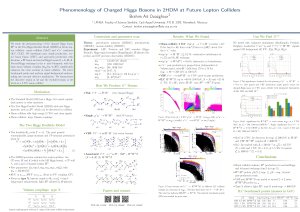
In this presentation, I will synthesize comprehensive investigations into the phenomenology of charged Higgs bosons (H±H^\pmH±) within the framework of the Two-Higgs-Doublet Model (2HDM) at future high-energy lepton colliders. As a direct consequence of extending the Standard Model scalar sector, the discovery of H±H^\pmH± would provide unambiguous evidence for physics beyond the Standard Model and offer deep insights into the mechanism of electroweak symmetry breaking. We specifically focus on the comparative potential of muon (μ+μ−\mu^+\mu^-μ+μ−) and electron–positron (e+e−e^+e^-e+e−) machines, including proposed facilities such as the International Linear Collider (ILC) and the Compact Linear Collider (CLIC). Our analysis covers a broad spectrum of production mechanisms, including:
* Pair and Single Production: μ+μ−→H+H−\mu^+\mu^- \to H^+H^-μ+μ−→H+H− and μ+μ−→W∓H±\mu^+\mu^- \to W^\mp H^\pmμ+μ−→W∓H±.
* Vector Boson Fusion (VBF): ℓ+ℓ−→ννˉH+H−\ell^+\ell^- \to \nu\bar{\nu}H^+H^-ℓ+ℓ−→ννˉH+H−, demonstrating that VBF becomes highly competitive with, and often surpasses, $2 \to 2$ processes at multi-TeV center-of-mass energies.
* Associated Production: ℓ+ℓ−→τ+ντH−\ell^+\ell^- \to \tau^+\nu_\tau H^-ℓ+ℓ−→τ+ντH−, ℓ+ℓ−→tbˉH−\ell^+\ell^- \to t\bar{b}H^-ℓ+ℓ−→tbˉH−, and production associated with neutral Higgs bosons (S=h,H,AS = h, H, AS=h,H,A) or ZZZ bosons.
A key finding of our research is the significant enhancement in production cross-sections at muon colliders. This is primarily attributed to the exchange of neutral Higgs bosons and unique sss-channel and ttt-channel diagrams, which leverage the significantly larger Yukawa couplings of the muon (mμ/me≈207m_\mu/m_e \approx 207mμ/me≈207) compared to the electron. Furthermore, we explore how specific symmetries, such as the discrete Z2Z_2Z2 symmetry typically imposed to suppress flavor-changing neutral currents, influence the observed cross sections and branching ratios. We present updated results for various center-of-mass energies ranging from 500 GeV to 3 TeV, evaluating the sensitivity to different parameter spaces of the model. These findings highlight the critical role of muon colliders in exploring the scalar sector of the 2HDM with unprecedented precision and its implications for the underlying symmetries of nature.
Keywords
Standard model
charged Higgs boson
Two-Higgs-Doublet Model
Lepton Colliders
Poster
Brahim_Ait_Ouazghour.pdf
Probing Charged Scalars at Photon Colliders: One-Loop Effects in the Inert Doublet Model
Origin of the Covariant Wigner Operator as a Quantum Amplitude in QCD