Event submissions
Published
This submission belongs to the session S2. Chemical Processes and Systems of the event The 5th International Electronic Conference on Processes
Published date
15 Oct, 2026
Academic Editor
'%3e%3cpath%20d='M12.6657%2010.9104C12.4185%2010.325%2012.0599%209.79327%2011.6097%209.34482C11.1609%208.89508%2010.6293%208.5365%2010.0442%208.28888C10.0389%208.28626%2010.0337%208.28495%2010.0285%208.28233C10.8446%207.69279%2011.3752%206.73249%2011.3752%205.64904C11.3752%203.8542%209.92103%202.39999%208.1262%202.39999C6.33136%202.39999%204.87715%203.8542%204.87715%205.64904C4.87715%206.73249%205.40774%207.69279%206.22393%208.28364C6.21869%208.28626%206.21345%208.28757%206.20821%208.29019C5.62129%208.5378%205.09463%208.89284%204.64265%209.34613C4.1929%209.79493%203.83432%2010.3266%203.58671%2010.9117C3.34345%2011.4845%203.21226%2012.0987%203.20023%2012.7209C3.19988%2012.7349%203.20233%2012.7488%203.20744%2012.7619C3.21255%2012.7749%203.22022%2012.7867%203.22998%2012.7968C3.23975%2012.8068%203.25142%2012.8147%203.26431%2012.8202C3.2772%2012.8256%203.29105%2012.8284%203.30504%2012.8284H4.09109C4.14874%2012.8284%204.19459%2012.7825%204.1959%2012.7262C4.2221%2011.7148%204.62823%2010.7676%205.34617%2010.0497C6.08899%209.30683%207.0755%208.89808%208.1262%208.89808C9.17689%208.89808%2010.1634%209.30683%2010.9062%2010.0497C11.6242%2010.7676%2012.0303%2011.7148%2012.0565%2012.7262C12.0578%2012.7838%2012.1037%2012.8284%2012.1613%2012.8284H12.9474C12.9613%2012.8284%2012.9752%2012.8256%2012.9881%2012.8202C13.001%2012.8147%2013.0126%2012.8068%2013.0224%2012.7968C13.0322%2012.7867%2013.0398%2012.7749%2013.0449%2012.7619C13.0501%2012.7488%2013.0525%2012.7349%2013.0522%2012.7209C13.0391%2012.0947%2012.9094%2011.4855%2012.6657%2010.9104ZM8.1262%207.9024C7.52486%207.9024%206.9589%207.6679%206.53312%207.24211C6.10733%206.81633%205.87283%206.25037%205.87283%205.64904C5.87283%205.0477%206.10733%204.48174%206.53312%204.05596C6.9589%203.63018%207.52486%203.39567%208.1262%203.39567C8.72753%203.39567%209.29349%203.63018%209.71927%204.05596C10.1451%204.48174%2010.3796%205.0477%2010.3796%205.64904C10.3796%206.25037%2010.1451%206.81633%209.71927%207.24211C9.29349%207.6679%208.72753%207.9024%208.1262%207.9024Z'%20fill='%235D1EE1'/%3e%3c/g%3e%3c/svg%3e) Blaž Likozar
Blaž LikozarCitation
Angelina Morkel , Alina Gordienko, ISOLATION OF AN Α-AMYLASE FRACTION FROM THE CULTURE LIQUID OF A PSYCHROTROPHIC BACTERIAL ISOLATE DERIVED FROM THE BODY CAVITY OF THE CALIFORNIA RED WORM (EISENIA FETIDA), in Proceedings of The 5th International Electronic Conference on Processes, 20 October–22 October 2026, MDPI: Basel, Switzerland
Share
Email
Facebook
Twitter
LinkedIn
ISOLATION OF AN Α-AMYLASE FRACTION FROM THE CULTURE LIQUID OF A PSYCHROTROPHIC BACTERIAL ISOLATE DERIVED FROM THE BODY CAVITY OF THE CALIFORNIA RED WORM (EISENIA FETIDA)
'%3e%3cpath%20d='M12.6647%2010.9104C12.4176%2010.325%2012.0589%209.7933%2011.6088%209.34485C11.16%208.89511%2010.6283%208.53653%2010.0432%208.28891C10.038%208.28629%2010.0327%208.28498%2010.0275%208.28236C10.8437%207.69282%2011.3743%206.73252%2011.3743%205.64907C11.3743%203.85423%209.92005%202.40002%208.12522%202.40002C6.33038%202.40002%204.87618%203.85423%204.87618%205.64907C4.87618%206.73252%205.40677%207.69282%206.22296%208.28367C6.21772%208.28629%206.21248%208.2876%206.20724%208.29022C5.62031%208.53783%205.09365%208.89287%204.64167%209.34616C4.19192%209.79496%203.83334%2010.3266%203.58573%2010.9117C3.34247%2011.4846%203.21128%2012.0987%203.19925%2012.721C3.1989%2012.735%203.20135%2012.7489%203.20646%2012.7619C3.21157%2012.7749%203.21924%2012.7868%203.22901%2012.7968C3.23877%2012.8068%203.25045%2012.8148%203.26334%2012.8202C3.27623%2012.8256%203.29007%2012.8284%203.30406%2012.8284H4.09012C4.14776%2012.8284%204.19362%2012.7825%204.19493%2012.7262C4.22113%2011.7148%204.62726%2010.7676%205.34519%2010.0497C6.08802%209.30686%207.07452%208.89811%208.12522%208.89811C9.17592%208.89811%2010.1624%209.30686%2010.9052%2010.0497C11.6232%2010.7676%2012.0293%2011.7148%2012.0555%2012.7262C12.0568%2012.7839%2012.1027%2012.8284%2012.1603%2012.8284H12.9464C12.9604%2012.8284%2012.9742%2012.8256%2012.9871%2012.8202C13%2012.8148%2013.0117%2012.8068%2013.0214%2012.7968C13.0312%2012.7868%2013.0389%2012.7749%2013.044%2012.7619C13.0491%2012.7489%2013.0515%2012.735%2013.0512%2012.721C13.0381%2012.0947%2012.9084%2011.4856%2012.6647%2010.9104ZM8.12522%207.90243C7.52388%207.90243%206.95792%207.66793%206.53214%207.24215C6.10636%206.81636%205.87185%206.2504%205.87185%205.64907C5.87185%205.04773%206.10636%204.48177%206.53214%204.05599C6.95792%203.63021%207.52388%203.3957%208.12522%203.3957C8.72655%203.3957%209.29252%203.63021%209.7183%204.05599C10.1441%204.48177%2010.3786%205.04773%2010.3786%205.64907C10.3786%206.2504%2010.1441%206.81636%209.7183%207.24215C9.29252%207.66793%208.72655%207.90243%208.12522%207.90243Z'%20fill='%235D1EE1'/%3e%3c/g%3e%3c/svg%3e)
Angelina Morkel 1
Alina Gordienko 1
1. Department of Biotechnology, Institute of Pharmacy, Chemistry and Biology, Federal State Autonomous Educational Institution of Higher Education "Belgorod State National Research University", Belgorod, 308015, Russia
Abstract
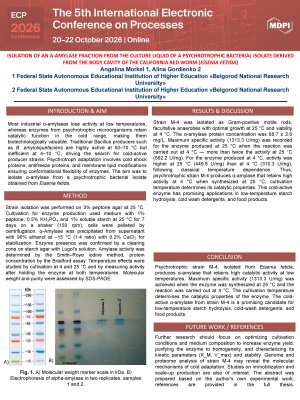
Most industrial α-amylases lose activity at low temperatures, whereas enzymes from psychrotrophic microorganisms retain catalytic function in the cold range, making them biotechnologically valuable. Traditional Bacillus producers B. amyloliquefaciens are highly active at 50–70 °C but inefficient at 4–10 °C, driving the search for cold-active producer strains. Psychrotroph adaptation involves cold shock proteins, antifreeze proteins, and membrane lipid modifications ensuring conformational flexibility of enzymes. The aim was to isolate α‑amylase from a psychrotrophic bacterial isolate obtained from *Eisenia fetida*. Strain isolation was performed on 3% peptone agar at 25 °C. Cultivation for enzyme production used medium with 1% peptone, 0.5% KH₂PO₄ and 1% soluble starch at 25 °C for 7 days on a shaker (150 rpm); cells were pelleted by centrifugation. α‑Amylase was precipitated from supernatant with 96% ethanol at –15 °C (1:4 ratio) with 0.2% CaCl₂ for stabilization. Enzyme presence was confirmed by a clearing zone on starch agar with Lugol's solution. Amylase activity was determined by the Smith–Roye iodine method, protein concentration by the Bradford assay. Temperature effects were studied by cultivation at 4 and 25 °C and by measuring activity after holding the enzyme at both temperatures. Molecular weight and purity were assessed by SDS‑PAGE. Strain M‑4 was isolated as Gram‑positive motile rods, facultative anaerobes with optimal growth at 25 °C and viability at 4 °C. The α‑amylase protein concentration was 66.7 ± 2.6 mg/L. Maximum specific activity (1313.3 U/mg) was recorded for the enzyme produced at 25 °C when the reaction was carried out at 4 °C more than twice the activity at 25 °C (562.2 U/mg). For the enzyme produced at 4 °C, activity was higher at 25 °C (449.8 U/mg) than at 4 °C (310.3 U/mg), following classical temperature dependence. Thus, psychrotrophic strain M‑4 produces α‑amylase that retains high activity at 4 °C when synthesized at 25 °C; cultivation temperature determines its catalytic properties. This cold‑active enzyme has promising applications in low‑temperature starch hydrolysis, cold‑wash detergents, food products.
Keywords
ISOLATION OF AN Α-AMYLASE FRACTION FROM THE CULTURE LIQUID OF A PSYCHROTROPHIC BACTERIAL ISOLATE DERIVED FROM THE BODY CAVITY OF THE CALIFORNIA RED WORM (EISENIA FETIDA)
Poster
Morkel A.R..pdf
Obtaining of 2,2,2-trifluoroethyl-2,2,2-trifluoroacetate via reactive distillation
Study on Suppression of the Reaction between Incineration Ash and Water Using Heating Temperature and Cooling Temperature Variations