Event submissions
Published
This submission belongs to the session S2. Chemical Processes and Systems of the event The 5th International Electronic Conference on Processes
Published date
15 Oct, 2026
Academic Editor
'%3e%3cpath%20d='M12.6657%2010.9104C12.4185%2010.325%2012.0599%209.79327%2011.6097%209.34482C11.1609%208.89508%2010.6293%208.5365%2010.0442%208.28888C10.0389%208.28626%2010.0337%208.28495%2010.0285%208.28233C10.8446%207.69279%2011.3752%206.73249%2011.3752%205.64904C11.3752%203.8542%209.92103%202.39999%208.1262%202.39999C6.33136%202.39999%204.87715%203.8542%204.87715%205.64904C4.87715%206.73249%205.40774%207.69279%206.22393%208.28364C6.21869%208.28626%206.21345%208.28757%206.20821%208.29019C5.62129%208.5378%205.09463%208.89284%204.64265%209.34613C4.1929%209.79493%203.83432%2010.3266%203.58671%2010.9117C3.34345%2011.4845%203.21226%2012.0987%203.20023%2012.7209C3.19988%2012.7349%203.20233%2012.7488%203.20744%2012.7619C3.21255%2012.7749%203.22022%2012.7867%203.22998%2012.7968C3.23975%2012.8068%203.25142%2012.8147%203.26431%2012.8202C3.2772%2012.8256%203.29105%2012.8284%203.30504%2012.8284H4.09109C4.14874%2012.8284%204.19459%2012.7825%204.1959%2012.7262C4.2221%2011.7148%204.62823%2010.7676%205.34617%2010.0497C6.08899%209.30683%207.0755%208.89808%208.1262%208.89808C9.17689%208.89808%2010.1634%209.30683%2010.9062%2010.0497C11.6242%2010.7676%2012.0303%2011.7148%2012.0565%2012.7262C12.0578%2012.7838%2012.1037%2012.8284%2012.1613%2012.8284H12.9474C12.9613%2012.8284%2012.9752%2012.8256%2012.9881%2012.8202C13.001%2012.8147%2013.0126%2012.8068%2013.0224%2012.7968C13.0322%2012.7867%2013.0398%2012.7749%2013.0449%2012.7619C13.0501%2012.7488%2013.0525%2012.7349%2013.0522%2012.7209C13.0391%2012.0947%2012.9094%2011.4855%2012.6657%2010.9104ZM8.1262%207.9024C7.52486%207.9024%206.9589%207.6679%206.53312%207.24211C6.10733%206.81633%205.87283%206.25037%205.87283%205.64904C5.87283%205.0477%206.10733%204.48174%206.53312%204.05596C6.9589%203.63018%207.52486%203.39567%208.1262%203.39567C8.72753%203.39567%209.29349%203.63018%209.71927%204.05596C10.1451%204.48174%2010.3796%205.0477%2010.3796%205.64904C10.3796%206.25037%2010.1451%206.81633%209.71927%207.24211C9.29349%207.6679%208.72753%207.9024%208.1262%207.9024Z'%20fill='%235D1EE1'/%3e%3c/g%3e%3c/svg%3e) Blaž Likozar
Blaž LikozarCitation
Khayitali Adinaev, Zafar Turakulov, Optimization of Gold Leaching from Roasted Pyrite in a Sodium Thiosulfate–Copper Sulfate System, in Proceedings of The 5th International Electronic Conference on Processes, 20 October–22 October 2026, MDPI: Basel, Switzerland
Share
Email
Facebook
Twitter
LinkedIn
Optimization of Gold Leaching from Roasted Pyrite in a Sodium Thiosulfate–Copper Sulfate System
'%3e%3cpath%20d='M12.6647%2010.9104C12.4176%2010.325%2012.0589%209.7933%2011.6088%209.34485C11.16%208.89511%2010.6283%208.53653%2010.0432%208.28891C10.038%208.28629%2010.0327%208.28498%2010.0275%208.28236C10.8437%207.69282%2011.3743%206.73252%2011.3743%205.64907C11.3743%203.85423%209.92005%202.40002%208.12522%202.40002C6.33038%202.40002%204.87618%203.85423%204.87618%205.64907C4.87618%206.73252%205.40677%207.69282%206.22296%208.28367C6.21772%208.28629%206.21248%208.2876%206.20724%208.29022C5.62031%208.53783%205.09365%208.89287%204.64167%209.34616C4.19192%209.79496%203.83334%2010.3266%203.58573%2010.9117C3.34247%2011.4846%203.21128%2012.0987%203.19925%2012.721C3.1989%2012.735%203.20135%2012.7489%203.20646%2012.7619C3.21157%2012.7749%203.21924%2012.7868%203.22901%2012.7968C3.23877%2012.8068%203.25045%2012.8148%203.26334%2012.8202C3.27623%2012.8256%203.29007%2012.8284%203.30406%2012.8284H4.09012C4.14776%2012.8284%204.19362%2012.7825%204.19493%2012.7262C4.22113%2011.7148%204.62726%2010.7676%205.34519%2010.0497C6.08802%209.30686%207.07452%208.89811%208.12522%208.89811C9.17592%208.89811%2010.1624%209.30686%2010.9052%2010.0497C11.6232%2010.7676%2012.0293%2011.7148%2012.0555%2012.7262C12.0568%2012.7839%2012.1027%2012.8284%2012.1603%2012.8284H12.9464C12.9604%2012.8284%2012.9742%2012.8256%2012.9871%2012.8202C13%2012.8148%2013.0117%2012.8068%2013.0214%2012.7968C13.0312%2012.7868%2013.0389%2012.7749%2013.044%2012.7619C13.0491%2012.7489%2013.0515%2012.735%2013.0512%2012.721C13.0381%2012.0947%2012.9084%2011.4856%2012.6647%2010.9104ZM8.12522%207.90243C7.52388%207.90243%206.95792%207.66793%206.53214%207.24215C6.10636%206.81636%205.87185%206.2504%205.87185%205.64907C5.87185%205.04773%206.10636%204.48177%206.53214%204.05599C6.95792%203.63021%207.52388%203.3957%208.12522%203.3957C8.72655%203.3957%209.29252%203.63021%209.7183%204.05599C10.1441%204.48177%2010.3786%205.04773%2010.3786%205.64907C10.3786%206.2504%2010.1441%206.81636%209.7183%207.24215C9.29252%207.66793%208.72655%207.90243%208.12522%207.90243Z'%20fill='%235D1EE1'/%3e%3c/g%3e%3c/svg%3e)
Khayitali Adinaev 1

Zafar Turakulov 2
1. Institute of General and Inorganic Chemistry of the Academy of Sciences of the Republic of Uzbekistan, Tashkent, Uzbekistan
2. Department of Automation and Digital Control, Tashkent Institute of Chemical Technology, Tashkent, Uzbekistan
Abstract
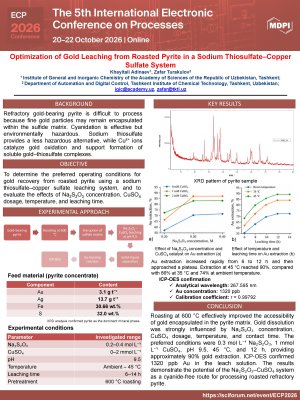
The development of environmentally safer alternatives to cyanidation is particularly important for processing refractory gold-bearing sulfide materials. This study investigates the effects of key operating parameters on gold extraction from roasted pyrite using a sodium thiosulfate–copper sulfate leaching system. The initial pyrite sample contained 3.1 g t⁻¹ Au, 13.7 g t⁻¹ Ag, 30.66 wt.% Fe, and 32.0 wt.% S. X-ray diffraction analysis confirmed that pyrite was the dominant mineral phase. To disrupt the sulfide matrix and improve gold accessibility, the sample was roasted at 600 °C before leaching. Experiments were conducted at pH 9.5 using 0.2–0.4 mol L⁻¹ Na₂S₂O₃, 0–2 mmol L⁻¹ CuSO₄, temperatures ranging from ambient conditions to 45 °C, and leaching times of 6–14 h. Gold dissolution increased substantially when the thiosulfate concentration was raised from 0.2 to 0.3 mol L⁻¹, whereas a further increase to 0.4 mol L⁻¹ produced no significant improvement. The addition of 1 mmol L⁻¹ CuSO₄ enhanced gold oxidation and increased extraction from approximately 68% to 88% at 0.3 mol L⁻¹ Na₂S₂O₃. Increasing the CuSO₄ concentration to 2 mmol L⁻¹ slightly reduced extraction, presumably because excessive Cu²⁺ promoted thiosulfate degradation. Temperature and contact time also significantly affected the process. Gold extraction increased from approximately 74% at ambient temperature to nearly 90% at 45 °C, with the extraction curve approaching a plateau after 12 h. ICP-OES analysis at 267.595 nm detected 1320 ppb Au in the optimized leach solution, with a calibration correlation coefficient of 0.99792. The results identify 0.3 mol L⁻¹ Na₂S₂O₃, 1 mmol L⁻¹ CuSO₄, pH 9.5, 45 °C, and 12 h as the preferred operating conditions for gold recovery from roasted pyrite.
Keywords
refractory gold
pyrite roasting
sodium thiosulfate
copper-catalysed leaching
process optimization
ICP-OES
X-ray diffraction
Poster
Poster 3.pdf
Effect of Ashless Polymer Binders on the Strength and Leaching Behaviour of Pelletized Pyrite Concentrate
Self-Healing and Protective Performance of Protonated versus Undoped Polyaniline@Alginate Coatings on Steel