Event submissions
Published
This submission belongs to the session S1. Environmental and Green Processes of the event The 5th International Electronic Conference on Processes
Published date
15 Oct, 2026
Academic Editor
'%3e%3cpath%20d='M12.6657%2010.9104C12.4185%2010.325%2012.0599%209.79327%2011.6097%209.34482C11.1609%208.89508%2010.6293%208.5365%2010.0442%208.28888C10.0389%208.28626%2010.0337%208.28495%2010.0285%208.28233C10.8446%207.69279%2011.3752%206.73249%2011.3752%205.64904C11.3752%203.8542%209.92103%202.39999%208.1262%202.39999C6.33136%202.39999%204.87715%203.8542%204.87715%205.64904C4.87715%206.73249%205.40774%207.69279%206.22393%208.28364C6.21869%208.28626%206.21345%208.28757%206.20821%208.29019C5.62129%208.5378%205.09463%208.89284%204.64265%209.34613C4.1929%209.79493%203.83432%2010.3266%203.58671%2010.9117C3.34345%2011.4845%203.21226%2012.0987%203.20023%2012.7209C3.19988%2012.7349%203.20233%2012.7488%203.20744%2012.7619C3.21255%2012.7749%203.22022%2012.7867%203.22998%2012.7968C3.23975%2012.8068%203.25142%2012.8147%203.26431%2012.8202C3.2772%2012.8256%203.29105%2012.8284%203.30504%2012.8284H4.09109C4.14874%2012.8284%204.19459%2012.7825%204.1959%2012.7262C4.2221%2011.7148%204.62823%2010.7676%205.34617%2010.0497C6.08899%209.30683%207.0755%208.89808%208.1262%208.89808C9.17689%208.89808%2010.1634%209.30683%2010.9062%2010.0497C11.6242%2010.7676%2012.0303%2011.7148%2012.0565%2012.7262C12.0578%2012.7838%2012.1037%2012.8284%2012.1613%2012.8284H12.9474C12.9613%2012.8284%2012.9752%2012.8256%2012.9881%2012.8202C13.001%2012.8147%2013.0126%2012.8068%2013.0224%2012.7968C13.0322%2012.7867%2013.0398%2012.7749%2013.0449%2012.7619C13.0501%2012.7488%2013.0525%2012.7349%2013.0522%2012.7209C13.0391%2012.0947%2012.9094%2011.4855%2012.6657%2010.9104ZM8.1262%207.9024C7.52486%207.9024%206.9589%207.6679%206.53312%207.24211C6.10733%206.81633%205.87283%206.25037%205.87283%205.64904C5.87283%205.0477%206.10733%204.48174%206.53312%204.05596C6.9589%203.63018%207.52486%203.39567%208.1262%203.39567C8.72753%203.39567%209.29349%203.63018%209.71927%204.05596C10.1451%204.48174%2010.3796%205.0477%2010.3796%205.64904C10.3796%206.25037%2010.1451%206.81633%209.71927%207.24211C9.29349%207.6679%208.72753%207.9024%208.1262%207.9024Z'%20fill='%235D1EE1'/%3e%3c/g%3e%3c/svg%3e) Juan Francisco García Martín
Juan Francisco García MartínCitation
Marwa Elkady, Hassan shokry, Joshua Anani, Self-Healing and Protective Performance of Protonated versus Undoped Polyaniline@Alginate Coatings on Steel, in Proceedings of The 5th International Electronic Conference on Processes, 20 October–22 October 2026, MDPI: Basel, Switzerland
Share
Email
Facebook
Twitter
LinkedIn
Self-Healing and Protective Performance of Protonated versus Undoped Polyaniline@Alginate Coatings on Steel

Marwa Elkady 1

Hassan shokry 1

Joshua Anani 2
1. Chemical and Petrochemical Engineering Department, Egypt-Japan University of Science and Technology (E-JUST), New Borg El Arab City, Alexandria, 21934, Egypt
2. Environmental Engineering Department, Egypt-Japan University of Science and Technology (E-JUST), New Borg El Arab City, Alexandria, 21934, Egypt
Abstract
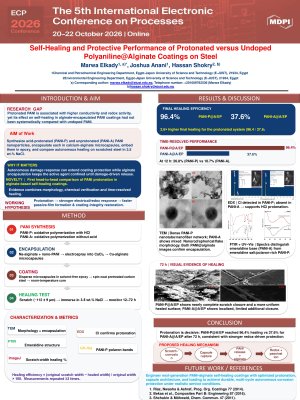
Self-healing polymeric coatings have emerged as an effective strategy for extending the service life of steel structures by autonomously repairing coating defects and mitigating corrosion. Among conductive polymers, polyaniline (PANI) has attracted considerable attention owing to its excellent redox activity and corrosion-inhibiting capability. However, the influence of PANI protonation on the self-healing performance of encapsulated coating systems has not been systematically investigated. In this study, protonated polyaniline (PANI-P) and unprotonated polyaniline (PANI-A) nanoparticles were synthesized through oxidative polymerization and subsequently encapsulated within calcium alginate microcapsules using an electrospraying technique. The prepared nanomaterials and composite microcapsules were comprehensively characterized by scanning electron microscopy (SEM), transmission electron microscopy (TEM), energy-dispersive X-ray spectroscopy (EDX), Fourier transform infrared spectroscopy (FTIR), and UV–Vis spectroscopy to confirm their morphology, chemical structure, elemental composition, and successful encapsulation. The microcapsules were then incorporated into epoxy coatings, and their self-healing performance was evaluated on scratched carbon steel substrates immersed in 3.5 wt.% NaCl solution. Both coating systems exhibited autonomous healing behavior through the controlled release of encapsulated PANI following microcapsule rupture. However, the PANI- P@Alginate/epoxy coating demonstrated significantly superior healing kinetics and corrosion protection, achieving a self-healing efficiency of 96.4% after 72 h, compared with only 37.6% for the PANI-A@Alginate/epoxy coating. The enhanced performance of the protonated system is attributed to its higher electrical conductivity and redox activity, which promote rapid passive film formation and restoration of coating integrity. These findings provide the first comparative evidence of the critical role of PANI protonation in alginate-based self-healing coatings and demonstrate the significant potential of protonated PANI microcapsules for developing durable, environmentally friendly anticorrosion coatings for steel infrastructures operating in aggressive environments.
Keywords
Polyaniline
Protonation
Self-healing coatings
Alginate microcapsules
Steel corrosion protection
Epoxy coatings
Poster
poster Sciforum-204557-6-10-2026.pdf
Optimization of Gold Leaching from Roasted Pyrite in a Sodium Thiosulfate–Copper Sulfate System
Comparative Evaluation of Cyanide-Free Lixiviant Systems for Gold Recovery from Pyrite Concentrate