Event submissions
Published
This submission belongs to the session S2. Chemical Processes and Systems of the event The 5th International Electronic Conference on Processes
Published date
15 Oct, 2026
Academic Editor
'%3e%3cpath%20d='M12.6657%2010.9104C12.4185%2010.325%2012.0599%209.79327%2011.6097%209.34482C11.1609%208.89508%2010.6293%208.5365%2010.0442%208.28888C10.0389%208.28626%2010.0337%208.28495%2010.0285%208.28233C10.8446%207.69279%2011.3752%206.73249%2011.3752%205.64904C11.3752%203.8542%209.92103%202.39999%208.1262%202.39999C6.33136%202.39999%204.87715%203.8542%204.87715%205.64904C4.87715%206.73249%205.40774%207.69279%206.22393%208.28364C6.21869%208.28626%206.21345%208.28757%206.20821%208.29019C5.62129%208.5378%205.09463%208.89284%204.64265%209.34613C4.1929%209.79493%203.83432%2010.3266%203.58671%2010.9117C3.34345%2011.4845%203.21226%2012.0987%203.20023%2012.7209C3.19988%2012.7349%203.20233%2012.7488%203.20744%2012.7619C3.21255%2012.7749%203.22022%2012.7867%203.22998%2012.7968C3.23975%2012.8068%203.25142%2012.8147%203.26431%2012.8202C3.2772%2012.8256%203.29105%2012.8284%203.30504%2012.8284H4.09109C4.14874%2012.8284%204.19459%2012.7825%204.1959%2012.7262C4.2221%2011.7148%204.62823%2010.7676%205.34617%2010.0497C6.08899%209.30683%207.0755%208.89808%208.1262%208.89808C9.17689%208.89808%2010.1634%209.30683%2010.9062%2010.0497C11.6242%2010.7676%2012.0303%2011.7148%2012.0565%2012.7262C12.0578%2012.7838%2012.1037%2012.8284%2012.1613%2012.8284H12.9474C12.9613%2012.8284%2012.9752%2012.8256%2012.9881%2012.8202C13.001%2012.8147%2013.0126%2012.8068%2013.0224%2012.7968C13.0322%2012.7867%2013.0398%2012.7749%2013.0449%2012.7619C13.0501%2012.7488%2013.0525%2012.7349%2013.0522%2012.7209C13.0391%2012.0947%2012.9094%2011.4855%2012.6657%2010.9104ZM8.1262%207.9024C7.52486%207.9024%206.9589%207.6679%206.53312%207.24211C6.10733%206.81633%205.87283%206.25037%205.87283%205.64904C5.87283%205.0477%206.10733%204.48174%206.53312%204.05596C6.9589%203.63018%207.52486%203.39567%208.1262%203.39567C8.72753%203.39567%209.29349%203.63018%209.71927%204.05596C10.1451%204.48174%2010.3796%205.0477%2010.3796%205.64904C10.3796%206.25037%2010.1451%206.81633%209.71927%207.24211C9.29349%207.6679%208.72753%207.9024%208.1262%207.9024Z'%20fill='%235D1EE1'/%3e%3c/g%3e%3c/svg%3e) Blaž Likozar
Blaž LikozarCitation
Yusuf Jo'raqobilovich Boysariyev, Synthesis, Physicochemical Characterization, and Stimuli-Responsive Swelling Behavior of Superabsorbent Polymer Hydrogels Based on Hydrolyzed Polyacrylonitrile and Polyacrylamide for Multisectoral Applications, in Proceedings of The 5th International Electronic Conference on Processes, 20 October–22 October 2026, MDPI: Basel, Switzerland
Share
Email
Facebook
Twitter
LinkedIn
Synthesis, Physicochemical Characterization, and Stimuli-Responsive Swelling Behavior of Superabsorbent Polymer Hydrogels Based on Hydrolyzed Polyacrylonitrile and Polyacrylamide for Multisectoral Applications
'%3e%3cpath%20d='M12.6647%2010.9104C12.4176%2010.325%2012.0589%209.7933%2011.6088%209.34485C11.16%208.89511%2010.6283%208.53653%2010.0432%208.28891C10.038%208.28629%2010.0327%208.28498%2010.0275%208.28236C10.8437%207.69282%2011.3743%206.73252%2011.3743%205.64907C11.3743%203.85423%209.92005%202.40002%208.12522%202.40002C6.33038%202.40002%204.87618%203.85423%204.87618%205.64907C4.87618%206.73252%205.40677%207.69282%206.22296%208.28367C6.21772%208.28629%206.21248%208.2876%206.20724%208.29022C5.62031%208.53783%205.09365%208.89287%204.64167%209.34616C4.19192%209.79496%203.83334%2010.3266%203.58573%2010.9117C3.34247%2011.4846%203.21128%2012.0987%203.19925%2012.721C3.1989%2012.735%203.20135%2012.7489%203.20646%2012.7619C3.21157%2012.7749%203.21924%2012.7868%203.22901%2012.7968C3.23877%2012.8068%203.25045%2012.8148%203.26334%2012.8202C3.27623%2012.8256%203.29007%2012.8284%203.30406%2012.8284H4.09012C4.14776%2012.8284%204.19362%2012.7825%204.19493%2012.7262C4.22113%2011.7148%204.62726%2010.7676%205.34519%2010.0497C6.08802%209.30686%207.07452%208.89811%208.12522%208.89811C9.17592%208.89811%2010.1624%209.30686%2010.9052%2010.0497C11.6232%2010.7676%2012.0293%2011.7148%2012.0555%2012.7262C12.0568%2012.7839%2012.1027%2012.8284%2012.1603%2012.8284H12.9464C12.9604%2012.8284%2012.9742%2012.8256%2012.9871%2012.8202C13%2012.8148%2013.0117%2012.8068%2013.0214%2012.7968C13.0312%2012.7868%2013.0389%2012.7749%2013.044%2012.7619C13.0491%2012.7489%2013.0515%2012.735%2013.0512%2012.721C13.0381%2012.0947%2012.9084%2011.4856%2012.6647%2010.9104ZM8.12522%207.90243C7.52388%207.90243%206.95792%207.66793%206.53214%207.24215C6.10636%206.81636%205.87185%206.2504%205.87185%205.64907C5.87185%205.04773%206.10636%204.48177%206.53214%204.05599C6.95792%203.63021%207.52388%203.3957%208.12522%203.3957C8.72655%203.3957%209.29252%203.63021%209.7183%204.05599C10.1441%204.48177%2010.3786%205.04773%2010.3786%205.64907C10.3786%206.2504%2010.1441%206.81636%209.7183%207.24215C9.29252%207.66793%208.72655%207.90243%208.12522%207.90243Z'%20fill='%235D1EE1'/%3e%3c/g%3e%3c/svg%3e)
Yusuf Jo'raqobilovich Boysariyev 1
1. Department of Automation and Digital Control, Faculty of Industrial Engineering, Tashkent Institute of Chemical Technology, Tashkent, 100011, Uzbekistan.
Abstract
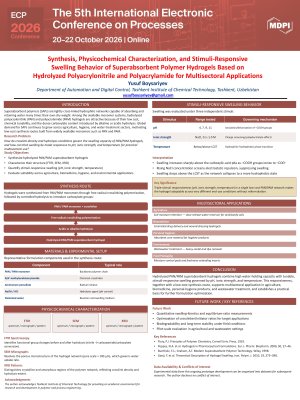
Superabsorbent polymer hydrogels (SAPs) are advanced intelligent materials widely utilized in biomedicine, agriculture, civil engineering, and petroleum extraction due to their exceptional fluid retention. This study synthesized and systematically characterized crosslinked hydrogels based on hydrolyzed polyacrylonitrile (HPAN) and polyacrylamide (PAA). Using formaldehyde and sulfuric acid as crosslinking agents, the investigation comprehensively analyzed the impact of pH, ionic strength, and solvent composition on equilibrium and kinetic swelling behavior via gravimetric analysis.
The synthesized hydrogels demonstrated outstanding superabsorbent properties, achieving equilibrium swelling ratios of 80 to 120 g/g in distilled water. Kinetic modeling revealed a biphasic swelling mechanism: an initial rapid diffusion phase within the first two hours, followed by a slower polymer-chain relaxation phase reaching ultimate equilibrium between 24 and 48 hours.
Swelling capacity exhibited a pronounced dependence on external stimuli:
-
Ionic Strength: Increasing the KCl concentration from 0.001 N to 1 N triggered a 2- to 3-fold reduction in swelling. This is attributed to the charge-screening effect, which shields and diminishes electrostatic repulsions among ionized carboxylate groups within the polymer network.
-
pH-Responsiveness: The hydrogels displayed significant sensitivity to pH, with maximum swelling peaks observed in both highly acidic and strongly alkaline media (0.1 N HCl, 0.1 N NaOH, and 5% ) driven by the dissociation dynamics of carboxylic acid groups.
-
Solvent Composition: In water-organic solvent mixtures, increasing the fractions of ethanol or acetone systematically decreased swelling capacity due to lowered dielectric constants and reduced thermodynamic affinity for the hydrophilic chains.
These findings firmly establish the synthesized HPAN/PAA hydrogels as stimuli-responsive "smart" materials with highly controllable swelling behavior. Practically, this research provides a fundamental framework for tailoring hydrogels for critical applications, including selective water shut-off in petroleum wells, soil moisture retention in agriculture, and advanced biocompatible drug delivery systems.
Keywords
Keywords: superabsorbent hydrogels
swelling kinetics
polyacrylonitrile
polyacrylamide
stimuli-responsive polymers
ionic strength effect
pH sensitivity
enhanced oil recovery
agricultural water management
biomedical materials
Poster
201100Poster_Hydrogel_Boysariyev.pdf
Recovery of High-Purity α-Alumina from Thermal Power Plant Ash via Sodium Carbonate Roasting and Seeded Precipitation
A Comparative Study of Ultrasound and Cold Plasma Processing on Egg White Protein–Oil Palm Leaf Polyphenol Conjugates for Improved Functional Characteristics