Event submissions
Published
This submission belongs to the session S1. Environmental and Green Processes of the event The 5th International Electronic Conference on Processes
Published date
15 Oct, 2026
Academic Editor
'%3e%3cpath%20d='M12.6657%2010.9104C12.4185%2010.325%2012.0599%209.79327%2011.6097%209.34482C11.1609%208.89508%2010.6293%208.5365%2010.0442%208.28888C10.0389%208.28626%2010.0337%208.28495%2010.0285%208.28233C10.8446%207.69279%2011.3752%206.73249%2011.3752%205.64904C11.3752%203.8542%209.92103%202.39999%208.1262%202.39999C6.33136%202.39999%204.87715%203.8542%204.87715%205.64904C4.87715%206.73249%205.40774%207.69279%206.22393%208.28364C6.21869%208.28626%206.21345%208.28757%206.20821%208.29019C5.62129%208.5378%205.09463%208.89284%204.64265%209.34613C4.1929%209.79493%203.83432%2010.3266%203.58671%2010.9117C3.34345%2011.4845%203.21226%2012.0987%203.20023%2012.7209C3.19988%2012.7349%203.20233%2012.7488%203.20744%2012.7619C3.21255%2012.7749%203.22022%2012.7867%203.22998%2012.7968C3.23975%2012.8068%203.25142%2012.8147%203.26431%2012.8202C3.2772%2012.8256%203.29105%2012.8284%203.30504%2012.8284H4.09109C4.14874%2012.8284%204.19459%2012.7825%204.1959%2012.7262C4.2221%2011.7148%204.62823%2010.7676%205.34617%2010.0497C6.08899%209.30683%207.0755%208.89808%208.1262%208.89808C9.17689%208.89808%2010.1634%209.30683%2010.9062%2010.0497C11.6242%2010.7676%2012.0303%2011.7148%2012.0565%2012.7262C12.0578%2012.7838%2012.1037%2012.8284%2012.1613%2012.8284H12.9474C12.9613%2012.8284%2012.9752%2012.8256%2012.9881%2012.8202C13.001%2012.8147%2013.0126%2012.8068%2013.0224%2012.7968C13.0322%2012.7867%2013.0398%2012.7749%2013.0449%2012.7619C13.0501%2012.7488%2013.0525%2012.7349%2013.0522%2012.7209C13.0391%2012.0947%2012.9094%2011.4855%2012.6657%2010.9104ZM8.1262%207.9024C7.52486%207.9024%206.9589%207.6679%206.53312%207.24211C6.10733%206.81633%205.87283%206.25037%205.87283%205.64904C5.87283%205.0477%206.10733%204.48174%206.53312%204.05596C6.9589%203.63018%207.52486%203.39567%208.1262%203.39567C8.72753%203.39567%209.29349%203.63018%209.71927%204.05596C10.1451%204.48174%2010.3796%205.0477%2010.3796%205.64904C10.3796%206.25037%2010.1451%206.81633%209.71927%207.24211C9.29349%207.6679%208.72753%207.9024%208.1262%207.9024Z'%20fill='%235D1EE1'/%3e%3c/g%3e%3c/svg%3e) Juan Francisco García Martín
Juan Francisco García MartínCitation
Muhammad Waqar, Worawan Panpipat, Natasha Abbas Butt, Manat Chaijan, A Comparative Study of Ultrasound and Cold Plasma Processing on Egg White Protein–Oil Palm Leaf Polyphenol Conjugates for Improved Functional Characteristics, in Proceedings of The 5th International Electronic Conference on Processes, 20 October–22 October 2026, MDPI: Basel, Switzerland
Share
Email
Facebook
Twitter
LinkedIn
A Comparative Study of Ultrasound and Cold Plasma Processing on Egg White Protein–Oil Palm Leaf Polyphenol Conjugates for Improved Functional Characteristics

Muhammad Waqar 1
'%3e%3cpath%20d='M12.6647%2010.9104C12.4176%2010.325%2012.0589%209.7933%2011.6088%209.34485C11.16%208.89511%2010.6283%208.53653%2010.0432%208.28891C10.038%208.28629%2010.0327%208.28498%2010.0275%208.28236C10.8437%207.69282%2011.3743%206.73252%2011.3743%205.64907C11.3743%203.85423%209.92005%202.40002%208.12522%202.40002C6.33038%202.40002%204.87618%203.85423%204.87618%205.64907C4.87618%206.73252%205.40677%207.69282%206.22296%208.28367C6.21772%208.28629%206.21248%208.2876%206.20724%208.29022C5.62031%208.53783%205.09365%208.89287%204.64167%209.34616C4.19192%209.79496%203.83334%2010.3266%203.58573%2010.9117C3.34247%2011.4846%203.21128%2012.0987%203.19925%2012.721C3.1989%2012.735%203.20135%2012.7489%203.20646%2012.7619C3.21157%2012.7749%203.21924%2012.7868%203.22901%2012.7968C3.23877%2012.8068%203.25045%2012.8148%203.26334%2012.8202C3.27623%2012.8256%203.29007%2012.8284%203.30406%2012.8284H4.09012C4.14776%2012.8284%204.19362%2012.7825%204.19493%2012.7262C4.22113%2011.7148%204.62726%2010.7676%205.34519%2010.0497C6.08802%209.30686%207.07452%208.89811%208.12522%208.89811C9.17592%208.89811%2010.1624%209.30686%2010.9052%2010.0497C11.6232%2010.7676%2012.0293%2011.7148%2012.0555%2012.7262C12.0568%2012.7839%2012.1027%2012.8284%2012.1603%2012.8284H12.9464C12.9604%2012.8284%2012.9742%2012.8256%2012.9871%2012.8202C13%2012.8148%2013.0117%2012.8068%2013.0214%2012.7968C13.0312%2012.7868%2013.0389%2012.7749%2013.044%2012.7619C13.0491%2012.7489%2013.0515%2012.735%2013.0512%2012.721C13.0381%2012.0947%2012.9084%2011.4856%2012.6647%2010.9104ZM8.12522%207.90243C7.52388%207.90243%206.95792%207.66793%206.53214%207.24215C6.10636%206.81636%205.87185%206.2504%205.87185%205.64907C5.87185%205.04773%206.10636%204.48177%206.53214%204.05599C6.95792%203.63021%207.52388%203.3957%208.12522%203.3957C8.72655%203.3957%209.29252%203.63021%209.7183%204.05599C10.1441%204.48177%2010.3786%205.04773%2010.3786%205.64907C10.3786%206.2504%2010.1441%206.81636%209.7183%207.24215C9.29252%207.66793%208.72655%207.90243%208.12522%207.90243Z'%20fill='%235D1EE1'/%3e%3c/g%3e%3c/svg%3e)
Worawan Panpipat 1
Natasha Abbas Butt 2

Manat Chaijan 1
1. Food Technology and Innovation Research Center of Excellence, School of Agricultural Technology and Food Industry, Walailak University, Thai Buri, Tha Sala, Nakhon Si Thammarat 80160, Thailand
2. Department of Biomedical Engineering, Ziauddin University, Karachi, Pakistan
Abstract
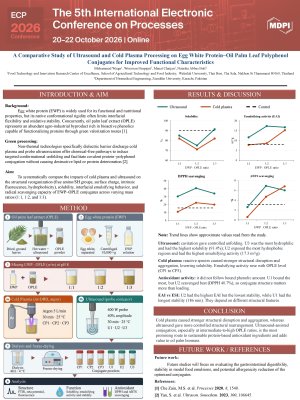
Oil palm leaf extract (OPLE) is an agricultural byproduct rich in phenolic source. Present studyhas utilized OPLE for the green modification of egg white protein (EWP) through cold plasma and ultrasound treatments. OPLE, obtained by hot-water extraction was conjugated with EWP at protein-to-extract mass ratios of 1:1, 1:2, and 1:3. Structural, functional, and antioxidant properties of the resulting conjugates were then evaluated by advanced analytical techniques, including FTIR, Zeta Potential Analyzer, and Fluorescence Spectrophotometer. The two processing routes generated distinct outcomes. Cold plasma caused stronger surface and tertiary perturbation and promoted a more association-prone state, whereas ultrasound induced a more controlled structural reorganization as was evident through changes in zeta potential, tryptophan fluorescence, dityrosine content, surface hydrophobicity, and FTIR profiles. From a techno-functional perspective, ultrasound was more effective overall, giving the highest solubility in U3 (91.40%), the highest emulsifying activity index in U2 (17.34 m²/g), and the strongest antioxidant performance, with DPPH scavenging of 40.7% and ABTS scavenging of 6.9%. In contrast, the highest emulsion stability index was observed in U1 (186.14 min), indicating that emulsion formation and long-term emulsion stability were governed by different structural attributes. Correlation analysis further showed that emulsifying activity was positively associated with antioxidant capacity and negatively associated with tryptophan fluorescence and dityrosine, highlighting a close link between structural rearrangement and functionality. Overall, ultrasound-assisted EWP–OPLE conjugation, particularly at intermediate-to-high OPLE ratios, appears to be the most promising strategy for developing sustainable protein-based antioxidant ingredients while simultaneously valorizing oil palm biomass for food applications.
Keywords
egg white protein
oil palm leaves extract
ultrasound
cold plasma
protein–polyphenol conjugates
antioxidant activity.
Poster
Waqar-EWP-OPLE_Poster_ECP2026.pdf
Synthesis, Physicochemical Characterization, and Stimuli-Responsive Swelling Behavior of Superabsorbent Polymer Hydrogels Based on Hydrolyzed Polyacrylonitrile and Polyacrylamide for Multisectoral Applications
Sensitive Electrochemical Detection of Pb²⁺ and Cd²⁺ in Water Using α-MnO2-Based Electrode Materials