Event submissions
Published
This submission belongs to the session S3. Applied Physics of the event The 1st International Online Conference on Symmetry
Published date
15 Oct, 2026
Academic Editor
'%3e%3cpath%20d='M12.6657%2010.9104C12.4185%2010.325%2012.0599%209.79327%2011.6097%209.34482C11.1609%208.89508%2010.6293%208.5365%2010.0442%208.28888C10.0389%208.28626%2010.0337%208.28495%2010.0285%208.28233C10.8446%207.69279%2011.3752%206.73249%2011.3752%205.64904C11.3752%203.8542%209.92103%202.39999%208.1262%202.39999C6.33136%202.39999%204.87715%203.8542%204.87715%205.64904C4.87715%206.73249%205.40774%207.69279%206.22393%208.28364C6.21869%208.28626%206.21345%208.28757%206.20821%208.29019C5.62129%208.5378%205.09463%208.89284%204.64265%209.34613C4.1929%209.79493%203.83432%2010.3266%203.58671%2010.9117C3.34345%2011.4845%203.21226%2012.0987%203.20023%2012.7209C3.19988%2012.7349%203.20233%2012.7488%203.20744%2012.7619C3.21255%2012.7749%203.22022%2012.7867%203.22998%2012.7968C3.23975%2012.8068%203.25142%2012.8147%203.26431%2012.8202C3.2772%2012.8256%203.29105%2012.8284%203.30504%2012.8284H4.09109C4.14874%2012.8284%204.19459%2012.7825%204.1959%2012.7262C4.2221%2011.7148%204.62823%2010.7676%205.34617%2010.0497C6.08899%209.30683%207.0755%208.89808%208.1262%208.89808C9.17689%208.89808%2010.1634%209.30683%2010.9062%2010.0497C11.6242%2010.7676%2012.0303%2011.7148%2012.0565%2012.7262C12.0578%2012.7838%2012.1037%2012.8284%2012.1613%2012.8284H12.9474C12.9613%2012.8284%2012.9752%2012.8256%2012.9881%2012.8202C13.001%2012.8147%2013.0126%2012.8068%2013.0224%2012.7968C13.0322%2012.7867%2013.0398%2012.7749%2013.0449%2012.7619C13.0501%2012.7488%2013.0525%2012.7349%2013.0522%2012.7209C13.0391%2012.0947%2012.9094%2011.4855%2012.6657%2010.9104ZM8.1262%207.9024C7.52486%207.9024%206.9589%207.6679%206.53312%207.24211C6.10733%206.81633%205.87283%206.25037%205.87283%205.64904C5.87283%205.0477%206.10733%204.48174%206.53312%204.05596C6.9589%203.63018%207.52486%203.39567%208.1262%203.39567C8.72753%203.39567%209.29349%203.63018%209.71927%204.05596C10.1451%204.48174%2010.3796%205.0477%2010.3796%205.64904C10.3796%206.25037%2010.1451%206.81633%209.71927%207.24211C9.29349%207.6679%208.72753%207.9024%208.1262%207.9024Z'%20fill='%235D1EE1'/%3e%3c/g%3e%3c/svg%3e) Joao Pacheco B.C. de Melo
Joao Pacheco B.C. de MeloCitation
Alexander Lyashenko, Vladimir Toporovsky, Oleg Kolesnikov, Ilya Galaktionov, Symmetry breaking in fiber optic connector endface geometry: correction via controlled manual polishing, in Proceedings of The 1st International Online Conference on Symmetry, 20 October–22 October 2026, MDPI: Basel, Switzerland
Share
Email
Facebook
Twitter
LinkedIn
Symmetry breaking in fiber optic connector endface geometry: correction via controlled manual polishing
'%3e%3cpath%20d='M12.6647%2010.9104C12.4176%2010.325%2012.0589%209.7933%2011.6088%209.34485C11.16%208.89511%2010.6283%208.53653%2010.0432%208.28891C10.038%208.28629%2010.0327%208.28498%2010.0275%208.28236C10.8437%207.69282%2011.3743%206.73252%2011.3743%205.64907C11.3743%203.85423%209.92005%202.40002%208.12522%202.40002C6.33038%202.40002%204.87618%203.85423%204.87618%205.64907C4.87618%206.73252%205.40677%207.69282%206.22296%208.28367C6.21772%208.28629%206.21248%208.2876%206.20724%208.29022C5.62031%208.53783%205.09365%208.89287%204.64167%209.34616C4.19192%209.79496%203.83334%2010.3266%203.58573%2010.9117C3.34247%2011.4846%203.21128%2012.0987%203.19925%2012.721C3.1989%2012.735%203.20135%2012.7489%203.20646%2012.7619C3.21157%2012.7749%203.21924%2012.7868%203.22901%2012.7968C3.23877%2012.8068%203.25045%2012.8148%203.26334%2012.8202C3.27623%2012.8256%203.29007%2012.8284%203.30406%2012.8284H4.09012C4.14776%2012.8284%204.19362%2012.7825%204.19493%2012.7262C4.22113%2011.7148%204.62726%2010.7676%205.34519%2010.0497C6.08802%209.30686%207.07452%208.89811%208.12522%208.89811C9.17592%208.89811%2010.1624%209.30686%2010.9052%2010.0497C11.6232%2010.7676%2012.0293%2011.7148%2012.0555%2012.7262C12.0568%2012.7839%2012.1027%2012.8284%2012.1603%2012.8284H12.9464C12.9604%2012.8284%2012.9742%2012.8256%2012.9871%2012.8202C13%2012.8148%2013.0117%2012.8068%2013.0214%2012.7968C13.0312%2012.7868%2013.0389%2012.7749%2013.044%2012.7619C13.0491%2012.7489%2013.0515%2012.735%2013.0512%2012.721C13.0381%2012.0947%2012.9084%2011.4856%2012.6647%2010.9104ZM8.12522%207.90243C7.52388%207.90243%206.95792%207.66793%206.53214%207.24215C6.10636%206.81636%205.87185%206.2504%205.87185%205.64907C5.87185%205.04773%206.10636%204.48177%206.53214%204.05599C6.95792%203.63021%207.52388%203.3957%208.12522%203.3957C8.72655%203.3957%209.29252%203.63021%209.7183%204.05599C10.1441%204.48177%2010.3786%205.04773%2010.3786%205.64907C10.3786%206.2504%2010.1441%206.81636%209.7183%207.24215C9.29252%207.66793%208.72655%207.90243%208.12522%207.90243Z'%20fill='%235D1EE1'/%3e%3c/g%3e%3c/svg%3e)
Alexander Lyashenko 1

Vladimir Toporovsky 2,3
Oleg Kolesnikov 2
Ilya Galaktionov 2,4
1. Optical and quantum communications department, Moscow Technical University of Communications and Informatics, Moscow 111024, Russia
2. Quantum Center, Moscow Technical University of Communications and Informatics, Moscow, 111024, Russia
3. Department of Higher Mathematics, MIREA – Russian Technological University, 78 Vernadsky Avenue, Moscow 119454, Russia
4. Physics Department, Moscow Polytechnic University, Moscow, 107023, Russia
Abstract
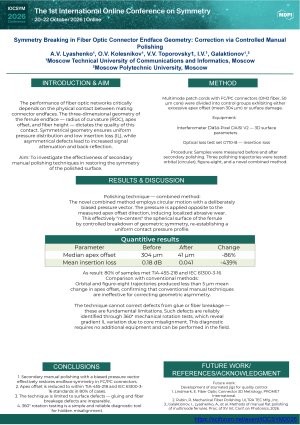
The performance of fiber optic networks critically depends on the physical contact between mating connector endfaces. The three-dimensional geometry of the ferrule endface—particularly the radius of curvature (ROC), apex offset, and fiber height—dictates the quality of this contact. Symmetrical geometry ensures uniform pressure distribution and low insertion loss (IL), while asymmetrical defects lead to increased signal attenuation and back-reflection.
This study investigates the effectiveness of secondary manual polishing techniques in restoring the symmetry of the polished surface. Multimode patch cords with FC/PC connectors (OM2 fiber, 50 µm core) were divided into control groups exhibiting either excessive apex offset (mean 304 µm) or surface damage. An interferometer (Data-Pixel DAISI V2) was used to quantify the 3D surface parameters before and after polishing.
A novel combined polishing technique, employing circular motion with a deliberately biased pressure vector, was developed to induce localized abrasive wear. This method acts directly against the vector of the observed apex offset, effectively “re-centering” the spherical surface of the ferrule. The physical mechanism relies on the controlled breakdown of geometric symmetry to re-establish a uniform contact pressure profile.
The combined method demonstrated superior efficiency. In 80% of cases, the median apex offset was reduced from 304 µm to 41 µm. For samples with surface damage, the mean IL decreased by a factor of 4.5 (from 0.18 dB to 0.041 dB). The study reveals that while the technique is highly effective, it cannot correct defects originating from glue or fiber breakage, confirming that such flaws are fundamental limitations set by manufacturing processes and can be identified through 360° mechanical rotation tests.
Keywords
fiber optic connectors
manual polishing
apex offset
symmetry restoration
physical contact
insertion loss
Poster
Poster_IOCSYM2026.pdf
Symmetry and Quantum Entanglement in the Rotational Dynamics of a Molecular Dimer under an External Electric Field
Symmetric vs. asymmetric PON architectures: a comparative analysis of power budgets and reach for next-generation access networks