Event submissions
Published
This submission belongs to the session S3. Applied Physics of the event The 1st International Online Conference on Symmetry
Published date
15 Oct, 2026
Academic Editor
'%3e%3cpath%20d='M12.6657%2010.9104C12.4185%2010.325%2012.0599%209.79327%2011.6097%209.34482C11.1609%208.89508%2010.6293%208.5365%2010.0442%208.28888C10.0389%208.28626%2010.0337%208.28495%2010.0285%208.28233C10.8446%207.69279%2011.3752%206.73249%2011.3752%205.64904C11.3752%203.8542%209.92103%202.39999%208.1262%202.39999C6.33136%202.39999%204.87715%203.8542%204.87715%205.64904C4.87715%206.73249%205.40774%207.69279%206.22393%208.28364C6.21869%208.28626%206.21345%208.28757%206.20821%208.29019C5.62129%208.5378%205.09463%208.89284%204.64265%209.34613C4.1929%209.79493%203.83432%2010.3266%203.58671%2010.9117C3.34345%2011.4845%203.21226%2012.0987%203.20023%2012.7209C3.19988%2012.7349%203.20233%2012.7488%203.20744%2012.7619C3.21255%2012.7749%203.22022%2012.7867%203.22998%2012.7968C3.23975%2012.8068%203.25142%2012.8147%203.26431%2012.8202C3.2772%2012.8256%203.29105%2012.8284%203.30504%2012.8284H4.09109C4.14874%2012.8284%204.19459%2012.7825%204.1959%2012.7262C4.2221%2011.7148%204.62823%2010.7676%205.34617%2010.0497C6.08899%209.30683%207.0755%208.89808%208.1262%208.89808C9.17689%208.89808%2010.1634%209.30683%2010.9062%2010.0497C11.6242%2010.7676%2012.0303%2011.7148%2012.0565%2012.7262C12.0578%2012.7838%2012.1037%2012.8284%2012.1613%2012.8284H12.9474C12.9613%2012.8284%2012.9752%2012.8256%2012.9881%2012.8202C13.001%2012.8147%2013.0126%2012.8068%2013.0224%2012.7968C13.0322%2012.7867%2013.0398%2012.7749%2013.0449%2012.7619C13.0501%2012.7488%2013.0525%2012.7349%2013.0522%2012.7209C13.0391%2012.0947%2012.9094%2011.4855%2012.6657%2010.9104ZM8.1262%207.9024C7.52486%207.9024%206.9589%207.6679%206.53312%207.24211C6.10733%206.81633%205.87283%206.25037%205.87283%205.64904C5.87283%205.0477%206.10733%204.48174%206.53312%204.05596C6.9589%203.63018%207.52486%203.39567%208.1262%203.39567C8.72753%203.39567%209.29349%203.63018%209.71927%204.05596C10.1451%204.48174%2010.3796%205.0477%2010.3796%205.64904C10.3796%206.25037%2010.1451%206.81633%209.71927%207.24211C9.29349%207.6679%208.72753%207.9024%208.1262%207.9024Z'%20fill='%235D1EE1'/%3e%3c/g%3e%3c/svg%3e) Joao Pacheco B.C. de Melo
Joao Pacheco B.C. de MeloCitation
Nikita Pechin, Vladimir Toporovsky, Oleg Kolesnikov, Ilya Galaktionov, Symmetric vs. asymmetric PON architectures: a comparative analysis of power budgets and reach for next-generation access networks, in Proceedings of The 1st International Online Conference on Symmetry, 20 October–22 October 2026, MDPI: Basel, Switzerland
Share
Email
Facebook
Twitter
LinkedIn
Symmetric vs. asymmetric PON architectures: a comparative analysis of power budgets and reach for next-generation access networks
'%3e%3cpath%20d='M12.6647%2010.9104C12.4176%2010.325%2012.0589%209.7933%2011.6088%209.34485C11.16%208.89511%2010.6283%208.53653%2010.0432%208.28891C10.038%208.28629%2010.0327%208.28498%2010.0275%208.28236C10.8437%207.69282%2011.3743%206.73252%2011.3743%205.64907C11.3743%203.85423%209.92005%202.40002%208.12522%202.40002C6.33038%202.40002%204.87618%203.85423%204.87618%205.64907C4.87618%206.73252%205.40677%207.69282%206.22296%208.28367C6.21772%208.28629%206.21248%208.2876%206.20724%208.29022C5.62031%208.53783%205.09365%208.89287%204.64167%209.34616C4.19192%209.79496%203.83334%2010.3266%203.58573%2010.9117C3.34247%2011.4846%203.21128%2012.0987%203.19925%2012.721C3.1989%2012.735%203.20135%2012.7489%203.20646%2012.7619C3.21157%2012.7749%203.21924%2012.7868%203.22901%2012.7968C3.23877%2012.8068%203.25045%2012.8148%203.26334%2012.8202C3.27623%2012.8256%203.29007%2012.8284%203.30406%2012.8284H4.09012C4.14776%2012.8284%204.19362%2012.7825%204.19493%2012.7262C4.22113%2011.7148%204.62726%2010.7676%205.34519%2010.0497C6.08802%209.30686%207.07452%208.89811%208.12522%208.89811C9.17592%208.89811%2010.1624%209.30686%2010.9052%2010.0497C11.6232%2010.7676%2012.0293%2011.7148%2012.0555%2012.7262C12.0568%2012.7839%2012.1027%2012.8284%2012.1603%2012.8284H12.9464C12.9604%2012.8284%2012.9742%2012.8256%2012.9871%2012.8202C13%2012.8148%2013.0117%2012.8068%2013.0214%2012.7968C13.0312%2012.7868%2013.0389%2012.7749%2013.044%2012.7619C13.0491%2012.7489%2013.0515%2012.735%2013.0512%2012.721C13.0381%2012.0947%2012.9084%2011.4856%2012.6647%2010.9104ZM8.12522%207.90243C7.52388%207.90243%206.95792%207.66793%206.53214%207.24215C6.10636%206.81636%205.87185%206.2504%205.87185%205.64907C5.87185%205.04773%206.10636%204.48177%206.53214%204.05599C6.95792%203.63021%207.52388%203.3957%208.12522%203.3957C8.72655%203.3957%209.29252%203.63021%209.7183%204.05599C10.1441%204.48177%2010.3786%205.04773%2010.3786%205.64907C10.3786%206.2504%2010.1441%206.81636%209.7183%207.24215C9.29252%207.66793%208.72655%207.90243%208.12522%207.90243Z'%20fill='%235D1EE1'/%3e%3c/g%3e%3c/svg%3e)
Nikita Pechin 1

Vladimir Toporovsky 2,3
Oleg Kolesnikov 2
Ilya Galaktionov 2,4
1. Department of quantum and optical links, Moscow Technical University of Communications and Informatics, Moscow 111024, Russia
2. Quantum Center, Moscow Technical University of Communications and Informatics, Moscow, 111024, Russia
3. Department of Higher Mathematics, MIREA – Russian Technological University, 78 Vernadsky Avenue, Moscow 119454, Russia
4. Physics Department, Moscow Polytechnic University, Moscow, 107023, Russia
Abstract
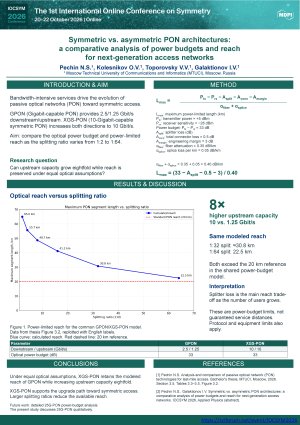
The rapid growth of bandwidth-intensive services (4K/8K video, cloud gaming, IoT) demands a fundamental upgrade of the access network segment, commonly known as the "last mile". Among the competing solutions, passive optical networks (PONs) are considered the most scalable and cost-effective. However, the evolution from asymmetric GPON (2.5/1.25 Gbit/s) to symmetric XGS-PON (10/10 Gbit/s) and further to 25G-PON (25/25 Gbit/s) raises a critical question: how does the symmetry of the physical layer affect the reach and power budget?
In this work, we develop a comprehensive analytical model for the optical power budget of PON systems. We calculate the maximum achievable link length as a function of the splitting ratio (1:2 to 1:64), considering all key loss components: fiber attenuation (0.35 dB/km), connector losses (0.5 dB), splicing losses (0.1 dB per splice), and a 3 dB engineering margin. The transmitter power is taken as +5 dBm, and the receiver sensitivity as –28 dBm, yielding an overall power budget of 33 dB. Our results reveal that both GPON and XGS-PON provide sufficient optical power for a standard 20 km reach at a 1:32 split ratio. However, the symmetric XGS-PON architecture demonstrates an 8× higher upstream capacity (10 Gbit/s vs. 1.25 Gbit/s) while maintaining the same physical reach as asymmetric GPON when using identical optical components. The emerging 25G‑PON standard is discussed qualitatively as an intermediate step toward multi‑gigabit services; its detailed power budget analysis is beyond the scope of this work.
We conclude that symmetric PON solutions, particularly XGS-PON, represent an optimal balance between physical layer performance and future upgrade paths. The preservation of reach and power budget while increasing capacity eightfold makes XGS-PON the preferred choice for operators seeking a sustainable long‑term evolution strategy. Our findings provide a quantitative framework for network planning and technology selection in urban and suburban access networks.
Keywords
passive optical networks (PON)
GPON
XGS-PON
power budget
optical reach
splitting ratio
fiber attenuation
symmetrical access
physical layer
access network
Poster
IOCSYM2026_Pechin_Poster.pdf
Symmetry breaking in fiber optic connector endface geometry: correction via controlled manual polishing
Adaptive restoration of wavefront symmetry in turbulent atmospheric optical channels: an applied physics perspective on control algorithms