Event submissions
Published
This submission belongs to the session S3. Applied Physics of the event The 1st International Online Conference on Symmetry
Published date
15 Oct, 2026
Academic Editor
'%3e%3cpath%20d='M12.6657%2010.9104C12.4185%2010.325%2012.0599%209.79327%2011.6097%209.34482C11.1609%208.89508%2010.6293%208.5365%2010.0442%208.28888C10.0389%208.28626%2010.0337%208.28495%2010.0285%208.28233C10.8446%207.69279%2011.3752%206.73249%2011.3752%205.64904C11.3752%203.8542%209.92103%202.39999%208.1262%202.39999C6.33136%202.39999%204.87715%203.8542%204.87715%205.64904C4.87715%206.73249%205.40774%207.69279%206.22393%208.28364C6.21869%208.28626%206.21345%208.28757%206.20821%208.29019C5.62129%208.5378%205.09463%208.89284%204.64265%209.34613C4.1929%209.79493%203.83432%2010.3266%203.58671%2010.9117C3.34345%2011.4845%203.21226%2012.0987%203.20023%2012.7209C3.19988%2012.7349%203.20233%2012.7488%203.20744%2012.7619C3.21255%2012.7749%203.22022%2012.7867%203.22998%2012.7968C3.23975%2012.8068%203.25142%2012.8147%203.26431%2012.8202C3.2772%2012.8256%203.29105%2012.8284%203.30504%2012.8284H4.09109C4.14874%2012.8284%204.19459%2012.7825%204.1959%2012.7262C4.2221%2011.7148%204.62823%2010.7676%205.34617%2010.0497C6.08899%209.30683%207.0755%208.89808%208.1262%208.89808C9.17689%208.89808%2010.1634%209.30683%2010.9062%2010.0497C11.6242%2010.7676%2012.0303%2011.7148%2012.0565%2012.7262C12.0578%2012.7838%2012.1037%2012.8284%2012.1613%2012.8284H12.9474C12.9613%2012.8284%2012.9752%2012.8256%2012.9881%2012.8202C13.001%2012.8147%2013.0126%2012.8068%2013.0224%2012.7968C13.0322%2012.7867%2013.0398%2012.7749%2013.0449%2012.7619C13.0501%2012.7488%2013.0525%2012.7349%2013.0522%2012.7209C13.0391%2012.0947%2012.9094%2011.4855%2012.6657%2010.9104ZM8.1262%207.9024C7.52486%207.9024%206.9589%207.6679%206.53312%207.24211C6.10733%206.81633%205.87283%206.25037%205.87283%205.64904C5.87283%205.0477%206.10733%204.48174%206.53312%204.05596C6.9589%203.63018%207.52486%203.39567%208.1262%203.39567C8.72753%203.39567%209.29349%203.63018%209.71927%204.05596C10.1451%204.48174%2010.3796%205.0477%2010.3796%205.64904C10.3796%206.25037%2010.1451%206.81633%209.71927%207.24211C9.29349%207.6679%208.72753%207.9024%208.1262%207.9024Z'%20fill='%235D1EE1'/%3e%3c/g%3e%3c/svg%3e) Joao Pacheco B.C. de Melo
Joao Pacheco B.C. de MeloCitation
Amide Alasgar Sadigova, Saida Mammadova, DFT Investigations on the Thermoelectric and Electronic Properties of Ni₀.₄₀Zn₀.₆₀Fe₂O₄, in Proceedings of The 1st International Online Conference on Symmetry, 20 October–22 October 2026, MDPI: Basel, Switzerland
Share
Email
Facebook
Twitter
LinkedIn
DFT Investigations on the Thermoelectric and Electronic Properties of Ni0.40Zn0.60Fe2O4
'%3e%3cpath%20d='M12.6647%2010.9104C12.4176%2010.325%2012.0589%209.7933%2011.6088%209.34485C11.16%208.89511%2010.6283%208.53653%2010.0432%208.28891C10.038%208.28629%2010.0327%208.28498%2010.0275%208.28236C10.8437%207.69282%2011.3743%206.73252%2011.3743%205.64907C11.3743%203.85423%209.92005%202.40002%208.12522%202.40002C6.33038%202.40002%204.87618%203.85423%204.87618%205.64907C4.87618%206.73252%205.40677%207.69282%206.22296%208.28367C6.21772%208.28629%206.21248%208.2876%206.20724%208.29022C5.62031%208.53783%205.09365%208.89287%204.64167%209.34616C4.19192%209.79496%203.83334%2010.3266%203.58573%2010.9117C3.34247%2011.4846%203.21128%2012.0987%203.19925%2012.721C3.1989%2012.735%203.20135%2012.7489%203.20646%2012.7619C3.21157%2012.7749%203.21924%2012.7868%203.22901%2012.7968C3.23877%2012.8068%203.25045%2012.8148%203.26334%2012.8202C3.27623%2012.8256%203.29007%2012.8284%203.30406%2012.8284H4.09012C4.14776%2012.8284%204.19362%2012.7825%204.19493%2012.7262C4.22113%2011.7148%204.62726%2010.7676%205.34519%2010.0497C6.08802%209.30686%207.07452%208.89811%208.12522%208.89811C9.17592%208.89811%2010.1624%209.30686%2010.9052%2010.0497C11.6232%2010.7676%2012.0293%2011.7148%2012.0555%2012.7262C12.0568%2012.7839%2012.1027%2012.8284%2012.1603%2012.8284H12.9464C12.9604%2012.8284%2012.9742%2012.8256%2012.9871%2012.8202C13%2012.8148%2013.0117%2012.8068%2013.0214%2012.7968C13.0312%2012.7868%2013.0389%2012.7749%2013.044%2012.7619C13.0491%2012.7489%2013.0515%2012.735%2013.0512%2012.721C13.0381%2012.0947%2012.9084%2011.4856%2012.6647%2010.9104ZM8.12522%207.90243C7.52388%207.90243%206.95792%207.66793%206.53214%207.24215C6.10636%206.81636%205.87185%206.2504%205.87185%205.64907C5.87185%205.04773%206.10636%204.48177%206.53214%204.05599C6.95792%203.63021%207.52388%203.3957%208.12522%203.3957C8.72655%203.3957%209.29252%203.63021%209.7183%204.05599C10.1441%204.48177%2010.3786%205.04773%2010.3786%205.64907C10.3786%206.2504%2010.1441%206.81636%209.7183%207.24215C9.29252%207.66793%208.72655%207.90243%208.12522%207.90243Z'%20fill='%235D1EE1'/%3e%3c/g%3e%3c/svg%3e)
Amide Alasgar Sadigova 1
Saida Mammadova 1,2
1. Institute of Physics, Ministry of Science and Education of Azerbaijan, AZ1143 Baku, Azerbaijan
2. Faculty of Mathematics, Khazar University, AZ1096 Baku, Azerbaijan
Abstract
Introduction
The electronic properties of materials are important for understanding charge transport behavior and distinguishing between metals, semiconductors, and insulators through their band-gap characteristics. These properties strongly influence optical, thermodynamic, and thermoelectric performance, making them essential for applications such as transistors, sensors, and solar cells [1-3].
Methods
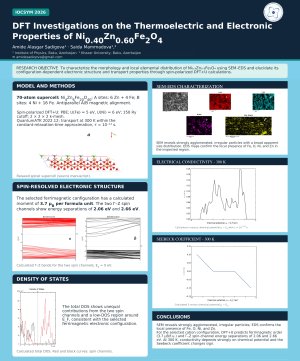
We applied a theoretical approach to study the structural and electrical properties of nickel ferrite. Theoretical approaches such as Density Functional Theory using with spin generalized gradient approximation was employed.
Discussion
The purpose of this review is to provide a brief overview of the Hubbard-U approach and examine how its incorporation into conventional DFT affects the electronic and structural characteristics of the Ni0.40Zn0.60Fe2O4 system, together with its thermoelectric behavior.
Conclusions
In this work, the electronic and thermoelectric properties of Ni0.40Zn0.60Fe2O4 spinel ferrites were investigated using DFT. The electrical transport properties are directly influenced by the energy band structure of the material. We have explored Zn doping in NiFe2O4 materials and the dopant concentration in Ni1-xZnxFe2O4 is varied (x=6%). The calculated electrical conductivity (σ) for the investigated compounds shows different behavior due to the particular charge concentration. In addition, the obtained DOS, electronic structure, and thermoelectric results are consistent with available experimental data.
1. Yifeng Meng et al., IOP Conf. Series: Materials Science and Engineering 569 (2019) 022016.
2. Syed Hatim Shah et al., Double Perovskite.Research Square. DOI: https://doi.org/10.21203/rs.3.rs-4402339/v1
3. S.Mammadova et al., Advanced Physical Research, v.8, 2026.
Keywords
DFT
Thermoelectric and Electronic Properties
Poster
IOCSYM2026_Poster.pdf
Theoretical study of the electronic and magnetic behavior of Ca-Doped Ni–Zn Ferrites
Symplectic Symmetry Preservation in Relativistic Particle Dynamics via Physics-Informed Neural Network Integrators