Event submissions
Published
This submission belongs to the session S4. Astronomy, Astrophysics and Cosmology of the event The 1st International Online Conference on Symmetry
Published date
15 Oct, 2026
Academic Editor
'%3e%3cpath%20d='M12.6657%2010.9104C12.4185%2010.325%2012.0599%209.79327%2011.6097%209.34482C11.1609%208.89508%2010.6293%208.5365%2010.0442%208.28888C10.0389%208.28626%2010.0337%208.28495%2010.0285%208.28233C10.8446%207.69279%2011.3752%206.73249%2011.3752%205.64904C11.3752%203.8542%209.92103%202.39999%208.1262%202.39999C6.33136%202.39999%204.87715%203.8542%204.87715%205.64904C4.87715%206.73249%205.40774%207.69279%206.22393%208.28364C6.21869%208.28626%206.21345%208.28757%206.20821%208.29019C5.62129%208.5378%205.09463%208.89284%204.64265%209.34613C4.1929%209.79493%203.83432%2010.3266%203.58671%2010.9117C3.34345%2011.4845%203.21226%2012.0987%203.20023%2012.7209C3.19988%2012.7349%203.20233%2012.7488%203.20744%2012.7619C3.21255%2012.7749%203.22022%2012.7867%203.22998%2012.7968C3.23975%2012.8068%203.25142%2012.8147%203.26431%2012.8202C3.2772%2012.8256%203.29105%2012.8284%203.30504%2012.8284H4.09109C4.14874%2012.8284%204.19459%2012.7825%204.1959%2012.7262C4.2221%2011.7148%204.62823%2010.7676%205.34617%2010.0497C6.08899%209.30683%207.0755%208.89808%208.1262%208.89808C9.17689%208.89808%2010.1634%209.30683%2010.9062%2010.0497C11.6242%2010.7676%2012.0303%2011.7148%2012.0565%2012.7262C12.0578%2012.7838%2012.1037%2012.8284%2012.1613%2012.8284H12.9474C12.9613%2012.8284%2012.9752%2012.8256%2012.9881%2012.8202C13.001%2012.8147%2013.0126%2012.8068%2013.0224%2012.7968C13.0322%2012.7867%2013.0398%2012.7749%2013.0449%2012.7619C13.0501%2012.7488%2013.0525%2012.7349%2013.0522%2012.7209C13.0391%2012.0947%2012.9094%2011.4855%2012.6657%2010.9104ZM8.1262%207.9024C7.52486%207.9024%206.9589%207.6679%206.53312%207.24211C6.10733%206.81633%205.87283%206.25037%205.87283%205.64904C5.87283%205.0477%206.10733%204.48174%206.53312%204.05596C6.9589%203.63018%207.52486%203.39567%208.1262%203.39567C8.72753%203.39567%209.29349%203.63018%209.71927%204.05596C10.1451%204.48174%2010.3796%205.0477%2010.3796%205.64904C10.3796%206.25037%2010.1451%206.81633%209.71927%207.24211C9.29349%207.6679%208.72753%207.9024%208.1262%207.9024Z'%20fill='%235D1EE1'/%3e%3c/g%3e%3c/svg%3e) Sándor Frey
Sándor FreyCitation
Pedro Fernandez de Córdoba, José María Isidro, Benjamin Koch, Angel Rincon, Zdeněk Stuchlík, QNMs and Shadows of Charged Scale-Dependent Black Holes, in Proceedings of The 1st International Online Conference on Symmetry, 20 October–22 October 2026, MDPI: Basel, Switzerland
Share
Email
Facebook
Twitter
LinkedIn
QNMs and Shadows of Charged Scale-Dependent Black Holes

Pedro Fernandez de Córdoba 1
'%3e%3cpath%20d='M12.6647%2010.9104C12.4176%2010.325%2012.0589%209.7933%2011.6088%209.34485C11.16%208.89511%2010.6283%208.53653%2010.0432%208.28891C10.038%208.28629%2010.0327%208.28498%2010.0275%208.28236C10.8437%207.69282%2011.3743%206.73252%2011.3743%205.64907C11.3743%203.85423%209.92005%202.40002%208.12522%202.40002C6.33038%202.40002%204.87618%203.85423%204.87618%205.64907C4.87618%206.73252%205.40677%207.69282%206.22296%208.28367C6.21772%208.28629%206.21248%208.2876%206.20724%208.29022C5.62031%208.53783%205.09365%208.89287%204.64167%209.34616C4.19192%209.79496%203.83334%2010.3266%203.58573%2010.9117C3.34247%2011.4846%203.21128%2012.0987%203.19925%2012.721C3.1989%2012.735%203.20135%2012.7489%203.20646%2012.7619C3.21157%2012.7749%203.21924%2012.7868%203.22901%2012.7968C3.23877%2012.8068%203.25045%2012.8148%203.26334%2012.8202C3.27623%2012.8256%203.29007%2012.8284%203.30406%2012.8284H4.09012C4.14776%2012.8284%204.19362%2012.7825%204.19493%2012.7262C4.22113%2011.7148%204.62726%2010.7676%205.34519%2010.0497C6.08802%209.30686%207.07452%208.89811%208.12522%208.89811C9.17592%208.89811%2010.1624%209.30686%2010.9052%2010.0497C11.6232%2010.7676%2012.0293%2011.7148%2012.0555%2012.7262C12.0568%2012.7839%2012.1027%2012.8284%2012.1603%2012.8284H12.9464C12.9604%2012.8284%2012.9742%2012.8256%2012.9871%2012.8202C13%2012.8148%2013.0117%2012.8068%2013.0214%2012.7968C13.0312%2012.7868%2013.0389%2012.7749%2013.044%2012.7619C13.0491%2012.7489%2013.0515%2012.735%2013.0512%2012.721C13.0381%2012.0947%2012.9084%2011.4856%2012.6647%2010.9104ZM8.12522%207.90243C7.52388%207.90243%206.95792%207.66793%206.53214%207.24215C6.10636%206.81636%205.87185%206.2504%205.87185%205.64907C5.87185%205.04773%206.10636%204.48177%206.53214%204.05599C6.95792%203.63021%207.52388%203.3957%208.12522%203.3957C8.72655%203.3957%209.29252%203.63021%209.7183%204.05599C10.1441%204.48177%2010.3786%205.04773%2010.3786%205.64907C10.3786%206.2504%2010.1441%206.81636%209.7183%207.24215C9.29252%207.66793%208.72655%207.90243%208.12522%207.90243Z'%20fill='%235D1EE1'/%3e%3c/g%3e%3c/svg%3e)
José María Isidro 1
Benjamin Koch 2
Angel Rincon 1,3,4

Zdeněk Stuchlík 4
1. University Institute of Pure and Applied Mathematics, Universitat Politécnica de Valéncia, Valencia 46022, Spain
2. Institut fur Theoretische Physik, Technische Universitat Wien, Wiedner Hauptstrasse 8-10, A-1040 Vienna, Austria.
3. Departamento de Física, Universidad del Bío-Bío, Concepción 4051381, Chile.
4. Research Centre for Theoretical Physics and Astrophysics, Institute of Physics, Silesian University in Opava, Bezrucovo nám. 13, 74601 Opava, Czech Republic.
Abstract
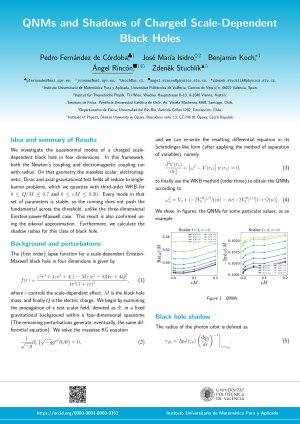
In this talk, we present a detailed analysis of the quasi-normal modes (QNMs) and optical shadows of charged black holes within the framework of scale-dependent gravity. These models introduce an explicit dependence of the geometric parameters on the radial scale, which modifies the properties of the event horizon and the asymptotic behavior of spacetime compared to the standard Einstein–Maxwell solutions.
We compute the full spectrum of QNMs for different types of perturbations using the higher-order Wentzel–Kramers–Brillouin (WKB) method and the eikonal approximation in the large angular momentum limit. Both techniques yield complex frequencies (ω=ωR+iωI\omega = \omega_R +i \omega_Iω=ωR+iωI) with high precision, revealing the impact of the charge and scale dependence on the stability and relaxation timescales of the black hole.
Additionally, we determine the black hole shadow by calculating the unstable photon orbits and the critical radius of the photon sphere. We analyze the deformation and size of the shadow as functions of the charge and scale parameters, and evaluate its observability with next-generation instruments such as the Event Horizon Telescope. All results are systematically compared with the classical Reissner–Nordström black hole, allowing us to quantify the deviations introduced by scale dependence. We show that both the QNMs and the shadows exhibit observable differences that could serve as probes to distinguish these modified solutions from the predictions of general relativity.
Keywords
Black holes
Quasinormal modes
Shadows
WKB method.
Poster
Poster_v2.pdf
Rhodonea-type Laser Scan Patterns Generated by a Pair of Rotational Risley Prisms
Determination of the Connection in Metric-Affine Gravity