Event submissions
Published
This submission belongs to the session S1. Environmental and Green Processes of the event The 5th International Electronic Conference on Processes
Published date
15 Oct, 2026
Academic Editor
'%3e%3cpath%20d='M12.6657%2010.9104C12.4185%2010.325%2012.0599%209.79327%2011.6097%209.34482C11.1609%208.89508%2010.6293%208.5365%2010.0442%208.28888C10.0389%208.28626%2010.0337%208.28495%2010.0285%208.28233C10.8446%207.69279%2011.3752%206.73249%2011.3752%205.64904C11.3752%203.8542%209.92103%202.39999%208.1262%202.39999C6.33136%202.39999%204.87715%203.8542%204.87715%205.64904C4.87715%206.73249%205.40774%207.69279%206.22393%208.28364C6.21869%208.28626%206.21345%208.28757%206.20821%208.29019C5.62129%208.5378%205.09463%208.89284%204.64265%209.34613C4.1929%209.79493%203.83432%2010.3266%203.58671%2010.9117C3.34345%2011.4845%203.21226%2012.0987%203.20023%2012.7209C3.19988%2012.7349%203.20233%2012.7488%203.20744%2012.7619C3.21255%2012.7749%203.22022%2012.7867%203.22998%2012.7968C3.23975%2012.8068%203.25142%2012.8147%203.26431%2012.8202C3.2772%2012.8256%203.29105%2012.8284%203.30504%2012.8284H4.09109C4.14874%2012.8284%204.19459%2012.7825%204.1959%2012.7262C4.2221%2011.7148%204.62823%2010.7676%205.34617%2010.0497C6.08899%209.30683%207.0755%208.89808%208.1262%208.89808C9.17689%208.89808%2010.1634%209.30683%2010.9062%2010.0497C11.6242%2010.7676%2012.0303%2011.7148%2012.0565%2012.7262C12.0578%2012.7838%2012.1037%2012.8284%2012.1613%2012.8284H12.9474C12.9613%2012.8284%2012.9752%2012.8256%2012.9881%2012.8202C13.001%2012.8147%2013.0126%2012.8068%2013.0224%2012.7968C13.0322%2012.7867%2013.0398%2012.7749%2013.0449%2012.7619C13.0501%2012.7488%2013.0525%2012.7349%2013.0522%2012.7209C13.0391%2012.0947%2012.9094%2011.4855%2012.6657%2010.9104ZM8.1262%207.9024C7.52486%207.9024%206.9589%207.6679%206.53312%207.24211C6.10733%206.81633%205.87283%206.25037%205.87283%205.64904C5.87283%205.0477%206.10733%204.48174%206.53312%204.05596C6.9589%203.63018%207.52486%203.39567%208.1262%203.39567C8.72753%203.39567%209.29349%203.63018%209.71927%204.05596C10.1451%204.48174%2010.3796%205.0477%2010.3796%205.64904C10.3796%206.25037%2010.1451%206.81633%209.71927%207.24211C9.29349%207.6679%208.72753%207.9024%208.1262%207.9024Z'%20fill='%235D1EE1'/%3e%3c/g%3e%3c/svg%3e) Juan Francisco García Martín
Juan Francisco García MartínCitation
Bikash Das, Janki Prasad, Lower atmospheric chemical transformation processes from urban-industrial emission to sulfurous and photochemical fog-smog in the Haldia petrochemical region, Eastern India, in Proceedings of The 5th International Electronic Conference on Processes, 20 October–22 October 2026, MDPI: Basel, Switzerland
Share
Email
Facebook
Twitter
LinkedIn
Lower atmospheric chemical transformation processes from urban-industrial emission to sulfurous and photochemical fog-smog in the Haldia petrochemical region, Eastern India

Bikash Das 1
'%3e%3cpath%20d='M12.6647%2010.9104C12.4176%2010.325%2012.0589%209.7933%2011.6088%209.34485C11.16%208.89511%2010.6283%208.53653%2010.0432%208.28891C10.038%208.28629%2010.0327%208.28498%2010.0275%208.28236C10.8437%207.69282%2011.3743%206.73252%2011.3743%205.64907C11.3743%203.85423%209.92005%202.40002%208.12522%202.40002C6.33038%202.40002%204.87618%203.85423%204.87618%205.64907C4.87618%206.73252%205.40677%207.69282%206.22296%208.28367C6.21772%208.28629%206.21248%208.2876%206.20724%208.29022C5.62031%208.53783%205.09365%208.89287%204.64167%209.34616C4.19192%209.79496%203.83334%2010.3266%203.58573%2010.9117C3.34247%2011.4846%203.21128%2012.0987%203.19925%2012.721C3.1989%2012.735%203.20135%2012.7489%203.20646%2012.7619C3.21157%2012.7749%203.21924%2012.7868%203.22901%2012.7968C3.23877%2012.8068%203.25045%2012.8148%203.26334%2012.8202C3.27623%2012.8256%203.29007%2012.8284%203.30406%2012.8284H4.09012C4.14776%2012.8284%204.19362%2012.7825%204.19493%2012.7262C4.22113%2011.7148%204.62726%2010.7676%205.34519%2010.0497C6.08802%209.30686%207.07452%208.89811%208.12522%208.89811C9.17592%208.89811%2010.1624%209.30686%2010.9052%2010.0497C11.6232%2010.7676%2012.0293%2011.7148%2012.0555%2012.7262C12.0568%2012.7839%2012.1027%2012.8284%2012.1603%2012.8284H12.9464C12.9604%2012.8284%2012.9742%2012.8256%2012.9871%2012.8202C13%2012.8148%2013.0117%2012.8068%2013.0214%2012.7968C13.0312%2012.7868%2013.0389%2012.7749%2013.044%2012.7619C13.0491%2012.7489%2013.0515%2012.735%2013.0512%2012.721C13.0381%2012.0947%2012.9084%2011.4856%2012.6647%2010.9104ZM8.12522%207.90243C7.52388%207.90243%206.95792%207.66793%206.53214%207.24215C6.10636%206.81636%205.87185%206.2504%205.87185%205.64907C5.87185%205.04773%206.10636%204.48177%206.53214%204.05599C6.95792%203.63021%207.52388%203.3957%208.12522%203.3957C8.72655%203.3957%209.29252%203.63021%209.7183%204.05599C10.1441%204.48177%2010.3786%205.04773%2010.3786%205.64907C10.3786%206.2504%2010.1441%206.81636%209.7183%207.24215C9.29252%207.66793%208.72655%207.90243%208.12522%207.90243Z'%20fill='%235D1EE1'/%3e%3c/g%3e%3c/svg%3e)
Janki Prasad 1
1. Department of Geography, Faculty of Earth Science, Indira Gandhi National Tribal University, Amarkantak, Madhya Pradesh, 48487, India
Abstract
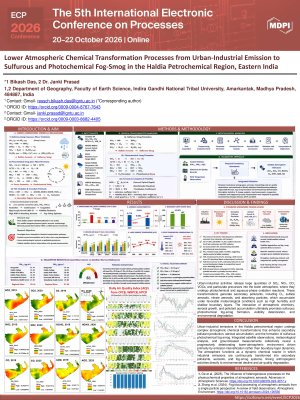
Rapid urban industrialization has substantially intensified atmospheric pollution through the formation of sulfurous and photochemical smog in developing industrial corridors worldwide. Although previous studies have examined individual pollutants and air-quality indicators, limited research has comprehensively investigated the coupled atmospheric transformation processes linking precursor gases, secondary pollutant formation, aerosol dynamics, meteorological controls, and fog-smog development. Therefore, the present study investigates these atmospheric processes in the rapidly growing petrochemical-industrial region of Haldia, eastern India. An integrated multi-source framework was developed using Sentinel-5P observations of SO₂, NO₂, CO, HCHO, O₃, and the Absorbing Aerosol Index (AER-AI), MODIS MAIAC Aerosol Optical Depth (AOD), ERA5 Boundary Layer Height (BLH) and relative humidity (RH), NASA POWER meteorological variables, Landsat-derived Land Surface Temperature (LST), field-based infrared thermometer observations, and ground-based PM₂.₅, PM₁₀, AQI, and historical air-quality records. Atmospheric chemical pathways associated with sulfurous smog formation, photochemical ozone production, aerosol transformation, and pollutant accumulation were evaluated for 2019-2025.
The results indicated substantial increases in NO₂ (+24.8%), CO (+4.6%), HCHO (+4.3%), O₃ (+4.4%), and AER-AI (+54.2%), whereas SO₂ exhibited only marginal variation (+0.48%). Mean AOD decreased from 0.779 to 0.682, indicating lower total aerosol loading, while the marked increase in AER-AI suggested a transition toward more UV-absorbing combustion-derived aerosols. Nearly stable BLH conditions (465-467 m) indicated that pollution intensification was primarily emission-driven rather than meteorologically controlled. Ground observations recorded mean PM₂.₅ and PM₁₀ concentrations of approximately 29.2 and 51.8 μg m⁻³, respectively, under moderate AQI conditions, consistent with the satellite-derived atmospheric patterns. Elevated relative humidity, together with persistent particulate matter concentrations, suggested favorable conditions for hygroscopic aerosol growth, visibility reduction, and haze/fog-smog development. Overall, the findings indicate that combustion-driven photochemical reactions and aerosol transformation are the dominant processes governing atmospheric deterioration in Haldia, providing a process-based scientific foundation for air-quality and sustainable urban-industrial planning in rapidly growing regions.
Keywords
Atmospheric chemical processes
Industrial emissions
Sulfurous and photochemical fog-smog
Secondary aerosols
AOD
AER-AI
BLH
Environmental green-sustainable processes
Poster
Bikash_Das_Lower atmospheric chemical transformation processes _Poster_ECP2026.pdf.pdf
Adsorption of Hexavalent Chromium onto Wood-Based Adsorbent: Kinetic and Isotherm Study
Ultrasound- and microwave-assisted extraction of phenolic compounds from Satureja montana L. using lactic acid–urea natural deep eutectic solvent