Event submissions
Published
This submission belongs to the session S1. Environmental and Green Processes of the event The 5th International Electronic Conference on Processes
Published date
15 Oct, 2026
Academic Editor
'%3e%3cpath%20d='M12.6657%2010.9104C12.4185%2010.325%2012.0599%209.79327%2011.6097%209.34482C11.1609%208.89508%2010.6293%208.5365%2010.0442%208.28888C10.0389%208.28626%2010.0337%208.28495%2010.0285%208.28233C10.8446%207.69279%2011.3752%206.73249%2011.3752%205.64904C11.3752%203.8542%209.92103%202.39999%208.1262%202.39999C6.33136%202.39999%204.87715%203.8542%204.87715%205.64904C4.87715%206.73249%205.40774%207.69279%206.22393%208.28364C6.21869%208.28626%206.21345%208.28757%206.20821%208.29019C5.62129%208.5378%205.09463%208.89284%204.64265%209.34613C4.1929%209.79493%203.83432%2010.3266%203.58671%2010.9117C3.34345%2011.4845%203.21226%2012.0987%203.20023%2012.7209C3.19988%2012.7349%203.20233%2012.7488%203.20744%2012.7619C3.21255%2012.7749%203.22022%2012.7867%203.22998%2012.7968C3.23975%2012.8068%203.25142%2012.8147%203.26431%2012.8202C3.2772%2012.8256%203.29105%2012.8284%203.30504%2012.8284H4.09109C4.14874%2012.8284%204.19459%2012.7825%204.1959%2012.7262C4.2221%2011.7148%204.62823%2010.7676%205.34617%2010.0497C6.08899%209.30683%207.0755%208.89808%208.1262%208.89808C9.17689%208.89808%2010.1634%209.30683%2010.9062%2010.0497C11.6242%2010.7676%2012.0303%2011.7148%2012.0565%2012.7262C12.0578%2012.7838%2012.1037%2012.8284%2012.1613%2012.8284H12.9474C12.9613%2012.8284%2012.9752%2012.8256%2012.9881%2012.8202C13.001%2012.8147%2013.0126%2012.8068%2013.0224%2012.7968C13.0322%2012.7867%2013.0398%2012.7749%2013.0449%2012.7619C13.0501%2012.7488%2013.0525%2012.7349%2013.0522%2012.7209C13.0391%2012.0947%2012.9094%2011.4855%2012.6657%2010.9104ZM8.1262%207.9024C7.52486%207.9024%206.9589%207.6679%206.53312%207.24211C6.10733%206.81633%205.87283%206.25037%205.87283%205.64904C5.87283%205.0477%206.10733%204.48174%206.53312%204.05596C6.9589%203.63018%207.52486%203.39567%208.1262%203.39567C8.72753%203.39567%209.29349%203.63018%209.71927%204.05596C10.1451%204.48174%2010.3796%205.0477%2010.3796%205.64904C10.3796%206.25037%2010.1451%206.81633%209.71927%207.24211C9.29349%207.6679%208.72753%207.9024%208.1262%207.9024Z'%20fill='%235D1EE1'/%3e%3c/g%3e%3c/svg%3e) Juan Francisco García Martín
Juan Francisco García MartínCitation
Mioto Uno, Rei Takamatsu, Young-Cheol Chang, Isolation and Evaluation of Lignin-Degrading Bacteria from Decayed Wood in a Landfill, in Proceedings of The 5th International Electronic Conference on Processes, 20 October–22 October 2026, MDPI: Basel, Switzerland
Share
Email
Facebook
Twitter
LinkedIn
Isolation and Evaluation of Lignin-Degrading Bacteria from Decayed Wood in a Landfill
'%3e%3cpath%20d='M12.6647%2010.9104C12.4176%2010.325%2012.0589%209.7933%2011.6088%209.34485C11.16%208.89511%2010.6283%208.53653%2010.0432%208.28891C10.038%208.28629%2010.0327%208.28498%2010.0275%208.28236C10.8437%207.69282%2011.3743%206.73252%2011.3743%205.64907C11.3743%203.85423%209.92005%202.40002%208.12522%202.40002C6.33038%202.40002%204.87618%203.85423%204.87618%205.64907C4.87618%206.73252%205.40677%207.69282%206.22296%208.28367C6.21772%208.28629%206.21248%208.2876%206.20724%208.29022C5.62031%208.53783%205.09365%208.89287%204.64167%209.34616C4.19192%209.79496%203.83334%2010.3266%203.58573%2010.9117C3.34247%2011.4846%203.21128%2012.0987%203.19925%2012.721C3.1989%2012.735%203.20135%2012.7489%203.20646%2012.7619C3.21157%2012.7749%203.21924%2012.7868%203.22901%2012.7968C3.23877%2012.8068%203.25045%2012.8148%203.26334%2012.8202C3.27623%2012.8256%203.29007%2012.8284%203.30406%2012.8284H4.09012C4.14776%2012.8284%204.19362%2012.7825%204.19493%2012.7262C4.22113%2011.7148%204.62726%2010.7676%205.34519%2010.0497C6.08802%209.30686%207.07452%208.89811%208.12522%208.89811C9.17592%208.89811%2010.1624%209.30686%2010.9052%2010.0497C11.6232%2010.7676%2012.0293%2011.7148%2012.0555%2012.7262C12.0568%2012.7839%2012.1027%2012.8284%2012.1603%2012.8284H12.9464C12.9604%2012.8284%2012.9742%2012.8256%2012.9871%2012.8202C13%2012.8148%2013.0117%2012.8068%2013.0214%2012.7968C13.0312%2012.7868%2013.0389%2012.7749%2013.044%2012.7619C13.0491%2012.7489%2013.0515%2012.735%2013.0512%2012.721C13.0381%2012.0947%2012.9084%2011.4856%2012.6647%2010.9104ZM8.12522%207.90243C7.52388%207.90243%206.95792%207.66793%206.53214%207.24215C6.10636%206.81636%205.87185%206.2504%205.87185%205.64907C5.87185%205.04773%206.10636%204.48177%206.53214%204.05599C6.95792%203.63021%207.52388%203.3957%208.12522%203.3957C8.72655%203.3957%209.29252%203.63021%209.7183%204.05599C10.1441%204.48177%2010.3786%205.04773%2010.3786%205.64907C10.3786%206.2504%2010.1441%206.81636%209.7183%207.24215C9.29252%207.66793%208.72655%207.90243%208.12522%207.90243Z'%20fill='%235D1EE1'/%3e%3c/g%3e%3c/svg%3e)
Mioto Uno 1
Rei Takamatsu 2

Young-Cheol Chang 1
1. Course of Chemical and Biological Engineering, Division of Sustainable and Environmental Engineering, Muroran Institute of Technology, Hokkaido, Japan
2. Course of Chemical and Biological System, Department of Sciences and Informatics, Faculty of Science and Engineering, Muroran Institute of Technology, Hokkaido, Japan
Abstract
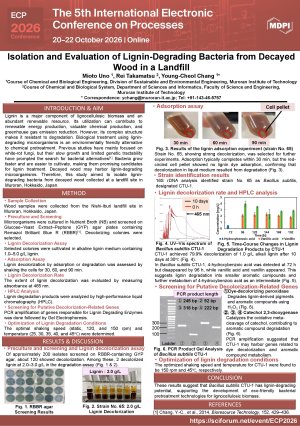
Lignin is a major biomass resource whose utilization is expected to contribute to renewable energy production and the reduction of greenhouse gas emissions. Biological treatment using lignin-degrading microorganisms has attracted attention as an environmentally friendly alternative to conventional chemical pretreatment methods. While previous studies have mainly focused on white-rot fungi, their slow growth rates and limited genetic tractability have prompted the search for bacterial alternatives. Therefore, this study aimed to isolate lignin-degrading bacteria from decayed wood collected from a landfill site. Wood samples were collected from a landfill site in Muroran, Hokkaido, Japan. Microorganisms were enriched in Nutrient Broth (NB) medium and screened on glucose–yeast extract–peptone (GYP) agar plates containing Remazol Brilliant Blue R (RBBR). Decolorizing colonies were selected and cultured in alkaline lignin medium (1.0–5.0 g/L) to evaluate their lignin decolorization ability. Strains showing decolorization were further subjected to adsorption assays using cells harvested after 5 days of cultivation. In addition, lignin degradation products were analyzed by high-performance liquid chromatography (HPLC). Approximately 200 isolates showed decolorization on RBBR plates, whereas only two strains showed decolorization in alkaline lignin medium. These strains were identified as Bacillus subtilis CTU-1 and Proteus sp. CTU-3. Bacillus subtilis CTU-1 exhibited higher decolorization activity compared to CTU-3 and was selected for further analysis. Adsorption assays indicated that lignin decolorization was not caused by adsorption. The lignin decolorization rate of Bacillus subtilis CTU-1 reached 79.9% after 5 days of cultivation in medium containing 1.0 g/L lignin. HPLC analysis of lignin degradation products revealed peaks corresponding to 4-hydroxybenzoic acid, vanillin, and vanillic acid. These results demonstrate that Bacillus subtilis CTU-1 possesses significant lignin-degrading potential, providing a foundation for the development of environmentally friendly bacterial pretreatment technologies for lignocellulosic biomass.
Keywords
lignin
lignin degradation
landfill site
Bacillus subtilis
Poster
Mioto_Uno ECP2026.pdf
Plant-Assisted Synthesized Mn-Doped Hematite materials for Enhanced Photocatalytic Degradation of Methylene Blue dye
Process-Oriented Engineering of Dye Adsorption: Controlling Diffusion and Surface Kinetics through Hierarchical Porosity in Pickering Emulsion-Derived Polymer Microspheres