Event submissions
Published
This submission belongs to the session S4. Astronomy, Astrophysics and Cosmology of the event The 1st International Online Conference on Symmetry
Published date
15 Oct, 2026
Academic Editor
'%3e%3cpath%20d='M12.6657%2010.9104C12.4185%2010.325%2012.0599%209.79327%2011.6097%209.34482C11.1609%208.89508%2010.6293%208.5365%2010.0442%208.28888C10.0389%208.28626%2010.0337%208.28495%2010.0285%208.28233C10.8446%207.69279%2011.3752%206.73249%2011.3752%205.64904C11.3752%203.8542%209.92103%202.39999%208.1262%202.39999C6.33136%202.39999%204.87715%203.8542%204.87715%205.64904C4.87715%206.73249%205.40774%207.69279%206.22393%208.28364C6.21869%208.28626%206.21345%208.28757%206.20821%208.29019C5.62129%208.5378%205.09463%208.89284%204.64265%209.34613C4.1929%209.79493%203.83432%2010.3266%203.58671%2010.9117C3.34345%2011.4845%203.21226%2012.0987%203.20023%2012.7209C3.19988%2012.7349%203.20233%2012.7488%203.20744%2012.7619C3.21255%2012.7749%203.22022%2012.7867%203.22998%2012.7968C3.23975%2012.8068%203.25142%2012.8147%203.26431%2012.8202C3.2772%2012.8256%203.29105%2012.8284%203.30504%2012.8284H4.09109C4.14874%2012.8284%204.19459%2012.7825%204.1959%2012.7262C4.2221%2011.7148%204.62823%2010.7676%205.34617%2010.0497C6.08899%209.30683%207.0755%208.89808%208.1262%208.89808C9.17689%208.89808%2010.1634%209.30683%2010.9062%2010.0497C11.6242%2010.7676%2012.0303%2011.7148%2012.0565%2012.7262C12.0578%2012.7838%2012.1037%2012.8284%2012.1613%2012.8284H12.9474C12.9613%2012.8284%2012.9752%2012.8256%2012.9881%2012.8202C13.001%2012.8147%2013.0126%2012.8068%2013.0224%2012.7968C13.0322%2012.7867%2013.0398%2012.7749%2013.0449%2012.7619C13.0501%2012.7488%2013.0525%2012.7349%2013.0522%2012.7209C13.0391%2012.0947%2012.9094%2011.4855%2012.6657%2010.9104ZM8.1262%207.9024C7.52486%207.9024%206.9589%207.6679%206.53312%207.24211C6.10733%206.81633%205.87283%206.25037%205.87283%205.64904C5.87283%205.0477%206.10733%204.48174%206.53312%204.05596C6.9589%203.63018%207.52486%203.39567%208.1262%203.39567C8.72753%203.39567%209.29349%203.63018%209.71927%204.05596C10.1451%204.48174%2010.3796%205.0477%2010.3796%205.64904C10.3796%206.25037%2010.1451%206.81633%209.71927%207.24211C9.29349%207.6679%208.72753%207.9024%208.1262%207.9024Z'%20fill='%235D1EE1'/%3e%3c/g%3e%3c/svg%3e) Sándor Frey
Sándor FreyCitation
Mingyu Zhao, Spacetime–Mass Equivalence Principle: A New Gravitational Field Equation and Its Cosmological Applications, in Proceedings of The 1st International Online Conference on Symmetry, 20 October–22 October 2026, MDPI: Basel, Switzerland
Share
Email
Facebook
Twitter
LinkedIn
Spacetime–Mass Equivalence Principle: A New Gravitational Field Equation and Its Cosmological Applications

Mingyu Zhao 1
1. Independent Researcher, Xiangtan, Hunan, 411100, China
Abstract
Einstein’s general relativity interprets gravity as a geometric effect of spacetime curvature and has achieved great success in explaining classical gravitational phenomena. However, it fails to reveal the dynamical nature of gravity and encounters fundamental barriers to unification with quantum mechanics.
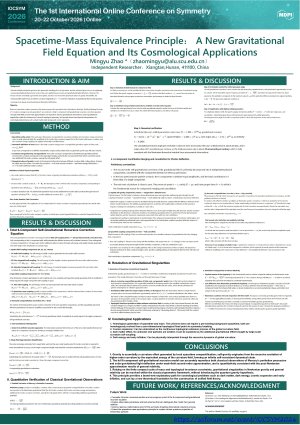
Based on spacetime–matter symmetry, this paper proposes the Spacetime–Mass Equivalence Principle. Its core axioms are: space and time are equal in status; mass is the total curvature integral of finite-scale compactified spacetime; mass corresponds to first-order spacetime curvature, while energy corresponds to second-order curvature; gravity arises from dynamical interactions between spacetime curvature configurations, rather than a pure geometric effect.
By this principle, gravity stems from local spacetime compactification. The first-order curvature matches the Newtonian gravitational field, satisfying g(r) = c^2 K(r) . The first-order field carries curvature energy and induces self-gravitation corrections. The radial self-gravitation is a single term; including tangential self-coupling, temporal self-coupling, spacetime cross-coupling and relativistic dynamical corrections yields a total second-order effect 6 times the radial value, fully consistent with the post-Newtonian approximation of general relativity.
The study derives a new recursive gravitational field equation with infinite self-consistent cyclic corrections. Its weak-field second-order approximation accurately reproduces two key observations: the 43 arcseconds per century residual precession of Mercury’s perihelion, and the 1.74-arcsecond starlight deflection by the Sun.
This framework resolves the r→0 gravitational singularity within classical topology without quantum gravity assumptions. It also accounts for dark energy density, dark matter origins, cosmic expansion and early cosmic inflation, laying a new foundation for unified field theory.
Keywords
Spacetime-Mass Equivalence Principle; self-gravitation effect; new gravitational field equation; precession of Mercury's perihelion; deflection of light in solar gravitational field; gravitational singularity; cosmology
Poster
A New Gravitational Field Equation and Its Cosmological Applications.pdf
Gravitational-wave polarization modes and stability analysis in Weyl geometry gravity
Axion propagation in a gravitational wave background