Event submissions
Published
This submission belongs to the session S2. Chemical Processes and Systems of the event The 5th International Electronic Conference on Processes
Published date
15 Oct, 2026
Academic Editor
'%3e%3cpath%20d='M12.6657%2010.9104C12.4185%2010.325%2012.0599%209.79327%2011.6097%209.34482C11.1609%208.89508%2010.6293%208.5365%2010.0442%208.28888C10.0389%208.28626%2010.0337%208.28495%2010.0285%208.28233C10.8446%207.69279%2011.3752%206.73249%2011.3752%205.64904C11.3752%203.8542%209.92103%202.39999%208.1262%202.39999C6.33136%202.39999%204.87715%203.8542%204.87715%205.64904C4.87715%206.73249%205.40774%207.69279%206.22393%208.28364C6.21869%208.28626%206.21345%208.28757%206.20821%208.29019C5.62129%208.5378%205.09463%208.89284%204.64265%209.34613C4.1929%209.79493%203.83432%2010.3266%203.58671%2010.9117C3.34345%2011.4845%203.21226%2012.0987%203.20023%2012.7209C3.19988%2012.7349%203.20233%2012.7488%203.20744%2012.7619C3.21255%2012.7749%203.22022%2012.7867%203.22998%2012.7968C3.23975%2012.8068%203.25142%2012.8147%203.26431%2012.8202C3.2772%2012.8256%203.29105%2012.8284%203.30504%2012.8284H4.09109C4.14874%2012.8284%204.19459%2012.7825%204.1959%2012.7262C4.2221%2011.7148%204.62823%2010.7676%205.34617%2010.0497C6.08899%209.30683%207.0755%208.89808%208.1262%208.89808C9.17689%208.89808%2010.1634%209.30683%2010.9062%2010.0497C11.6242%2010.7676%2012.0303%2011.7148%2012.0565%2012.7262C12.0578%2012.7838%2012.1037%2012.8284%2012.1613%2012.8284H12.9474C12.9613%2012.8284%2012.9752%2012.8256%2012.9881%2012.8202C13.001%2012.8147%2013.0126%2012.8068%2013.0224%2012.7968C13.0322%2012.7867%2013.0398%2012.7749%2013.0449%2012.7619C13.0501%2012.7488%2013.0525%2012.7349%2013.0522%2012.7209C13.0391%2012.0947%2012.9094%2011.4855%2012.6657%2010.9104ZM8.1262%207.9024C7.52486%207.9024%206.9589%207.6679%206.53312%207.24211C6.10733%206.81633%205.87283%206.25037%205.87283%205.64904C5.87283%205.0477%206.10733%204.48174%206.53312%204.05596C6.9589%203.63018%207.52486%203.39567%208.1262%203.39567C8.72753%203.39567%209.29349%203.63018%209.71927%204.05596C10.1451%204.48174%2010.3796%205.0477%2010.3796%205.64904C10.3796%206.25037%2010.1451%206.81633%209.71927%207.24211C9.29349%207.6679%208.72753%207.9024%208.1262%207.9024Z'%20fill='%235D1EE1'/%3e%3c/g%3e%3c/svg%3e) Blaž Likozar
Blaž LikozarContribution&Funding
Conceptualization,
[Vinod Kumar Nathan]
Methodology,
[Vinod Kumar Nathan]
Investigation,
[Vinod Kumar Nathan]
Data curation,
[Vinod Kumar Nathan]
Writing - original draft,
[Vinod Kumar Nathan]
Supervision,
[Vinod Kumar Nathan]
Funding acquisition,
[Vinod Kumar Nathan]
Funding: --
Citation
Vinod Kumar Nathan, Soy Residue Valorization Powers Sustainable Amylase Production by Exiguobacterium qingdaonense, in Proceedings of The 5th International Electronic Conference on Processes, 20 October–22 October 2026, MDPI: Basel, Switzerland
Share
Email
Facebook
Twitter
LinkedIn
Soy Residue Valorization Powers Sustainable Amylase Production by Exiguobacterium qingdaonense
'%3e%3cpath%20d='M12.6647%2010.9104C12.4176%2010.325%2012.0589%209.7933%2011.6088%209.34485C11.16%208.89511%2010.6283%208.53653%2010.0432%208.28891C10.038%208.28629%2010.0327%208.28498%2010.0275%208.28236C10.8437%207.69282%2011.3743%206.73252%2011.3743%205.64907C11.3743%203.85423%209.92005%202.40002%208.12522%202.40002C6.33038%202.40002%204.87618%203.85423%204.87618%205.64907C4.87618%206.73252%205.40677%207.69282%206.22296%208.28367C6.21772%208.28629%206.21248%208.2876%206.20724%208.29022C5.62031%208.53783%205.09365%208.89287%204.64167%209.34616C4.19192%209.79496%203.83334%2010.3266%203.58573%2010.9117C3.34247%2011.4846%203.21128%2012.0987%203.19925%2012.721C3.1989%2012.735%203.20135%2012.7489%203.20646%2012.7619C3.21157%2012.7749%203.21924%2012.7868%203.22901%2012.7968C3.23877%2012.8068%203.25045%2012.8148%203.26334%2012.8202C3.27623%2012.8256%203.29007%2012.8284%203.30406%2012.8284H4.09012C4.14776%2012.8284%204.19362%2012.7825%204.19493%2012.7262C4.22113%2011.7148%204.62726%2010.7676%205.34519%2010.0497C6.08802%209.30686%207.07452%208.89811%208.12522%208.89811C9.17592%208.89811%2010.1624%209.30686%2010.9052%2010.0497C11.6232%2010.7676%2012.0293%2011.7148%2012.0555%2012.7262C12.0568%2012.7839%2012.1027%2012.8284%2012.1603%2012.8284H12.9464C12.9604%2012.8284%2012.9742%2012.8256%2012.9871%2012.8202C13%2012.8148%2013.0117%2012.8068%2013.0214%2012.7968C13.0312%2012.7868%2013.0389%2012.7749%2013.044%2012.7619C13.0491%2012.7489%2013.0515%2012.735%2013.0512%2012.721C13.0381%2012.0947%2012.9084%2011.4856%2012.6647%2010.9104ZM8.12522%207.90243C7.52388%207.90243%206.95792%207.66793%206.53214%207.24215C6.10636%206.81636%205.87185%206.2504%205.87185%205.64907C5.87185%205.04773%206.10636%204.48177%206.53214%204.05599C6.95792%203.63021%207.52388%203.3957%208.12522%203.3957C8.72655%203.3957%209.29252%203.63021%209.7183%204.05599C10.1441%204.48177%2010.3786%205.04773%2010.3786%205.64907C10.3786%206.2504%2010.1441%206.81636%209.7183%207.24215C9.29252%207.66793%208.72655%207.90243%208.12522%207.90243Z'%20fill='%235D1EE1'/%3e%3c/g%3e%3c/svg%3e)
Vinod Kumar Nathan 1
1. Traditional Foods and Applied Nutrition, CSIR-Central Food Technological Research Institute, India, Mysuru, 570020, India
Abstract
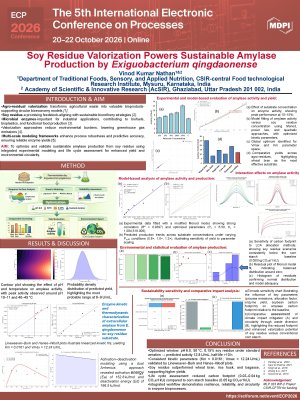
Agro-residual valorization offers a sustainable route for enzyme bioprocesses, reducing reliance on conventional starch substrates. In this study, soy residue was evaluated as a feedstock for extracellular amylase production by Exiguobacterium qingdaonense. Multi-scale modeling approaches including response surface methodology, kinetic fitting, and Monte Carlo reliability analysis were employed to capture process robustness. The optimized operating window was identified at pH 6.0, 50 °C, and 0.15% soy residue under standard aeration, yielding a predicted activity of 12.8 U/mL with a half-life (t1/2) exceeding 10 h. Lineweaver–Burk and Hanes–Woolf plots revealed consistent kinetic parameters (Km ≈ 0.0161; Vmax ≈ 12.24 U/mL), while dual Arrhenius modeling indicated activation and deactivation energies of 152.8 and 166.5 kJ/mol, respectively. Sensitivity analyses demonstrated strong dependence of enzyme yield on substrate concentration and aeration, with quadratic and modified Monod fits (R² ≈ 0.94–0.95) validating predictive accuracy. Comparative substrate screening confirmed soy residue as superior to wheat bran, rice husk, and bagasse, supporting higher yields. Importantly, life cycle assessment revealed a reduced carbon footprint (0.03–0.04 kg CO₂e/1kU) under waste valorization scenarios compared to conventional corn starch baselines (0.05 kg CO₂e/1kU). Tornado sensitivity analysis highlighted enzyme yield and allocation factors as key drivers of climate impact mitigation. Overall, this integrated workflow demonstrates that soy residue not only sustains high amylase productivity but also enhances process reliability and environmental circularity. The findings underscore the potential of agro-residual valorization in advancing resilient, low-carbon bioprocesses for industrial enzyme production.
Keywords
Amylase
valorization
circular economy
agro-waste
fermentation
Poster
ECP2026 Vinod Kumar Nathan Poster .pdf
PRODUCTION OF FUELS WITH IMPROVED ENVIRONMENTAL AND OPERATIONAL PROPERTIES BY BLENDING SYNTHETIC AND CONVENTIONAL FUELS AND INVESTIGATION OF THEIR PHYSICOCHEMICAL PROPERTIES
Thermal Performance Assessment and Fouling Diagnosis of a Shell-and-Tube Heat Exchanger in a Crude Oil Preheat Train Using Kern's Method