Event submissions
Published
This submission belongs to the session S2. Chemical Processes and Systems of the event The 5th International Electronic Conference on Processes
Published date
15 Oct, 2026
Academic Editor
'%3e%3cpath%20d='M12.6657%2010.9104C12.4185%2010.325%2012.0599%209.79327%2011.6097%209.34482C11.1609%208.89508%2010.6293%208.5365%2010.0442%208.28888C10.0389%208.28626%2010.0337%208.28495%2010.0285%208.28233C10.8446%207.69279%2011.3752%206.73249%2011.3752%205.64904C11.3752%203.8542%209.92103%202.39999%208.1262%202.39999C6.33136%202.39999%204.87715%203.8542%204.87715%205.64904C4.87715%206.73249%205.40774%207.69279%206.22393%208.28364C6.21869%208.28626%206.21345%208.28757%206.20821%208.29019C5.62129%208.5378%205.09463%208.89284%204.64265%209.34613C4.1929%209.79493%203.83432%2010.3266%203.58671%2010.9117C3.34345%2011.4845%203.21226%2012.0987%203.20023%2012.7209C3.19988%2012.7349%203.20233%2012.7488%203.20744%2012.7619C3.21255%2012.7749%203.22022%2012.7867%203.22998%2012.7968C3.23975%2012.8068%203.25142%2012.8147%203.26431%2012.8202C3.2772%2012.8256%203.29105%2012.8284%203.30504%2012.8284H4.09109C4.14874%2012.8284%204.19459%2012.7825%204.1959%2012.7262C4.2221%2011.7148%204.62823%2010.7676%205.34617%2010.0497C6.08899%209.30683%207.0755%208.89808%208.1262%208.89808C9.17689%208.89808%2010.1634%209.30683%2010.9062%2010.0497C11.6242%2010.7676%2012.0303%2011.7148%2012.0565%2012.7262C12.0578%2012.7838%2012.1037%2012.8284%2012.1613%2012.8284H12.9474C12.9613%2012.8284%2012.9752%2012.8256%2012.9881%2012.8202C13.001%2012.8147%2013.0126%2012.8068%2013.0224%2012.7968C13.0322%2012.7867%2013.0398%2012.7749%2013.0449%2012.7619C13.0501%2012.7488%2013.0525%2012.7349%2013.0522%2012.7209C13.0391%2012.0947%2012.9094%2011.4855%2012.6657%2010.9104ZM8.1262%207.9024C7.52486%207.9024%206.9589%207.6679%206.53312%207.24211C6.10733%206.81633%205.87283%206.25037%205.87283%205.64904C5.87283%205.0477%206.10733%204.48174%206.53312%204.05596C6.9589%203.63018%207.52486%203.39567%208.1262%203.39567C8.72753%203.39567%209.29349%203.63018%209.71927%204.05596C10.1451%204.48174%2010.3796%205.0477%2010.3796%205.64904C10.3796%206.25037%2010.1451%206.81633%209.71927%207.24211C9.29349%207.6679%208.72753%207.9024%208.1262%207.9024Z'%20fill='%235D1EE1'/%3e%3c/g%3e%3c/svg%3e) Blaž Likozar
Blaž LikozarContribution&Funding
Conceptualization,
[Rima Harche] ; [Amira Mammar] ; [Ikram Lekhdari]
Methodology,
[Ikram Lekhdari] ; [Amira Mammar]
Validation,
[Ikram Lekhdari] ; [Miroslav Variny] ; [Rima Harche] ; [Amira Mammar]
Formal analysis,
[Amira Mammar] ; [Ikram Lekhdari]
Investigation,
[Amira Mammar] ; [Ikram Lekhdari]
Writing - original draft,
[Amira Mammar] ; [Ikram Lekhdari]
Writing - review,
[editing] ; [Rima Harche] ; [Miroslav Variny]
Supervision,
[Rima Harche]
Project administration,
[Rima Harche]
Funding: --
Citation
Ikram Lekhdari, Amira Mammar, Rima Harche, Miroslav Variny, Thermal Performance Assessment and Fouling Diagnosis of a Shell-and-Tube Heat Exchanger in a Crude Oil Preheat Train Using Kern's Method, in Proceedings of The 5th International Electronic Conference on Processes, 20 October–22 October 2026, MDPI: Basel, Switzerland
Share
Email
Facebook
Twitter
LinkedIn
Thermal Performance Assessment and Fouling Diagnosis of a Shell-and-Tube Heat Exchanger in a Crude Oil Preheat Train Using Kern's Method
'%3e%3cpath%20d='M12.6647%2010.9104C12.4176%2010.325%2012.0589%209.7933%2011.6088%209.34485C11.16%208.89511%2010.6283%208.53653%2010.0432%208.28891C10.038%208.28629%2010.0327%208.28498%2010.0275%208.28236C10.8437%207.69282%2011.3743%206.73252%2011.3743%205.64907C11.3743%203.85423%209.92005%202.40002%208.12522%202.40002C6.33038%202.40002%204.87618%203.85423%204.87618%205.64907C4.87618%206.73252%205.40677%207.69282%206.22296%208.28367C6.21772%208.28629%206.21248%208.2876%206.20724%208.29022C5.62031%208.53783%205.09365%208.89287%204.64167%209.34616C4.19192%209.79496%203.83334%2010.3266%203.58573%2010.9117C3.34247%2011.4846%203.21128%2012.0987%203.19925%2012.721C3.1989%2012.735%203.20135%2012.7489%203.20646%2012.7619C3.21157%2012.7749%203.21924%2012.7868%203.22901%2012.7968C3.23877%2012.8068%203.25045%2012.8148%203.26334%2012.8202C3.27623%2012.8256%203.29007%2012.8284%203.30406%2012.8284H4.09012C4.14776%2012.8284%204.19362%2012.7825%204.19493%2012.7262C4.22113%2011.7148%204.62726%2010.7676%205.34519%2010.0497C6.08802%209.30686%207.07452%208.89811%208.12522%208.89811C9.17592%208.89811%2010.1624%209.30686%2010.9052%2010.0497C11.6232%2010.7676%2012.0293%2011.7148%2012.0555%2012.7262C12.0568%2012.7839%2012.1027%2012.8284%2012.1603%2012.8284H12.9464C12.9604%2012.8284%2012.9742%2012.8256%2012.9871%2012.8202C13%2012.8148%2013.0117%2012.8068%2013.0214%2012.7968C13.0312%2012.7868%2013.0389%2012.7749%2013.044%2012.7619C13.0491%2012.7489%2013.0515%2012.735%2013.0512%2012.721C13.0381%2012.0947%2012.9084%2011.4856%2012.6647%2010.9104ZM8.12522%207.90243C7.52388%207.90243%206.95792%207.66793%206.53214%207.24215C6.10636%206.81636%205.87185%206.2504%205.87185%205.64907C5.87185%205.04773%206.10636%204.48177%206.53214%204.05599C6.95792%203.63021%207.52388%203.3957%208.12522%203.3957C8.72655%203.3957%209.29252%203.63021%209.7183%204.05599C10.1441%204.48177%2010.3786%205.04773%2010.3786%205.64907C10.3786%206.2504%2010.1441%206.81636%209.7183%207.24215C9.29252%207.66793%208.72655%207.90243%208.12522%207.90243Z'%20fill='%235D1EE1'/%3e%3c/g%3e%3c/svg%3e)
Ikram Lekhdari 1
Amira Mammar 1
Rima Harche 1

Miroslav Variny 2
1. Department of Chemical Engineering and Cryogenics, Faculty of Mechanical and Process Engineering, University of Science and Technology Houari Boumediene (USTHB), Algiers, Algeria
2. Department of Chemical and Biochemical Engineering, Slovak University of Technology in Bratislava, Bratislava, 812 37, Slovakia
Abstract
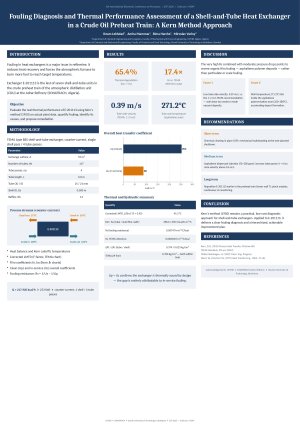
Fouling in heat exchangers is a major issue in refineries, directly reducing heat recovery and increasing fuel consumption. To address this issue and demonstrate the efficiency of a straightforward diagnostic method compared to extensive process simulations, exchanger E-201113, the last unit of the seven-exchanger crude preheat train at the Adrar Refinery, was selected for investigation, as it exhibited a marked decline in thermal performance during operation.
The evaluation was carried out using Kern's method, based on actual operating data. This comprised estimation of the heat duty, the corrected LMTD, the film coefficients for both sides, followed by determination of the clean and service overall heat transfer coefficients. The actual fouling resistance was estimated and compared against TEMA standard values.
A 65.4% drop in thermal efficiency was found, and the fouling resistance was 17.4 times higher than the TEMA reference. The diagnosis pointed to organic film fouling caused by asphaltene polymer deposits, attributed to two causes: a low tube-side velocity (0.39 m/s, below the recommended range of 1–2 m/s) and a tube wall temperature of 271.2°C, within the critical zone for asphaltene polymerization (220–280°C). The low velocity results mainly from an operational drift relative to the design flow rate.
Based on this diagnosis, a phased action plan is proposed. In the short term, chemical cleaning-in-place is recommended at 5,000–15,000 USD. In the medium term, dispersant inhibitor injection (300,000–1,200,000 USD/year, reducing fouling by 40–70%) and an increase in tube passes to raise the velocity are suggested. This would require verification of the hydraulic margin, as pressure drop scales with velocity squared. In the long term, repositioning the exchanger and a pinch analysis are recommended at 500,000–1,500,000 USD, to durably restore performance.
This case shows that Kern's method remains a practical, low-cost diagnostic approach for shell-and-tube exchangers; further work will focus on validating the economic estimates.
Keywords
shell-and-tube heat exchanger; fouling; crude oil preheating; Kern method; thermal performance; TEMA; asphaltene; refining
Poster
ECP2026_poster_E201113.pdf
Soy Residue Valorization Powers Sustainable Amylase Production by Exiguobacterium qingdaonense
Elucidation of Concerted and Non-Concerted Mechanisms in Pd-Catalyzed Direct C–H Arylation of Heterocycles: A DFT Investigation