Event submissions
Published
This submission belongs to the session S1. Environmental and Green Processes of the event The 5th International Electronic Conference on Processes
Published date
15 Oct, 2026
Academic Editor
'%3e%3cpath%20d='M12.6657%2010.9104C12.4185%2010.325%2012.0599%209.79327%2011.6097%209.34482C11.1609%208.89508%2010.6293%208.5365%2010.0442%208.28888C10.0389%208.28626%2010.0337%208.28495%2010.0285%208.28233C10.8446%207.69279%2011.3752%206.73249%2011.3752%205.64904C11.3752%203.8542%209.92103%202.39999%208.1262%202.39999C6.33136%202.39999%204.87715%203.8542%204.87715%205.64904C4.87715%206.73249%205.40774%207.69279%206.22393%208.28364C6.21869%208.28626%206.21345%208.28757%206.20821%208.29019C5.62129%208.5378%205.09463%208.89284%204.64265%209.34613C4.1929%209.79493%203.83432%2010.3266%203.58671%2010.9117C3.34345%2011.4845%203.21226%2012.0987%203.20023%2012.7209C3.19988%2012.7349%203.20233%2012.7488%203.20744%2012.7619C3.21255%2012.7749%203.22022%2012.7867%203.22998%2012.7968C3.23975%2012.8068%203.25142%2012.8147%203.26431%2012.8202C3.2772%2012.8256%203.29105%2012.8284%203.30504%2012.8284H4.09109C4.14874%2012.8284%204.19459%2012.7825%204.1959%2012.7262C4.2221%2011.7148%204.62823%2010.7676%205.34617%2010.0497C6.08899%209.30683%207.0755%208.89808%208.1262%208.89808C9.17689%208.89808%2010.1634%209.30683%2010.9062%2010.0497C11.6242%2010.7676%2012.0303%2011.7148%2012.0565%2012.7262C12.0578%2012.7838%2012.1037%2012.8284%2012.1613%2012.8284H12.9474C12.9613%2012.8284%2012.9752%2012.8256%2012.9881%2012.8202C13.001%2012.8147%2013.0126%2012.8068%2013.0224%2012.7968C13.0322%2012.7867%2013.0398%2012.7749%2013.0449%2012.7619C13.0501%2012.7488%2013.0525%2012.7349%2013.0522%2012.7209C13.0391%2012.0947%2012.9094%2011.4855%2012.6657%2010.9104ZM8.1262%207.9024C7.52486%207.9024%206.9589%207.6679%206.53312%207.24211C6.10733%206.81633%205.87283%206.25037%205.87283%205.64904C5.87283%205.0477%206.10733%204.48174%206.53312%204.05596C6.9589%203.63018%207.52486%203.39567%208.1262%203.39567C8.72753%203.39567%209.29349%203.63018%209.71927%204.05596C10.1451%204.48174%2010.3796%205.0477%2010.3796%205.64904C10.3796%206.25037%2010.1451%206.81633%209.71927%207.24211C9.29349%207.6679%208.72753%207.9024%208.1262%207.9024Z'%20fill='%235D1EE1'/%3e%3c/g%3e%3c/svg%3e) Juan Francisco García Martín
Juan Francisco García MartínCitation
Anastasia Saltevskaya, Anastasia Garkavaya, Antimicrobial activity of a fraction of pigment of microbial origin, in Proceedings of The 5th International Electronic Conference on Processes, 20 October–22 October 2026, MDPI: Basel, Switzerland
Share
Email
Facebook
Twitter
LinkedIn
Antimicrobial activity of a fraction of pigment of microbial origin
'%3e%3cpath%20d='M12.6647%2010.9104C12.4176%2010.325%2012.0589%209.7933%2011.6088%209.34485C11.16%208.89511%2010.6283%208.53653%2010.0432%208.28891C10.038%208.28629%2010.0327%208.28498%2010.0275%208.28236C10.8437%207.69282%2011.3743%206.73252%2011.3743%205.64907C11.3743%203.85423%209.92005%202.40002%208.12522%202.40002C6.33038%202.40002%204.87618%203.85423%204.87618%205.64907C4.87618%206.73252%205.40677%207.69282%206.22296%208.28367C6.21772%208.28629%206.21248%208.2876%206.20724%208.29022C5.62031%208.53783%205.09365%208.89287%204.64167%209.34616C4.19192%209.79496%203.83334%2010.3266%203.58573%2010.9117C3.34247%2011.4846%203.21128%2012.0987%203.19925%2012.721C3.1989%2012.735%203.20135%2012.7489%203.20646%2012.7619C3.21157%2012.7749%203.21924%2012.7868%203.22901%2012.7968C3.23877%2012.8068%203.25045%2012.8148%203.26334%2012.8202C3.27623%2012.8256%203.29007%2012.8284%203.30406%2012.8284H4.09012C4.14776%2012.8284%204.19362%2012.7825%204.19493%2012.7262C4.22113%2011.7148%204.62726%2010.7676%205.34519%2010.0497C6.08802%209.30686%207.07452%208.89811%208.12522%208.89811C9.17592%208.89811%2010.1624%209.30686%2010.9052%2010.0497C11.6232%2010.7676%2012.0293%2011.7148%2012.0555%2012.7262C12.0568%2012.7839%2012.1027%2012.8284%2012.1603%2012.8284H12.9464C12.9604%2012.8284%2012.9742%2012.8256%2012.9871%2012.8202C13%2012.8148%2013.0117%2012.8068%2013.0214%2012.7968C13.0312%2012.7868%2013.0389%2012.7749%2013.044%2012.7619C13.0491%2012.7489%2013.0515%2012.735%2013.0512%2012.721C13.0381%2012.0947%2012.9084%2011.4856%2012.6647%2010.9104ZM8.12522%207.90243C7.52388%207.90243%206.95792%207.66793%206.53214%207.24215C6.10636%206.81636%205.87185%206.2504%205.87185%205.64907C5.87185%205.04773%206.10636%204.48177%206.53214%204.05599C6.95792%203.63021%207.52388%203.3957%208.12522%203.3957C8.72655%203.3957%209.29252%203.63021%209.7183%204.05599C10.1441%204.48177%2010.3786%205.04773%2010.3786%205.64907C10.3786%206.2504%2010.1441%206.81636%209.7183%207.24215C9.29252%207.66793%208.72655%207.90243%208.12522%207.90243Z'%20fill='%235D1EE1'/%3e%3c/g%3e%3c/svg%3e)
Anastasia Saltevskaya 1
Anastasia Garkavaya 1
1. Biological Educational and Research Complex "Innovative Solutions", Belgorod State National Research University, Belgorod, Russia
Abstract
Bacterial pigments are structurally diverse low-molecular-weight secondary metabolites that perform adaptive, regulatory, and protective functions. Studying their antifungal potential is highly relevant given the current trend toward reducing synthetic chemical plant protection agents. Unlike traditional fungicides, bacterial pigment-based preparations do not induce pathogen resistance and do not accumulate in agroecosystems, thus supporting natural biodiversity.
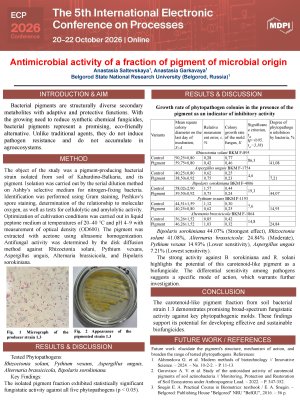
This study evaluated the antifungal activity of a pigment fraction from soil bacterial strain 1.3 against five mold fungi: Rhizoctonia solani, Pythium vexans, Aspergillus unguis, Alternaria brassicicola, and Bipolaris sorokiniana. The strain was grown in liquid peptone medium for 7 days at 25 °C. After centrifugation, cells were treated with acetone using an ultrasonic homogenizer. The supernatant was evaporated, and the resulting orange precipitate was dissolved in oleic acid. Based on its orange color, lack of water solubility, and solubility in organic solvents and fats, the fraction was presumptively identified as carotenoid-like.
Antifungal activity was assessed via the disk diffusion method. Petri dishes with Sabouraud medium received paper disks soaked in fungal spore suspensions, and 50 µL of pigment solution was added into surrounding wells. As a solvent control, oleic acid without the pigment was applied in parallel under identical conditions. Incubation at 25 °C for 5 days followed, with daily colony diameter measurements in two perpendicular directions. All experiments were performed in three independent replicates, and the data were analyzed using Student's t-test.
The isolated fraction exhibited statistically significant fungistatic activity against all five phytopathogens (p < 0.05). The strongest effect was against Bipolaris sorokiniana and Rhizoctonia solani, with inhibition rates of 44.07% and 41.08%, respectively. Moderate inhibition (24.84%) was noted for Alternaria brassicicola. Pythium vexans and Aspergillus unguis showed lower sensitivity, at 14.93% and 7.21%, respectively. These findings highlight the promising potential of the carotenoid-like pigment fraction from strain 1.3 for developing effective biofungicides.
Keywords
bacterial pigments
carotenoids
antifungal activity
fungistatic effect
phytopathogenic fungi
biofungicides
Poster
Antimicrobial activity of a fraction of pigment of microbial origin.pdf
Role and importance of proper kinetic parameter estimation during the kinetic modeling of COx Methanation
Heterogeneous Catalytic System for Biofuel Generation from Used Frying Oil