Event submissions
Published
This submission belongs to the session S1. Environmental and Green Processes of the event The 5th International Electronic Conference on Processes
Published date
15 Oct, 2026
Academic Editor
'%3e%3cpath%20d='M12.6657%2010.9104C12.4185%2010.325%2012.0599%209.79327%2011.6097%209.34482C11.1609%208.89508%2010.6293%208.5365%2010.0442%208.28888C10.0389%208.28626%2010.0337%208.28495%2010.0285%208.28233C10.8446%207.69279%2011.3752%206.73249%2011.3752%205.64904C11.3752%203.8542%209.92103%202.39999%208.1262%202.39999C6.33136%202.39999%204.87715%203.8542%204.87715%205.64904C4.87715%206.73249%205.40774%207.69279%206.22393%208.28364C6.21869%208.28626%206.21345%208.28757%206.20821%208.29019C5.62129%208.5378%205.09463%208.89284%204.64265%209.34613C4.1929%209.79493%203.83432%2010.3266%203.58671%2010.9117C3.34345%2011.4845%203.21226%2012.0987%203.20023%2012.7209C3.19988%2012.7349%203.20233%2012.7488%203.20744%2012.7619C3.21255%2012.7749%203.22022%2012.7867%203.22998%2012.7968C3.23975%2012.8068%203.25142%2012.8147%203.26431%2012.8202C3.2772%2012.8256%203.29105%2012.8284%203.30504%2012.8284H4.09109C4.14874%2012.8284%204.19459%2012.7825%204.1959%2012.7262C4.2221%2011.7148%204.62823%2010.7676%205.34617%2010.0497C6.08899%209.30683%207.0755%208.89808%208.1262%208.89808C9.17689%208.89808%2010.1634%209.30683%2010.9062%2010.0497C11.6242%2010.7676%2012.0303%2011.7148%2012.0565%2012.7262C12.0578%2012.7838%2012.1037%2012.8284%2012.1613%2012.8284H12.9474C12.9613%2012.8284%2012.9752%2012.8256%2012.9881%2012.8202C13.001%2012.8147%2013.0126%2012.8068%2013.0224%2012.7968C13.0322%2012.7867%2013.0398%2012.7749%2013.0449%2012.7619C13.0501%2012.7488%2013.0525%2012.7349%2013.0522%2012.7209C13.0391%2012.0947%2012.9094%2011.4855%2012.6657%2010.9104ZM8.1262%207.9024C7.52486%207.9024%206.9589%207.6679%206.53312%207.24211C6.10733%206.81633%205.87283%206.25037%205.87283%205.64904C5.87283%205.0477%206.10733%204.48174%206.53312%204.05596C6.9589%203.63018%207.52486%203.39567%208.1262%203.39567C8.72753%203.39567%209.29349%203.63018%209.71927%204.05596C10.1451%204.48174%2010.3796%205.0477%2010.3796%205.64904C10.3796%206.25037%2010.1451%206.81633%209.71927%207.24211C9.29349%207.6679%208.72753%207.9024%208.1262%207.9024Z'%20fill='%235D1EE1'/%3e%3c/g%3e%3c/svg%3e) Juan Francisco García Martín
Juan Francisco García MartínCitation
Adnan Aliyu, Zainab Habib Tijjani, Abdulmaleek Dahiru Kona, Graphene Functionalization for Enhanced Arsenic (As) Removal in Wastewater: A Computational Approach., in Proceedings of The 5th International Electronic Conference on Processes, 20 October–22 October 2026, MDPI: Basel, Switzerland
Share
Email
Facebook
Twitter
LinkedIn
Graphene Functionalization for Enhanced Arsenic (As) Removal in Wastewater: A Computational Approach.
'%3e%3cpath%20d='M12.6647%2010.9104C12.4176%2010.325%2012.0589%209.7933%2011.6088%209.34485C11.16%208.89511%2010.6283%208.53653%2010.0432%208.28891C10.038%208.28629%2010.0327%208.28498%2010.0275%208.28236C10.8437%207.69282%2011.3743%206.73252%2011.3743%205.64907C11.3743%203.85423%209.92005%202.40002%208.12522%202.40002C6.33038%202.40002%204.87618%203.85423%204.87618%205.64907C4.87618%206.73252%205.40677%207.69282%206.22296%208.28367C6.21772%208.28629%206.21248%208.2876%206.20724%208.29022C5.62031%208.53783%205.09365%208.89287%204.64167%209.34616C4.19192%209.79496%203.83334%2010.3266%203.58573%2010.9117C3.34247%2011.4846%203.21128%2012.0987%203.19925%2012.721C3.1989%2012.735%203.20135%2012.7489%203.20646%2012.7619C3.21157%2012.7749%203.21924%2012.7868%203.22901%2012.7968C3.23877%2012.8068%203.25045%2012.8148%203.26334%2012.8202C3.27623%2012.8256%203.29007%2012.8284%203.30406%2012.8284H4.09012C4.14776%2012.8284%204.19362%2012.7825%204.19493%2012.7262C4.22113%2011.7148%204.62726%2010.7676%205.34519%2010.0497C6.08802%209.30686%207.07452%208.89811%208.12522%208.89811C9.17592%208.89811%2010.1624%209.30686%2010.9052%2010.0497C11.6232%2010.7676%2012.0293%2011.7148%2012.0555%2012.7262C12.0568%2012.7839%2012.1027%2012.8284%2012.1603%2012.8284H12.9464C12.9604%2012.8284%2012.9742%2012.8256%2012.9871%2012.8202C13%2012.8148%2013.0117%2012.8068%2013.0214%2012.7968C13.0312%2012.7868%2013.0389%2012.7749%2013.044%2012.7619C13.0491%2012.7489%2013.0515%2012.735%2013.0512%2012.721C13.0381%2012.0947%2012.9084%2011.4856%2012.6647%2010.9104ZM8.12522%207.90243C7.52388%207.90243%206.95792%207.66793%206.53214%207.24215C6.10636%206.81636%205.87185%206.2504%205.87185%205.64907C5.87185%205.04773%206.10636%204.48177%206.53214%204.05599C6.95792%203.63021%207.52388%203.3957%208.12522%203.3957C8.72655%203.3957%209.29252%203.63021%209.7183%204.05599C10.1441%204.48177%2010.3786%205.04773%2010.3786%205.64907C10.3786%206.2504%2010.1441%206.81636%209.7183%207.24215C9.29252%207.66793%208.72655%207.90243%208.12522%207.90243Z'%20fill='%235D1EE1'/%3e%3c/g%3e%3c/svg%3e)
Adnan Aliyu 1,2
Zainab Habib Tijjani 2,3
Abdulmaleek Dahiru Kona 2,4
1. College of Engineering and Physical Sciences, Chemical and Biomedical Engineering Department, University of Wyoming, Laramie 82071, USA
2. Zuhra Educational Foundation, Zaria, Nigeria
3. Chemical Engineering Department, Ahmadu Bello University, Zaria 810211, Nigeria.
4. Swanson School of Engineering, Chemical and Petroleum Engineering Department, University of Pittsburgh, Pittsburgh 15213, USA
Abstract
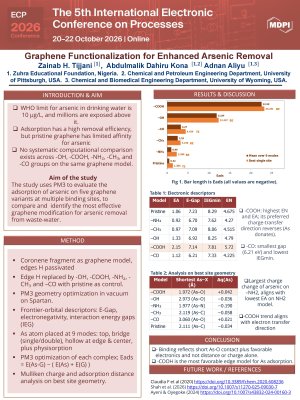
Arsenic contamination of water resources poses a public health threat, with long-term exposure linked to severe systemic health complications, including various forms of cancer. Although adsorption remains one of the most effective and cost-efficient water treatment strategies, its performance is highly dependent on the surface characteristics of the adsorbent material. Graphene has emerged as a promising adsorbent candidate; however, pristine graphene exhibits limited affinity towards arsenic, motivating the need for surface functionalization. This study investigates the role of covalent functionalization on the adsorption capacity of graphene for As removal in waste waters, exploring some selected functional groups and adsorption sites with the aim of identifying the most promising functionalized model via quantum molecular simulations. Six graphene models were examined: one pristine and five (5) functionalized with -OH, -COOH, -NH2, -CH3, and -CO groups. Adsorption potential across multiple sites, including top, bridge, hollow, and edge configurations was analyzed by employing PM3 calculations for the adsorption energy and quantum chemical properties. All functionalized graphene models exhibited promising adsorption potentials with enhanced selectivity, underscoring the superiority of functionalized graphene over pristine graphene and confirming the enhanced adsorption performance. The adsorption capacity followed this trend -COOH > -OH > -CO > -CH3 > -NH2 > Pure graphene. The -COOH functionalized model recorded the most favorable mean adsorption energy (-22.59 eV), driven by its relatively high electronegativity (5.72 eV) and electron affinity (2.15 eV). The edge bridge sites were consistently the preferred adsorption configuration across all models and agrees with previous findings reported in the literature. Our findings demonstrate that covalent functionalization, particularly with electron-withdrawing groups, significantly enhances the As adsorption capacity of graphene, positioning carboxyl-functionalized graphene as a strong candidate for As adsorption in water.
Keywords
Water treatment
arsenic
functionalization
molecular simulation
adsorption
Poster
Graphene Functionalization for Arsenic Removal.pdf
Heterogeneous Catalytic System for Biofuel Generation from Used Frying Oil
Interphase distribution of Ti(IV), rare metal, and rare-earth metal ions in hydrochloric acid solution – bifunctional hydrophobic ionic liquid system