Event submissions
Published
This submission belongs to the session S4. Process Control, Monitoring and Machine Learning of the event The 5th International Electronic Conference on Processes
Published date
15 Oct, 2026
Academic Editor
'%3e%3cpath%20d='M12.6657%2010.9104C12.4185%2010.325%2012.0599%209.79327%2011.6097%209.34482C11.1609%208.89508%2010.6293%208.5365%2010.0442%208.28888C10.0389%208.28626%2010.0337%208.28495%2010.0285%208.28233C10.8446%207.69279%2011.3752%206.73249%2011.3752%205.64904C11.3752%203.8542%209.92103%202.39999%208.1262%202.39999C6.33136%202.39999%204.87715%203.8542%204.87715%205.64904C4.87715%206.73249%205.40774%207.69279%206.22393%208.28364C6.21869%208.28626%206.21345%208.28757%206.20821%208.29019C5.62129%208.5378%205.09463%208.89284%204.64265%209.34613C4.1929%209.79493%203.83432%2010.3266%203.58671%2010.9117C3.34345%2011.4845%203.21226%2012.0987%203.20023%2012.7209C3.19988%2012.7349%203.20233%2012.7488%203.20744%2012.7619C3.21255%2012.7749%203.22022%2012.7867%203.22998%2012.7968C3.23975%2012.8068%203.25142%2012.8147%203.26431%2012.8202C3.2772%2012.8256%203.29105%2012.8284%203.30504%2012.8284H4.09109C4.14874%2012.8284%204.19459%2012.7825%204.1959%2012.7262C4.2221%2011.7148%204.62823%2010.7676%205.34617%2010.0497C6.08899%209.30683%207.0755%208.89808%208.1262%208.89808C9.17689%208.89808%2010.1634%209.30683%2010.9062%2010.0497C11.6242%2010.7676%2012.0303%2011.7148%2012.0565%2012.7262C12.0578%2012.7838%2012.1037%2012.8284%2012.1613%2012.8284H12.9474C12.9613%2012.8284%2012.9752%2012.8256%2012.9881%2012.8202C13.001%2012.8147%2013.0126%2012.8068%2013.0224%2012.7968C13.0322%2012.7867%2013.0398%2012.7749%2013.0449%2012.7619C13.0501%2012.7488%2013.0525%2012.7349%2013.0522%2012.7209C13.0391%2012.0947%2012.9094%2011.4855%2012.6657%2010.9104ZM8.1262%207.9024C7.52486%207.9024%206.9589%207.6679%206.53312%207.24211C6.10733%206.81633%205.87283%206.25037%205.87283%205.64904C5.87283%205.0477%206.10733%204.48174%206.53312%204.05596C6.9589%203.63018%207.52486%203.39567%208.1262%203.39567C8.72753%203.39567%209.29349%203.63018%209.71927%204.05596C10.1451%204.48174%2010.3796%205.0477%2010.3796%205.64904C10.3796%206.25037%2010.1451%206.81633%209.71927%207.24211C9.29349%207.6679%208.72753%207.9024%208.1262%207.9024Z'%20fill='%235D1EE1'/%3e%3c/g%3e%3c/svg%3e) Ravendra Singh
Ravendra SinghCitation
Esdras Miranda Lemos, Raul Duarte Campilho, João Miguel Machado, Ricardo Jorge Rocha, Non-conformity Mitigation Strategies in Composite Materials: A MASP-PDCA Approach for Sustainable Production in the Aerospace Industry, in Proceedings of The 5th International Electronic Conference on Processes, 20 October–22 October 2026, MDPI: Basel, Switzerland
Share
Email
Facebook
Twitter
LinkedIn
Non-conformity Mitigation Strategies in Composite Materials: A MASP-PDCA Approach for Sustainable Production in the Aerospace Industry
'%3e%3cpath%20d='M12.6647%2010.9104C12.4176%2010.325%2012.0589%209.7933%2011.6088%209.34485C11.16%208.89511%2010.6283%208.53653%2010.0432%208.28891C10.038%208.28629%2010.0327%208.28498%2010.0275%208.28236C10.8437%207.69282%2011.3743%206.73252%2011.3743%205.64907C11.3743%203.85423%209.92005%202.40002%208.12522%202.40002C6.33038%202.40002%204.87618%203.85423%204.87618%205.64907C4.87618%206.73252%205.40677%207.69282%206.22296%208.28367C6.21772%208.28629%206.21248%208.2876%206.20724%208.29022C5.62031%208.53783%205.09365%208.89287%204.64167%209.34616C4.19192%209.79496%203.83334%2010.3266%203.58573%2010.9117C3.34247%2011.4846%203.21128%2012.0987%203.19925%2012.721C3.1989%2012.735%203.20135%2012.7489%203.20646%2012.7619C3.21157%2012.7749%203.21924%2012.7868%203.22901%2012.7968C3.23877%2012.8068%203.25045%2012.8148%203.26334%2012.8202C3.27623%2012.8256%203.29007%2012.8284%203.30406%2012.8284H4.09012C4.14776%2012.8284%204.19362%2012.7825%204.19493%2012.7262C4.22113%2011.7148%204.62726%2010.7676%205.34519%2010.0497C6.08802%209.30686%207.07452%208.89811%208.12522%208.89811C9.17592%208.89811%2010.1624%209.30686%2010.9052%2010.0497C11.6232%2010.7676%2012.0293%2011.7148%2012.0555%2012.7262C12.0568%2012.7839%2012.1027%2012.8284%2012.1603%2012.8284H12.9464C12.9604%2012.8284%2012.9742%2012.8256%2012.9871%2012.8202C13%2012.8148%2013.0117%2012.8068%2013.0214%2012.7968C13.0312%2012.7868%2013.0389%2012.7749%2013.044%2012.7619C13.0491%2012.7489%2013.0515%2012.735%2013.0512%2012.721C13.0381%2012.0947%2012.9084%2011.4856%2012.6647%2010.9104ZM8.12522%207.90243C7.52388%207.90243%206.95792%207.66793%206.53214%207.24215C6.10636%206.81636%205.87185%206.2504%205.87185%205.64907C5.87185%205.04773%206.10636%204.48177%206.53214%204.05599C6.95792%203.63021%207.52388%203.3957%208.12522%203.3957C8.72655%203.3957%209.29252%203.63021%209.7183%204.05599C10.1441%204.48177%2010.3786%205.04773%2010.3786%205.64907C10.3786%206.2504%2010.1441%206.81636%209.7183%207.24215C9.29252%207.66793%208.72655%207.90243%208.12522%207.90243Z'%20fill='%235D1EE1'/%3e%3c/g%3e%3c/svg%3e)
Esdras Miranda Lemos 1

Raul Duarte Campilho 1
João Miguel Machado 2
Ricardo Jorge Rocha 1,2
1. Department of Mechanical Engineering, ISEP, Polytechnic of Porto, Porto, R. Dr. António Bernardino de Almeida, 431, Post Code: 4200-072, Portugal
2. Institute of Science and Innovation in Mechanical and Industrial Engineering (INEGI), Rua Dr Roberto Frias, 400, 4200-465 Porto, Portugal
Abstract
The manufacturing of composite structures is an essential pillar of the aerospace industry due to the excellent strength-to-weight ratio and outstanding structural performance of these materials. However, because it involves highly complex processes that are extremely sensitive to operational variables, this sector faces constant challenges with structural failures and significant production losses.To overcome these obstacles, this study presents a practical, integrated continuous improvement proposal that combines the PDCA cycle with the Method of Problem Analysis and Solving (MASP), using statistical analyses applied directly on the shop floor. The major differentiator of this work is not merely the diagnosis based on six fundamental dimensions materials, process parameters, equipment, human factors, environment, and operational procedures but rather the methodological articulation of well-established tools, such as the Ishikawa diagram and Process FMEA, integrated within the planning stage of the PDCA cycle. This innovative integration rests on three fundamental practical pillars: the functional fusion of tools that are usually applied in isolation; the quantitative validation of results by product family, comparing indicators before and after the actions taken; and the assurance of aerospace normative traceability, directly linking each corrective action to a Standard Operating Procedure (SOP). To test the model, a practical case study was conducted on a real aeronautical component manufacturing line. Data analysis revealed that only three types of problems stood out — geometric deviations, delamination, and negative deformations and that these issues accounted for approximately 72% of all production losses on the line. In addition, human factors and fluctuations in the material's curing parameters were identified as the crucial determinants behind the occurrence of these failures. Ultimately, the study demonstrates that combining real production data with continuous improvement methodologies is the path to success for reducing waste, saving financial resources, and supporting far more sustainable manufacturing practices.
Keywords
Scrap
Failure Mode and Effects Analysis
Ishikawa
Method of Problem Analysis and Solving
Plan-Do-Check-Act
Poster
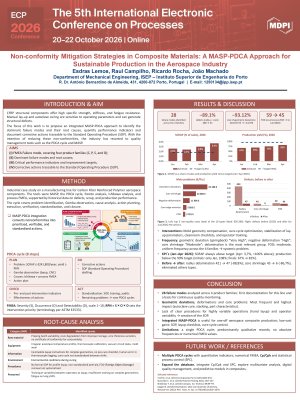
MASP-PDCA_Composites_EN.pdf
Prediction of Oxidation Reduction Potential (ORP) in Sewage Wastewater using Phytoremediation Process and Machine Learning Techniques
Machine Learning-Based Prediction of Catalytic Activity for CO2 Hydrogenation Reactions Using Physicochemical Descriptors