Event submissions
Published
This submission belongs to the session S4. Process Control, Monitoring and Machine Learning of the event The 5th International Electronic Conference on Processes
Published date
15 Oct, 2026
Academic Editor
'%3e%3cpath%20d='M12.6657%2010.9104C12.4185%2010.325%2012.0599%209.79327%2011.6097%209.34482C11.1609%208.89508%2010.6293%208.5365%2010.0442%208.28888C10.0389%208.28626%2010.0337%208.28495%2010.0285%208.28233C10.8446%207.69279%2011.3752%206.73249%2011.3752%205.64904C11.3752%203.8542%209.92103%202.39999%208.1262%202.39999C6.33136%202.39999%204.87715%203.8542%204.87715%205.64904C4.87715%206.73249%205.40774%207.69279%206.22393%208.28364C6.21869%208.28626%206.21345%208.28757%206.20821%208.29019C5.62129%208.5378%205.09463%208.89284%204.64265%209.34613C4.1929%209.79493%203.83432%2010.3266%203.58671%2010.9117C3.34345%2011.4845%203.21226%2012.0987%203.20023%2012.7209C3.19988%2012.7349%203.20233%2012.7488%203.20744%2012.7619C3.21255%2012.7749%203.22022%2012.7867%203.22998%2012.7968C3.23975%2012.8068%203.25142%2012.8147%203.26431%2012.8202C3.2772%2012.8256%203.29105%2012.8284%203.30504%2012.8284H4.09109C4.14874%2012.8284%204.19459%2012.7825%204.1959%2012.7262C4.2221%2011.7148%204.62823%2010.7676%205.34617%2010.0497C6.08899%209.30683%207.0755%208.89808%208.1262%208.89808C9.17689%208.89808%2010.1634%209.30683%2010.9062%2010.0497C11.6242%2010.7676%2012.0303%2011.7148%2012.0565%2012.7262C12.0578%2012.7838%2012.1037%2012.8284%2012.1613%2012.8284H12.9474C12.9613%2012.8284%2012.9752%2012.8256%2012.9881%2012.8202C13.001%2012.8147%2013.0126%2012.8068%2013.0224%2012.7968C13.0322%2012.7867%2013.0398%2012.7749%2013.0449%2012.7619C13.0501%2012.7488%2013.0525%2012.7349%2013.0522%2012.7209C13.0391%2012.0947%2012.9094%2011.4855%2012.6657%2010.9104ZM8.1262%207.9024C7.52486%207.9024%206.9589%207.6679%206.53312%207.24211C6.10733%206.81633%205.87283%206.25037%205.87283%205.64904C5.87283%205.0477%206.10733%204.48174%206.53312%204.05596C6.9589%203.63018%207.52486%203.39567%208.1262%203.39567C8.72753%203.39567%209.29349%203.63018%209.71927%204.05596C10.1451%204.48174%2010.3796%205.0477%2010.3796%205.64904C10.3796%206.25037%2010.1451%206.81633%209.71927%207.24211C9.29349%207.6679%208.72753%207.9024%208.1262%207.9024Z'%20fill='%235D1EE1'/%3e%3c/g%3e%3c/svg%3e) Ravendra Singh
Ravendra SinghCitation
SIDDHARTH MODI, Dhrumil Gandhi, Niraj Nair, Jaydeep Jivani, Himanshu Patel, Surendar Varadharajan, Dynamic Risk Assessment of Hydrogen Pipeline Leaks using Bow-Tie Analysis with Bayesian Updating, in Proceedings of The 5th International Electronic Conference on Processes, 20 October–22 October 2026, MDPI: Basel, Switzerland
Share
Email
Facebook
Twitter
LinkedIn
Dynamic Risk Assessment of Hydrogen Pipeline Leaks using Bow-Tie Analysis with Bayesian Updating
'%3e%3cpath%20d='M12.6647%2010.9104C12.4176%2010.325%2012.0589%209.7933%2011.6088%209.34485C11.16%208.89511%2010.6283%208.53653%2010.0432%208.28891C10.038%208.28629%2010.0327%208.28498%2010.0275%208.28236C10.8437%207.69282%2011.3743%206.73252%2011.3743%205.64907C11.3743%203.85423%209.92005%202.40002%208.12522%202.40002C6.33038%202.40002%204.87618%203.85423%204.87618%205.64907C4.87618%206.73252%205.40677%207.69282%206.22296%208.28367C6.21772%208.28629%206.21248%208.2876%206.20724%208.29022C5.62031%208.53783%205.09365%208.89287%204.64167%209.34616C4.19192%209.79496%203.83334%2010.3266%203.58573%2010.9117C3.34247%2011.4846%203.21128%2012.0987%203.19925%2012.721C3.1989%2012.735%203.20135%2012.7489%203.20646%2012.7619C3.21157%2012.7749%203.21924%2012.7868%203.22901%2012.7968C3.23877%2012.8068%203.25045%2012.8148%203.26334%2012.8202C3.27623%2012.8256%203.29007%2012.8284%203.30406%2012.8284H4.09012C4.14776%2012.8284%204.19362%2012.7825%204.19493%2012.7262C4.22113%2011.7148%204.62726%2010.7676%205.34519%2010.0497C6.08802%209.30686%207.07452%208.89811%208.12522%208.89811C9.17592%208.89811%2010.1624%209.30686%2010.9052%2010.0497C11.6232%2010.7676%2012.0293%2011.7148%2012.0555%2012.7262C12.0568%2012.7839%2012.1027%2012.8284%2012.1603%2012.8284H12.9464C12.9604%2012.8284%2012.9742%2012.8256%2012.9871%2012.8202C13%2012.8148%2013.0117%2012.8068%2013.0214%2012.7968C13.0312%2012.7868%2013.0389%2012.7749%2013.044%2012.7619C13.0491%2012.7489%2013.0515%2012.735%2013.0512%2012.721C13.0381%2012.0947%2012.9084%2011.4856%2012.6647%2010.9104ZM8.12522%207.90243C7.52388%207.90243%206.95792%207.66793%206.53214%207.24215C6.10636%206.81636%205.87185%206.2504%205.87185%205.64907C5.87185%205.04773%206.10636%204.48177%206.53214%204.05599C6.95792%203.63021%207.52388%203.3957%208.12522%203.3957C8.72655%203.3957%209.29252%203.63021%209.7183%204.05599C10.1441%204.48177%2010.3786%205.04773%2010.3786%205.64907C10.3786%206.2504%2010.1441%206.81636%209.7183%207.24215C9.29252%207.66793%208.72655%207.90243%208.12522%207.90243Z'%20fill='%235D1EE1'/%3e%3c/g%3e%3c/svg%3e)
SIDDHARTH MODI 1
Dhrumil Gandhi 1
Niraj Nair 1
Jaydeep Jivani 1
Himanshu Patel 2
Surendar Varadharajan 3
1. Department of Chemical Engineering, Dharmsinh Desai University, Nadiad – 387 001, Gujarat, India
2. Department of Instrumentation and Control, Dharmsinh Desai University (DDU), Nadiad – 387 001, Gujarat, India
3. Sustainability Cluster, School of Advanced Engineering, University of Petroleum and Energy Studies (UPES), Dehradun, Uttarakhand, India
Abstract
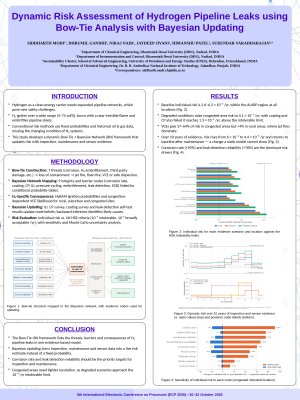
The increasing usage of hydrogen as a clean energy carrier requires expanded pipeline infrastructure, which poses safety challenges that cannot be addressed using conventional approaches alone. Unlike natural gas, hydrogen is far more reactive, and it readily ignites across a wide concentration range, burns with a flame that is difficult to detect, and gradually weakens the pipeline materials through embrittlement. These characteristics of hydrogen make failures both harder to predict and potentially more severe. Traditional risk assessment methods, which rely on fixed probabilities and historical oil and gas data, often fail to reflect the real, changing conditions of hydrogen systems. This study presents a more practical and realistic approach by introducing a dynamic, evidence-based risk framework. The proposed risk framework has at its core an evidence-based model capable not only of mapping possible failure events and their respective consequences but also of adapting according to the availability of new data on the integrity of the pipeline, such as the outcomes of inspections or maintenance operations and the status of any monitoring sensors installed in the system. The results suggest that the corrosion rate and leak detection reliability are the dominant risk drivers, making them the most critical targets for inspection and maintenance. The analysis also highlights that the consequences are location dependent, with vapour cloud explosions dominating in congested areas and degraded scenarios nearing the 10-4 per year intolerable risk threshold, which justifies the dynamic assessment. Overall, the framework presented here offers a clear, verifiable, and evidence-based approach for determining inspection priorities, maintenance schedules, and escalation actions that is not achievable through a fixed probability approach.
Keywords
Hydrogen Safety
Pipeline Safety
Risk Assessment
Bow-Tie Analysis
Bayesian Network
Poster
H2_Pipeline_Poster.pdf
Optimization of Operational Efficiency in the Production of Composite Aircraft Structures
Data-Driven Analysis of Gas Turbine Operating Regimes and Emission Patterns Using K-Means Clustering