Event submissions
Published
This submission belongs to the session S4. Process Control, Monitoring and Machine Learning of the event The 5th International Electronic Conference on Processes
Published date
15 Oct, 2026
Academic Editor
'%3e%3cpath%20d='M12.6657%2010.9104C12.4185%2010.325%2012.0599%209.79327%2011.6097%209.34482C11.1609%208.89508%2010.6293%208.5365%2010.0442%208.28888C10.0389%208.28626%2010.0337%208.28495%2010.0285%208.28233C10.8446%207.69279%2011.3752%206.73249%2011.3752%205.64904C11.3752%203.8542%209.92103%202.39999%208.1262%202.39999C6.33136%202.39999%204.87715%203.8542%204.87715%205.64904C4.87715%206.73249%205.40774%207.69279%206.22393%208.28364C6.21869%208.28626%206.21345%208.28757%206.20821%208.29019C5.62129%208.5378%205.09463%208.89284%204.64265%209.34613C4.1929%209.79493%203.83432%2010.3266%203.58671%2010.9117C3.34345%2011.4845%203.21226%2012.0987%203.20023%2012.7209C3.19988%2012.7349%203.20233%2012.7488%203.20744%2012.7619C3.21255%2012.7749%203.22022%2012.7867%203.22998%2012.7968C3.23975%2012.8068%203.25142%2012.8147%203.26431%2012.8202C3.2772%2012.8256%203.29105%2012.8284%203.30504%2012.8284H4.09109C4.14874%2012.8284%204.19459%2012.7825%204.1959%2012.7262C4.2221%2011.7148%204.62823%2010.7676%205.34617%2010.0497C6.08899%209.30683%207.0755%208.89808%208.1262%208.89808C9.17689%208.89808%2010.1634%209.30683%2010.9062%2010.0497C11.6242%2010.7676%2012.0303%2011.7148%2012.0565%2012.7262C12.0578%2012.7838%2012.1037%2012.8284%2012.1613%2012.8284H12.9474C12.9613%2012.8284%2012.9752%2012.8256%2012.9881%2012.8202C13.001%2012.8147%2013.0126%2012.8068%2013.0224%2012.7968C13.0322%2012.7867%2013.0398%2012.7749%2013.0449%2012.7619C13.0501%2012.7488%2013.0525%2012.7349%2013.0522%2012.7209C13.0391%2012.0947%2012.9094%2011.4855%2012.6657%2010.9104ZM8.1262%207.9024C7.52486%207.9024%206.9589%207.6679%206.53312%207.24211C6.10733%206.81633%205.87283%206.25037%205.87283%205.64904C5.87283%205.0477%206.10733%204.48174%206.53312%204.05596C6.9589%203.63018%207.52486%203.39567%208.1262%203.39567C8.72753%203.39567%209.29349%203.63018%209.71927%204.05596C10.1451%204.48174%2010.3796%205.0477%2010.3796%205.64904C10.3796%206.25037%2010.1451%206.81633%209.71927%207.24211C9.29349%207.6679%208.72753%207.9024%208.1262%207.9024Z'%20fill='%235D1EE1'/%3e%3c/g%3e%3c/svg%3e) Ravendra Singh
Ravendra SinghCitation
Botir Shukrullayevich Usmonov, Azizbek Kamolov, Yusuf Jo'raqobilovich Boysariyev, Real-Time Locomotion Process Control in a Biomimetic Quadruped Robot Using Sensor Fusion and Hierarchical State-Machine Architecture, in Proceedings of The 5th International Electronic Conference on Processes, 20 October–22 October 2026, MDPI: Basel, Switzerland
Share
Email
Facebook
Twitter
LinkedIn
Real-Time Locomotion Process Control in a Biomimetic Quadruped Robot Using Sensor Fusion and Hierarchical State-Machine Architecture

Botir Shukrullayevich Usmonov 1

Azizbek Kamolov 1
'%3e%3cpath%20d='M12.6647%2010.9104C12.4176%2010.325%2012.0589%209.7933%2011.6088%209.34485C11.16%208.89511%2010.6283%208.53653%2010.0432%208.28891C10.038%208.28629%2010.0327%208.28498%2010.0275%208.28236C10.8437%207.69282%2011.3743%206.73252%2011.3743%205.64907C11.3743%203.85423%209.92005%202.40002%208.12522%202.40002C6.33038%202.40002%204.87618%203.85423%204.87618%205.64907C4.87618%206.73252%205.40677%207.69282%206.22296%208.28367C6.21772%208.28629%206.21248%208.2876%206.20724%208.29022C5.62031%208.53783%205.09365%208.89287%204.64167%209.34616C4.19192%209.79496%203.83334%2010.3266%203.58573%2010.9117C3.34247%2011.4846%203.21128%2012.0987%203.19925%2012.721C3.1989%2012.735%203.20135%2012.7489%203.20646%2012.7619C3.21157%2012.7749%203.21924%2012.7868%203.22901%2012.7968C3.23877%2012.8068%203.25045%2012.8148%203.26334%2012.8202C3.27623%2012.8256%203.29007%2012.8284%203.30406%2012.8284H4.09012C4.14776%2012.8284%204.19362%2012.7825%204.19493%2012.7262C4.22113%2011.7148%204.62726%2010.7676%205.34519%2010.0497C6.08802%209.30686%207.07452%208.89811%208.12522%208.89811C9.17592%208.89811%2010.1624%209.30686%2010.9052%2010.0497C11.6232%2010.7676%2012.0293%2011.7148%2012.0555%2012.7262C12.0568%2012.7839%2012.1027%2012.8284%2012.1603%2012.8284H12.9464C12.9604%2012.8284%2012.9742%2012.8256%2012.9871%2012.8202C13%2012.8148%2013.0117%2012.8068%2013.0214%2012.7968C13.0312%2012.7868%2013.0389%2012.7749%2013.044%2012.7619C13.0491%2012.7489%2013.0515%2012.735%2013.0512%2012.721C13.0381%2012.0947%2012.9084%2011.4856%2012.6647%2010.9104ZM8.12522%207.90243C7.52388%207.90243%206.95792%207.66793%206.53214%207.24215C6.10636%206.81636%205.87185%206.2504%205.87185%205.64907C5.87185%205.04773%206.10636%204.48177%206.53214%204.05599C6.95792%203.63021%207.52388%203.3957%208.12522%203.3957C8.72655%203.3957%209.29252%203.63021%209.7183%204.05599C10.1441%204.48177%2010.3786%205.04773%2010.3786%205.64907C10.3786%206.2504%2010.1441%206.81636%209.7183%207.24215C9.29252%207.66793%208.72655%207.90243%208.12522%207.90243Z'%20fill='%235D1EE1'/%3e%3c/g%3e%3c/svg%3e)
Yusuf Jo'raqobilovich Boysariyev 1
1. Department of Automation and Digital Control, Faculty of Industrial Engineering, Tashkent Institute of Chemical Technology, Tashkent, 100011, Uzbekistan
Abstract
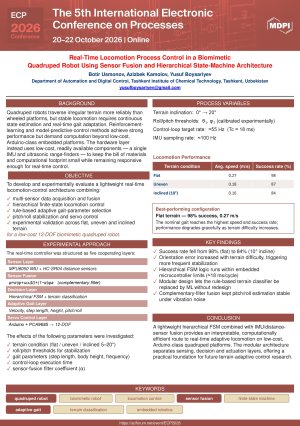
Introduction: Biomimetic quadruped robots replicating mammalian locomotion are emerging as autonomous platforms for process monitoring and inspection in unstructured environments. Reproducing the multi-gait, dynamically stable movement of the red fox (Vulpes vulpes) requires a tightly integrated control architecture capable of real-time sensing, adaptive gait switching, and obstacle avoidance within embedded hardware constraints.
Methods: The mechanical platform consists of FDM 3D-printed components (PLA/ABS, 0.15 mm layer height) with embedded cable routing, assembled around eight SG90 servo actuators—two per limb—driven by an Arduino Uno microcontroller. Joint-angle profiles for the knee (110–130°), hip (90–100°), and shoulder (~120°) were derived from biomechanical analysis of Vulpes vulpes locomotion. The control software implements four hierarchical layers: a hardware abstraction layer for PWM servo control; a sensor acquisition layer processing dual HC-SR04 ultrasonic rangefinders and a photoresistor (LDR); a proximity-based perception and planning layer; and a behavioural decision layer encoding four hierarchical finite-state machine (HFSM) states—stand, walk, trot, and obstacle avoidance—with sensor-triggered transitions. Pseudo-parallel limb motion is achieved through 1° incremental servo stepping at 15 ms intervals.
Results: Evaluation on a 4×6 m multi-surface arena using an OptiTrack motion-capture system (12 cameras, 120 Hz) over 100 standardised cycles yielded: positioning accuracy ±2 cm (hard surface) and ±5 cm (loose substrate); end-to-end sensor response latency 120 ms; obstacle-avoidance success rate 98%; peak gait-control efficiency 68% in trot mode; autonomous runtime 3 h per charge; and lateral disturbance tolerance up to 3 N. The system satisfies 83% of design targets.
Conclusion: A biologically-grounded hierarchical control architecture produces stable, energy-efficient locomotion on a low-cost microcontroller platform and provides an extensible foundation for future integration of inertial sensing, computer vision, and machine-learning gait adaptation, with direct applicability to autonomous process-monitoring systems in terrain-variable environments.
Keywords
Keywords: biomimetic robot
locomotion process control
hierarchical finite-state machine
sensor fusion
quadruped
obstacle avoidance
servo actuation
real-time monitoring
bioinspired engineering
Arduino
Poster
ECP2026_Poster_Gallery_Style2_1080x1536.pdf
Hydrothermal Synthesis and Fe Surface Decoration of TiO2 for Enhanced Photocatalytic CO2 Reduction
Intelligent Steam Consumption Control in Tire Vulcanization Processes Using ANFIS-GA Digital Twin Modeling and MPC