Event submissions
Published
This submission belongs to the session S1. Environmental and Green Processes of the event The 5th International Electronic Conference on Processes
Published date
15 Oct, 2026
Academic Editor
'%3e%3cpath%20d='M12.6657%2010.9104C12.4185%2010.325%2012.0599%209.79327%2011.6097%209.34482C11.1609%208.89508%2010.6293%208.5365%2010.0442%208.28888C10.0389%208.28626%2010.0337%208.28495%2010.0285%208.28233C10.8446%207.69279%2011.3752%206.73249%2011.3752%205.64904C11.3752%203.8542%209.92103%202.39999%208.1262%202.39999C6.33136%202.39999%204.87715%203.8542%204.87715%205.64904C4.87715%206.73249%205.40774%207.69279%206.22393%208.28364C6.21869%208.28626%206.21345%208.28757%206.20821%208.29019C5.62129%208.5378%205.09463%208.89284%204.64265%209.34613C4.1929%209.79493%203.83432%2010.3266%203.58671%2010.9117C3.34345%2011.4845%203.21226%2012.0987%203.20023%2012.7209C3.19988%2012.7349%203.20233%2012.7488%203.20744%2012.7619C3.21255%2012.7749%203.22022%2012.7867%203.22998%2012.7968C3.23975%2012.8068%203.25142%2012.8147%203.26431%2012.8202C3.2772%2012.8256%203.29105%2012.8284%203.30504%2012.8284H4.09109C4.14874%2012.8284%204.19459%2012.7825%204.1959%2012.7262C4.2221%2011.7148%204.62823%2010.7676%205.34617%2010.0497C6.08899%209.30683%207.0755%208.89808%208.1262%208.89808C9.17689%208.89808%2010.1634%209.30683%2010.9062%2010.0497C11.6242%2010.7676%2012.0303%2011.7148%2012.0565%2012.7262C12.0578%2012.7838%2012.1037%2012.8284%2012.1613%2012.8284H12.9474C12.9613%2012.8284%2012.9752%2012.8256%2012.9881%2012.8202C13.001%2012.8147%2013.0126%2012.8068%2013.0224%2012.7968C13.0322%2012.7867%2013.0398%2012.7749%2013.0449%2012.7619C13.0501%2012.7488%2013.0525%2012.7349%2013.0522%2012.7209C13.0391%2012.0947%2012.9094%2011.4855%2012.6657%2010.9104ZM8.1262%207.9024C7.52486%207.9024%206.9589%207.6679%206.53312%207.24211C6.10733%206.81633%205.87283%206.25037%205.87283%205.64904C5.87283%205.0477%206.10733%204.48174%206.53312%204.05596C6.9589%203.63018%207.52486%203.39567%208.1262%203.39567C8.72753%203.39567%209.29349%203.63018%209.71927%204.05596C10.1451%204.48174%2010.3796%205.0477%2010.3796%205.64904C10.3796%206.25037%2010.1451%206.81633%209.71927%207.24211C9.29349%207.6679%208.72753%207.9024%208.1262%207.9024Z'%20fill='%235D1EE1'/%3e%3c/g%3e%3c/svg%3e) Juan Francisco García Martín
Juan Francisco García MartínCitation
HADJER MABROUKI, ROSA HAOUCHE, ROUFAIDA AISSA BRAHIM, NADIA HAMZA, DJAMEL EDDINE AKRETCHE, Ultrasound-Assisted Green Synthesis of Silver Nanoparticles Using Moringa Oleifera Extract: Characterization and Evaluation of Antioxidant and Antimicrobial Activities, in Proceedings of The 5th International Electronic Conference on Processes, 20 October–22 October 2026, MDPI: Basel, Switzerland
Share
Email
Facebook
Twitter
LinkedIn
Ultrasound-Assisted Green Synthesis of Silver Nanoparticles Using Moringa Oleifera Extract: Characterization and Evaluation of Antioxidant and Antimicrobial Activities
'%3e%3cpath%20d='M12.6647%2010.9104C12.4176%2010.325%2012.0589%209.7933%2011.6088%209.34485C11.16%208.89511%2010.6283%208.53653%2010.0432%208.28891C10.038%208.28629%2010.0327%208.28498%2010.0275%208.28236C10.8437%207.69282%2011.3743%206.73252%2011.3743%205.64907C11.3743%203.85423%209.92005%202.40002%208.12522%202.40002C6.33038%202.40002%204.87618%203.85423%204.87618%205.64907C4.87618%206.73252%205.40677%207.69282%206.22296%208.28367C6.21772%208.28629%206.21248%208.2876%206.20724%208.29022C5.62031%208.53783%205.09365%208.89287%204.64167%209.34616C4.19192%209.79496%203.83334%2010.3266%203.58573%2010.9117C3.34247%2011.4846%203.21128%2012.0987%203.19925%2012.721C3.1989%2012.735%203.20135%2012.7489%203.20646%2012.7619C3.21157%2012.7749%203.21924%2012.7868%203.22901%2012.7968C3.23877%2012.8068%203.25045%2012.8148%203.26334%2012.8202C3.27623%2012.8256%203.29007%2012.8284%203.30406%2012.8284H4.09012C4.14776%2012.8284%204.19362%2012.7825%204.19493%2012.7262C4.22113%2011.7148%204.62726%2010.7676%205.34519%2010.0497C6.08802%209.30686%207.07452%208.89811%208.12522%208.89811C9.17592%208.89811%2010.1624%209.30686%2010.9052%2010.0497C11.6232%2010.7676%2012.0293%2011.7148%2012.0555%2012.7262C12.0568%2012.7839%2012.1027%2012.8284%2012.1603%2012.8284H12.9464C12.9604%2012.8284%2012.9742%2012.8256%2012.9871%2012.8202C13%2012.8148%2013.0117%2012.8068%2013.0214%2012.7968C13.0312%2012.7868%2013.0389%2012.7749%2013.044%2012.7619C13.0491%2012.7489%2013.0515%2012.735%2013.0512%2012.721C13.0381%2012.0947%2012.9084%2011.4856%2012.6647%2010.9104ZM8.12522%207.90243C7.52388%207.90243%206.95792%207.66793%206.53214%207.24215C6.10636%206.81636%205.87185%206.2504%205.87185%205.64907C5.87185%205.04773%206.10636%204.48177%206.53214%204.05599C6.95792%203.63021%207.52388%203.3957%208.12522%203.3957C8.72655%203.3957%209.29252%203.63021%209.7183%204.05599C10.1441%204.48177%2010.3786%205.04773%2010.3786%205.64907C10.3786%206.2504%2010.1441%206.81636%209.7183%207.24215C9.29252%207.66793%208.72655%207.90243%208.12522%207.90243Z'%20fill='%235D1EE1'/%3e%3c/g%3e%3c/svg%3e)
HADJER MABROUKI 1
ROSA HAOUCHE 1
ROUFAIDA AISSA BRAHIM 1
NADIA HAMZA 1
DJAMEL EDDINE AKRETCHE 2
1. Environmental engineering, University of science and technology of houari boumediene (USTHB), Algiers 16000, Algeria
2. Chemistry faculty, University of science and technology of houari boumediene (USTHB), Algiers 16000, Algeria
Abstract
Abstract
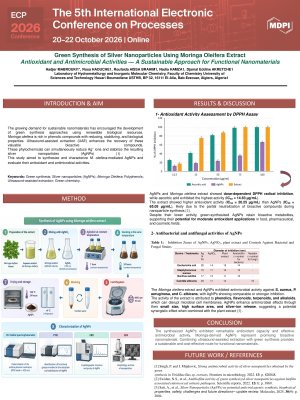
The growing demand for environmentally friendly nanomaterials has stimulated the development of green synthesis strategies based on renewable biological resources. In this study, silver nanoparticles (AgNPs) were synthesized using a hydroalcoholic extract of Moringa Oleifera obtained by ultrasound-assisted extraction. This extraction technique enhanced the recovery of bioactive compounds, yielding an extract rich in phenolic constituents with a total polyphenol content of 128 mg GAE/g of dry extract. These naturally occurring phytochemicals acted both as reducing agents for the conversion of silver ions into metallic nanoparticles and as stabilizing agents, eliminating the need for hazardous chemical reagents.
The synthesized AgNPs were characterized using UV–Visible spectroscopy, Fourier Transform Infrared Spectroscopy (FTIR), and Scanning Electron Microscopy (SEM). UV–Visible analysis revealed a characteristic surface plasmon resonance band at 423 nm, confirming the successful formation of silver nanoparticles. FTIR spectra indicated the participation of functional groups associated with phenolic compounds and other plant metabolites in the reduction and capping mechanisms. SEM observations further confirmed the formation of nanoparticles with a well-defined morphology.
The biological activities of the synthesized AgNPs were assessed through antioxidant and antimicrobial assays. The nanoparticles exhibited remarkable antioxidant capacity and demonstrated effective antimicrobial activity against the tested microbial strains. These results highlight the potential of Moringa-derived silver nanoparticles as promising bioactive nanomaterials. Furthermore, the combination of ultrasound-assisted extraction and green synthesis represents a sustainable and cost-effective approach for producing functional nanomaterials with potential applications in biomedical, pharmaceutical, and environmental fields.
Keywords: Green synthesis; Silver nanoparticles (AgNPs); Moringa Oleifera; Polyphenols; Ultrasound-assisted extraction; Green chemistry.
Keywords
Green synthesis
Silver nanoparticles (AgNPs)
Moringa Oleifera
Polyphenols
Ultrasound-assisted extraction.
Poster
ECP 2026.pdf
Transformer Autoencoder-Based Anomaly Detection and Intelligent Process Monitoring for Smart Water Treatment Plants
Physics-Informed Hybrid Modelling for the Techno-Economic Optimisation of Multi-Source Mineral Processing Systems: A Mine-to-Plant Framework