Event submissions
Published
This submission belongs to the session S4. Process Control, Monitoring and Machine Learning of the event The 5th International Electronic Conference on Processes
Published date
15 Oct, 2026
Academic Editor
'%3e%3cpath%20d='M12.6657%2010.9104C12.4185%2010.325%2012.0599%209.79327%2011.6097%209.34482C11.1609%208.89508%2010.6293%208.5365%2010.0442%208.28888C10.0389%208.28626%2010.0337%208.28495%2010.0285%208.28233C10.8446%207.69279%2011.3752%206.73249%2011.3752%205.64904C11.3752%203.8542%209.92103%202.39999%208.1262%202.39999C6.33136%202.39999%204.87715%203.8542%204.87715%205.64904C4.87715%206.73249%205.40774%207.69279%206.22393%208.28364C6.21869%208.28626%206.21345%208.28757%206.20821%208.29019C5.62129%208.5378%205.09463%208.89284%204.64265%209.34613C4.1929%209.79493%203.83432%2010.3266%203.58671%2010.9117C3.34345%2011.4845%203.21226%2012.0987%203.20023%2012.7209C3.19988%2012.7349%203.20233%2012.7488%203.20744%2012.7619C3.21255%2012.7749%203.22022%2012.7867%203.22998%2012.7968C3.23975%2012.8068%203.25142%2012.8147%203.26431%2012.8202C3.2772%2012.8256%203.29105%2012.8284%203.30504%2012.8284H4.09109C4.14874%2012.8284%204.19459%2012.7825%204.1959%2012.7262C4.2221%2011.7148%204.62823%2010.7676%205.34617%2010.0497C6.08899%209.30683%207.0755%208.89808%208.1262%208.89808C9.17689%208.89808%2010.1634%209.30683%2010.9062%2010.0497C11.6242%2010.7676%2012.0303%2011.7148%2012.0565%2012.7262C12.0578%2012.7838%2012.1037%2012.8284%2012.1613%2012.8284H12.9474C12.9613%2012.8284%2012.9752%2012.8256%2012.9881%2012.8202C13.001%2012.8147%2013.0126%2012.8068%2013.0224%2012.7968C13.0322%2012.7867%2013.0398%2012.7749%2013.0449%2012.7619C13.0501%2012.7488%2013.0525%2012.7349%2013.0522%2012.7209C13.0391%2012.0947%2012.9094%2011.4855%2012.6657%2010.9104ZM8.1262%207.9024C7.52486%207.9024%206.9589%207.6679%206.53312%207.24211C6.10733%206.81633%205.87283%206.25037%205.87283%205.64904C5.87283%205.0477%206.10733%204.48174%206.53312%204.05596C6.9589%203.63018%207.52486%203.39567%208.1262%203.39567C8.72753%203.39567%209.29349%203.63018%209.71927%204.05596C10.1451%204.48174%2010.3796%205.0477%2010.3796%205.64904C10.3796%206.25037%2010.1451%206.81633%209.71927%207.24211C9.29349%207.6679%208.72753%207.9024%208.1262%207.9024Z'%20fill='%235D1EE1'/%3e%3c/g%3e%3c/svg%3e) Ravendra Singh
Ravendra SinghCitation
Asma Anaya, Abdellah Ech-Chahad, Physics-Informed Hybrid Modelling for the Techno-Economic Optimisation of Multi-Source Mineral Processing Systems: A Mine-to-Plant Framework, in Proceedings of The 5th International Electronic Conference on Processes, 20 October–22 October 2026, MDPI: Basel, Switzerland
Share
Email
Facebook
Twitter
LinkedIn
Physics-Informed Hybrid Modelling for the Techno-Economic Optimisation of Multi-Source Mineral Processing Systems: A Mine-to-Plant Framework
'%3e%3cpath%20d='M12.6647%2010.9104C12.4176%2010.325%2012.0589%209.7933%2011.6088%209.34485C11.16%208.89511%2010.6283%208.53653%2010.0432%208.28891C10.038%208.28629%2010.0327%208.28498%2010.0275%208.28236C10.8437%207.69282%2011.3743%206.73252%2011.3743%205.64907C11.3743%203.85423%209.92005%202.40002%208.12522%202.40002C6.33038%202.40002%204.87618%203.85423%204.87618%205.64907C4.87618%206.73252%205.40677%207.69282%206.22296%208.28367C6.21772%208.28629%206.21248%208.2876%206.20724%208.29022C5.62031%208.53783%205.09365%208.89287%204.64167%209.34616C4.19192%209.79496%203.83334%2010.3266%203.58573%2010.9117C3.34247%2011.4846%203.21128%2012.0987%203.19925%2012.721C3.1989%2012.735%203.20135%2012.7489%203.20646%2012.7619C3.21157%2012.7749%203.21924%2012.7868%203.22901%2012.7968C3.23877%2012.8068%203.25045%2012.8148%203.26334%2012.8202C3.27623%2012.8256%203.29007%2012.8284%203.30406%2012.8284H4.09012C4.14776%2012.8284%204.19362%2012.7825%204.19493%2012.7262C4.22113%2011.7148%204.62726%2010.7676%205.34519%2010.0497C6.08802%209.30686%207.07452%208.89811%208.12522%208.89811C9.17592%208.89811%2010.1624%209.30686%2010.9052%2010.0497C11.6232%2010.7676%2012.0293%2011.7148%2012.0555%2012.7262C12.0568%2012.7839%2012.1027%2012.8284%2012.1603%2012.8284H12.9464C12.9604%2012.8284%2012.9742%2012.8256%2012.9871%2012.8202C13%2012.8148%2013.0117%2012.8068%2013.0214%2012.7968C13.0312%2012.7868%2013.0389%2012.7749%2013.044%2012.7619C13.0491%2012.7489%2013.0515%2012.735%2013.0512%2012.721C13.0381%2012.0947%2012.9084%2011.4856%2012.6647%2010.9104ZM8.12522%207.90243C7.52388%207.90243%206.95792%207.66793%206.53214%207.24215C6.10636%206.81636%205.87185%206.2504%205.87185%205.64907C5.87185%205.04773%206.10636%204.48177%206.53214%204.05599C6.95792%203.63021%207.52388%203.3957%208.12522%203.3957C8.72655%203.3957%209.29252%203.63021%209.7183%204.05599C10.1441%204.48177%2010.3786%205.04773%2010.3786%205.64907C10.3786%206.2504%2010.1441%206.81636%209.7183%207.24215C9.29252%207.66793%208.72655%207.90243%208.12522%207.90243Z'%20fill='%235D1EE1'/%3e%3c/g%3e%3c/svg%3e)
Asma Anaya 1
Abdellah Ech-Chahad 2
1. Laboratory of Physical Chemistry of Processes and Materials (LPCPM), Faculty of Sciences and Techniques of Settat (FSTS), Hassan First University, Settat, Morocco
2. Faculty of science and technology, Hassan First University, Settat, Morocco
Abstract
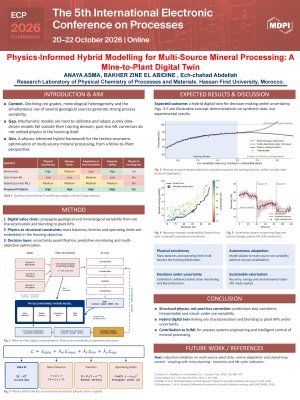
The increasing complexity of modern mineral processing operations is driven by declining ore grades, mineralogical heterogeneity, and the simultaneous exploitation of multiple geological sources. These conditions generate significant process variability and challenge the predictive capability of conventional modelling approaches. While mechanistic models suffer from calibration limitations and poor adaptability under feed variability, purely data-driven methods lack physical consistency and fail systematically outside their training domain. Existing hybrid approaches such as post-processing ML correctors applied to mechanistic baselines represent a first step but do not embed physical constraints within the learning architecture itself, limiting their reliability under genuine multi-source ore variability.
This work proposes a physics-informed hybrid modelling framework for the techno-economic optimisation of multi-source mineral processing systems within a Mine-to-Plant perspective. Unlike existing approaches, the proposed framework embeds fundamental process constraints mass balances, kinetic relationships, and operational limits directly into the learning objective as structural constraints, ensuring physically consistent predictions beyond the training distribution and enabling autonomous adaptation under ore variability. This structural distinction improves model interpretability, extrapolation capability, and robustness compared to conventional hybrid methods.
The framework establishes a digital representation of the mineral value chain, enabling the propagation of geological and mineralogical variability from ore characterisation and blending strategies to plant-scale performance indicators. Particular attention is given to uncertainty management, predictive monitoring, and multi-objective optimisation balancing metallurgical performance, energy efficiency, and sustainability objectives.
Expected outcomes include a hybrid digital twin supporting decision-making under uncertainty, improving resource valorisation, and enhancing operational resilience. The proposed methodology contributes to Scientific Machine Learning (SciML) applied to process systems engineering and offers new perspectives for intelligent control and optimisation of mineral processing operations.
Keywords
Physics-Informed Machine Learning
Hybrid Modelling
Mineral Processing
Mine-to-Plant
Digital Twin
Process Optimisation
Geometallurgy
Kinetic Modelling
Artificial Intelligence
Multi-Objective Optimisation
Poster
Poster_ECP2026_ANAYA_ASMA.pdf
Ultrasound-Assisted Green Synthesis of Silver Nanoparticles Using Moringa Oleifera Extract: Characterization and Evaluation of Antioxidant and Antimicrobial Activities
Biopolymers recovered from waste sludge as carriers for bacteria targeting 17β-Estradiol (E2) degradation