Event submissions
Published
This submission belongs to the session S4. Process Control, Monitoring and Machine Learning of the event The 5th International Electronic Conference on Processes
Published date
15 Oct, 2026
Academic Editor
'%3e%3cpath%20d='M12.6657%2010.9104C12.4185%2010.325%2012.0599%209.79327%2011.6097%209.34482C11.1609%208.89508%2010.6293%208.5365%2010.0442%208.28888C10.0389%208.28626%2010.0337%208.28495%2010.0285%208.28233C10.8446%207.69279%2011.3752%206.73249%2011.3752%205.64904C11.3752%203.8542%209.92103%202.39999%208.1262%202.39999C6.33136%202.39999%204.87715%203.8542%204.87715%205.64904C4.87715%206.73249%205.40774%207.69279%206.22393%208.28364C6.21869%208.28626%206.21345%208.28757%206.20821%208.29019C5.62129%208.5378%205.09463%208.89284%204.64265%209.34613C4.1929%209.79493%203.83432%2010.3266%203.58671%2010.9117C3.34345%2011.4845%203.21226%2012.0987%203.20023%2012.7209C3.19988%2012.7349%203.20233%2012.7488%203.20744%2012.7619C3.21255%2012.7749%203.22022%2012.7867%203.22998%2012.7968C3.23975%2012.8068%203.25142%2012.8147%203.26431%2012.8202C3.2772%2012.8256%203.29105%2012.8284%203.30504%2012.8284H4.09109C4.14874%2012.8284%204.19459%2012.7825%204.1959%2012.7262C4.2221%2011.7148%204.62823%2010.7676%205.34617%2010.0497C6.08899%209.30683%207.0755%208.89808%208.1262%208.89808C9.17689%208.89808%2010.1634%209.30683%2010.9062%2010.0497C11.6242%2010.7676%2012.0303%2011.7148%2012.0565%2012.7262C12.0578%2012.7838%2012.1037%2012.8284%2012.1613%2012.8284H12.9474C12.9613%2012.8284%2012.9752%2012.8256%2012.9881%2012.8202C13.001%2012.8147%2013.0126%2012.8068%2013.0224%2012.7968C13.0322%2012.7867%2013.0398%2012.7749%2013.0449%2012.7619C13.0501%2012.7488%2013.0525%2012.7349%2013.0522%2012.7209C13.0391%2012.0947%2012.9094%2011.4855%2012.6657%2010.9104ZM8.1262%207.9024C7.52486%207.9024%206.9589%207.6679%206.53312%207.24211C6.10733%206.81633%205.87283%206.25037%205.87283%205.64904C5.87283%205.0477%206.10733%204.48174%206.53312%204.05596C6.9589%203.63018%207.52486%203.39567%208.1262%203.39567C8.72753%203.39567%209.29349%203.63018%209.71927%204.05596C10.1451%204.48174%2010.3796%205.0477%2010.3796%205.64904C10.3796%206.25037%2010.1451%206.81633%209.71927%207.24211C9.29349%207.6679%208.72753%207.9024%208.1262%207.9024Z'%20fill='%235D1EE1'/%3e%3c/g%3e%3c/svg%3e) Ravendra Singh
Ravendra SinghCitation
Sarvar Rejabov, Botir Usmonov, Komil Usmanov, Zafar Turakulov, Jaloliddin Eshbobayev, Adham Norkobilov, Azizbek Kamolov, Abbos Elmanov, ANFIS-Based Intelligent Control of Solar Drying Processes: Comparative Performance Analysis with Neural Network Predictive and PID Controllers, in Proceedings of The 5th International Electronic Conference on Processes, 20 October–22 October 2026, MDPI: Basel, Switzerland
Share
Email
Facebook
Twitter
LinkedIn
ANFIS-Based Intelligent Control of Solar Drying Processes: Comparative Performance Analysis with Neural Network Predictive and PID Controllers
'%3e%3cpath%20d='M12.6647%2010.9104C12.4176%2010.325%2012.0589%209.7933%2011.6088%209.34485C11.16%208.89511%2010.6283%208.53653%2010.0432%208.28891C10.038%208.28629%2010.0327%208.28498%2010.0275%208.28236C10.8437%207.69282%2011.3743%206.73252%2011.3743%205.64907C11.3743%203.85423%209.92005%202.40002%208.12522%202.40002C6.33038%202.40002%204.87618%203.85423%204.87618%205.64907C4.87618%206.73252%205.40677%207.69282%206.22296%208.28367C6.21772%208.28629%206.21248%208.2876%206.20724%208.29022C5.62031%208.53783%205.09365%208.89287%204.64167%209.34616C4.19192%209.79496%203.83334%2010.3266%203.58573%2010.9117C3.34247%2011.4846%203.21128%2012.0987%203.19925%2012.721C3.1989%2012.735%203.20135%2012.7489%203.20646%2012.7619C3.21157%2012.7749%203.21924%2012.7868%203.22901%2012.7968C3.23877%2012.8068%203.25045%2012.8148%203.26334%2012.8202C3.27623%2012.8256%203.29007%2012.8284%203.30406%2012.8284H4.09012C4.14776%2012.8284%204.19362%2012.7825%204.19493%2012.7262C4.22113%2011.7148%204.62726%2010.7676%205.34519%2010.0497C6.08802%209.30686%207.07452%208.89811%208.12522%208.89811C9.17592%208.89811%2010.1624%209.30686%2010.9052%2010.0497C11.6232%2010.7676%2012.0293%2011.7148%2012.0555%2012.7262C12.0568%2012.7839%2012.1027%2012.8284%2012.1603%2012.8284H12.9464C12.9604%2012.8284%2012.9742%2012.8256%2012.9871%2012.8202C13%2012.8148%2013.0117%2012.8068%2013.0214%2012.7968C13.0312%2012.7868%2013.0389%2012.7749%2013.044%2012.7619C13.0491%2012.7489%2013.0515%2012.735%2013.0512%2012.721C13.0381%2012.0947%2012.9084%2011.4856%2012.6647%2010.9104ZM8.12522%207.90243C7.52388%207.90243%206.95792%207.66793%206.53214%207.24215C6.10636%206.81636%205.87185%206.2504%205.87185%205.64907C5.87185%205.04773%206.10636%204.48177%206.53214%204.05599C6.95792%203.63021%207.52388%203.3957%208.12522%203.3957C8.72655%203.3957%209.29252%203.63021%209.7183%204.05599C10.1441%204.48177%2010.3786%205.04773%2010.3786%205.64907C10.3786%206.2504%2010.1441%206.81636%209.7183%207.24215C9.29252%207.66793%208.72655%207.90243%208.12522%207.90243Z'%20fill='%235D1EE1'/%3e%3c/g%3e%3c/svg%3e)
Sarvar Rejabov 1

Botir Usmonov 2
Komil Usmanov 2

Zafar Turakulov 2
Jaloliddin Eshbobayev 2
Adham Norkobilov 3

Azizbek Kamolov 1
Abbos Elmanov 3
1. Department of Automation and Digital Control, Tashkent Chemical-Technological Institute, Tashkent, 100011, Uzbekistan
2. Department of IT, automation and control, Tashkent Institute of Chemical Technology, Tashkent, Uzbekistan
3. Faculty of Food Engineering in Shahrisabz, Karshi State Technical University, Shahrisabz 181306, Uzbekistan
Abstract
Abstract
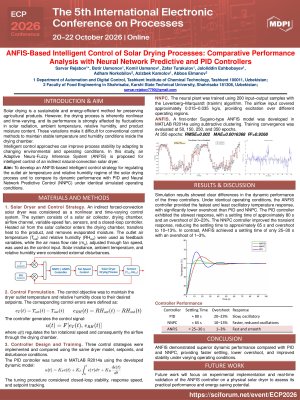
Solar drying is an environmentally friendly and energy-efficient technology for preserving agricultural products. However, its performance is strongly influenced by nonlinear heat and mass transfer as well as variations in solar radiation, ambient temperature, humidity, and product moisture content, limiting the effectiveness of conventional control methods. This study proposes an adaptive neuro-fuzzy inference system (ANFIS)-based intelligent control strategy and compares its simulated performance with proportional–integral–derivative (PID) and neural network predictive control (NNPC).
A closed-loop simulation model was developed in which outlet air temperature and relative humidity were used as feedback variables, while airflow rate was regulated through fan speed. A first-order Sugeno ANFIS model was trained using data generated from a validated mathematical model supported by previous experimental measurements of an indirect natural-convection solar dryer. Controller performance was evaluated using settling time, overshoot, and disturbance rejection under identical simulated operating conditions.
Simulation results demonstrated the superior performance of the ANFIS controller. The settling time decreased from approximately 80 s for PID and 65 s for NNPC to 25–30 s for ANFIS. Overshoot was reduced from 20–23% (PID) and 10–13% (NNPC) to only 1–3%. Moreover, ANFIS provided smoother control actions and maintained stable operation under variations in solar irradiance, ambient temperature, and relative humidity.
These findings indicate that ANFIS offers faster dynamic response, improved robustness, and enhanced process stability compared with conventional controllers. Although the present study is simulation-based, the proposed control strategy provides a promising foundation for intelligent solar dryer control. Experimental implementation and validation on a physical solar dryer will be carried out in future work to verify real-time performance and potential energy-saving benefits.
Keywords
solar dryer
ANFIS
intelligent control
neural network predictive control
PID control
adaptive control
drying process
temperature control
humidity control.
Poster
Poster 1.pdf
Physicochemical characterization of geranium distillation liquid residue (still water) for sustainable valorization
Optimization of Microwave-Assisted Extraction of Bioactive Compounds from Grape Pomace Using Response Surface Methodology