Event submissions
Published
This submission belongs to the session S4. Process Control, Monitoring and Machine Learning of the event The 5th International Electronic Conference on Processes
Published date
15 Oct, 2026
Academic Editor
'%3e%3cpath%20d='M12.6657%2010.9104C12.4185%2010.325%2012.0599%209.79327%2011.6097%209.34482C11.1609%208.89508%2010.6293%208.5365%2010.0442%208.28888C10.0389%208.28626%2010.0337%208.28495%2010.0285%208.28233C10.8446%207.69279%2011.3752%206.73249%2011.3752%205.64904C11.3752%203.8542%209.92103%202.39999%208.1262%202.39999C6.33136%202.39999%204.87715%203.8542%204.87715%205.64904C4.87715%206.73249%205.40774%207.69279%206.22393%208.28364C6.21869%208.28626%206.21345%208.28757%206.20821%208.29019C5.62129%208.5378%205.09463%208.89284%204.64265%209.34613C4.1929%209.79493%203.83432%2010.3266%203.58671%2010.9117C3.34345%2011.4845%203.21226%2012.0987%203.20023%2012.7209C3.19988%2012.7349%203.20233%2012.7488%203.20744%2012.7619C3.21255%2012.7749%203.22022%2012.7867%203.22998%2012.7968C3.23975%2012.8068%203.25142%2012.8147%203.26431%2012.8202C3.2772%2012.8256%203.29105%2012.8284%203.30504%2012.8284H4.09109C4.14874%2012.8284%204.19459%2012.7825%204.1959%2012.7262C4.2221%2011.7148%204.62823%2010.7676%205.34617%2010.0497C6.08899%209.30683%207.0755%208.89808%208.1262%208.89808C9.17689%208.89808%2010.1634%209.30683%2010.9062%2010.0497C11.6242%2010.7676%2012.0303%2011.7148%2012.0565%2012.7262C12.0578%2012.7838%2012.1037%2012.8284%2012.1613%2012.8284H12.9474C12.9613%2012.8284%2012.9752%2012.8256%2012.9881%2012.8202C13.001%2012.8147%2013.0126%2012.8068%2013.0224%2012.7968C13.0322%2012.7867%2013.0398%2012.7749%2013.0449%2012.7619C13.0501%2012.7488%2013.0525%2012.7349%2013.0522%2012.7209C13.0391%2012.0947%2012.9094%2011.4855%2012.6657%2010.9104ZM8.1262%207.9024C7.52486%207.9024%206.9589%207.6679%206.53312%207.24211C6.10733%206.81633%205.87283%206.25037%205.87283%205.64904C5.87283%205.0477%206.10733%204.48174%206.53312%204.05596C6.9589%203.63018%207.52486%203.39567%208.1262%203.39567C8.72753%203.39567%209.29349%203.63018%209.71927%204.05596C10.1451%204.48174%2010.3796%205.0477%2010.3796%205.64904C10.3796%206.25037%2010.1451%206.81633%209.71927%207.24211C9.29349%207.6679%208.72753%207.9024%208.1262%207.9024Z'%20fill='%235D1EE1'/%3e%3c/g%3e%3c/svg%3e) Ravendra Singh
Ravendra SinghCitation
Sarvar Rejabov, Jaloliddin Eshbobayev, Komil Usmanov, Mirjalol Yusupov, Zafar Turakulov, An Optimized ANFIS Framework for Intelligent Prediction and Control of Agricultural Product Drying Processes in Indirect Solar Dryers, in Proceedings of The 5th International Electronic Conference on Processes, 20 October–22 October 2026, MDPI: Basel, Switzerland
Share
Email
Facebook
Twitter
LinkedIn
An Optimized ANFIS Framework for Intelligent Prediction and Control of Agricultural Product Drying Processes in Indirect Solar Dryers
'%3e%3cpath%20d='M12.6647%2010.9104C12.4176%2010.325%2012.0589%209.7933%2011.6088%209.34485C11.16%208.89511%2010.6283%208.53653%2010.0432%208.28891C10.038%208.28629%2010.0327%208.28498%2010.0275%208.28236C10.8437%207.69282%2011.3743%206.73252%2011.3743%205.64907C11.3743%203.85423%209.92005%202.40002%208.12522%202.40002C6.33038%202.40002%204.87618%203.85423%204.87618%205.64907C4.87618%206.73252%205.40677%207.69282%206.22296%208.28367C6.21772%208.28629%206.21248%208.2876%206.20724%208.29022C5.62031%208.53783%205.09365%208.89287%204.64167%209.34616C4.19192%209.79496%203.83334%2010.3266%203.58573%2010.9117C3.34247%2011.4846%203.21128%2012.0987%203.19925%2012.721C3.1989%2012.735%203.20135%2012.7489%203.20646%2012.7619C3.21157%2012.7749%203.21924%2012.7868%203.22901%2012.7968C3.23877%2012.8068%203.25045%2012.8148%203.26334%2012.8202C3.27623%2012.8256%203.29007%2012.8284%203.30406%2012.8284H4.09012C4.14776%2012.8284%204.19362%2012.7825%204.19493%2012.7262C4.22113%2011.7148%204.62726%2010.7676%205.34519%2010.0497C6.08802%209.30686%207.07452%208.89811%208.12522%208.89811C9.17592%208.89811%2010.1624%209.30686%2010.9052%2010.0497C11.6232%2010.7676%2012.0293%2011.7148%2012.0555%2012.7262C12.0568%2012.7839%2012.1027%2012.8284%2012.1603%2012.8284H12.9464C12.9604%2012.8284%2012.9742%2012.8256%2012.9871%2012.8202C13%2012.8148%2013.0117%2012.8068%2013.0214%2012.7968C13.0312%2012.7868%2013.0389%2012.7749%2013.044%2012.7619C13.0491%2012.7489%2013.0515%2012.735%2013.0512%2012.721C13.0381%2012.0947%2012.9084%2011.4856%2012.6647%2010.9104ZM8.12522%207.90243C7.52388%207.90243%206.95792%207.66793%206.53214%207.24215C6.10636%206.81636%205.87185%206.2504%205.87185%205.64907C5.87185%205.04773%206.10636%204.48177%206.53214%204.05599C6.95792%203.63021%207.52388%203.3957%208.12522%203.3957C8.72655%203.3957%209.29252%203.63021%209.7183%204.05599C10.1441%204.48177%2010.3786%205.04773%2010.3786%205.64907C10.3786%206.2504%2010.1441%206.81636%209.7183%207.24215C9.29252%207.66793%208.72655%207.90243%208.12522%207.90243Z'%20fill='%235D1EE1'/%3e%3c/g%3e%3c/svg%3e)
Sarvar Rejabov 1
Jaloliddin Eshbobayev 2
Komil Usmanov 2
Mirjalol Yusupov 1

Zafar Turakulov 2
1. Department of Automation and Digital Control, Tashkent Institute of Chemical Technology, Tashkent 100011, Uzbekistan
2. Department of IT, automation and control, Tashkent Institute of Chemical Technology, Tashkent, Uzbekistan
Abstract
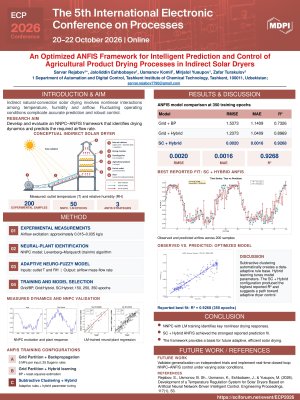
Agricultural product drying in indirect solar dryers is characterized by strong nonlinearities, time-varying environmental disturbances, and complex interactions between temperature, humidity, and airflow, making accurate prediction and intelligent control challenging using conventional approaches. This study presents an optimized Adaptive Neuro-Fuzzy Inference System (ANFIS) framework for modeling and intelligent control of the drying process in an indirect natural convection solar dryer. A dataset consisting of 200 experimentally collected samples was obtained from a laboratory-scale solar drying system under varying operating conditions. Initially, a Neural Network Predictive Controller (NNPC) was developed using the Levenberg–Marquardt (LM, trainlm) algorithm to identify the dynamic behavior of the drying process. Subsequently, ANFIS models were synthesized using three different training strategies, namely Grid Partition with Backpropagation, Grid Partition with Hybrid learning, and Subtractive Clustering combined with Hybrid learning. The models were trained and evaluated at different epoch numbers (150, 250, and 350 epochs) to investigate their convergence characteristics and prediction accuracy. The results demonstrated that the Subtractive Clustering–Hybrid ANFIS approach significantly improved model performance by automatically generating an efficient rule base and optimizing membership function parameters. Progressive reductions in prediction errors and improvements in generalization capability were observed throughout the training process. The optimized model achieved a predictive performance of RMSE = 0.002, MAE = 0.0091, and R² = 0.9268, indicating excellent agreement between experimental and predicted values. The findings demonstrate that integrating neural predictive control with optimized ANFIS architectures provides a robust soft-computing framework capable of accurately capturing the nonlinear dynamics of agricultural drying processes. The proposed intelligent model offers a reliable foundation for real-time monitoring, adaptive control, and energy-efficient operation of indirect solar drying systems, thereby contributing to improved product quality and sustainable agricultural processing technologies.
Keywords
indirect solar dryer
agricultural product drying
ANFIS
NNPC
predictive control
subtractive clustering
hybrid learning
intelligent control
soft computing
renewable energy.
Poster
Rejabov 2-poster.pdf
Optimization of Microwave-Assisted Extraction of Bioactive Compounds from Grape Pomace Using Response Surface Methodology
Spectral Characterization of Hydrodynamic Regimes in Multiphase Mixing Using PSD Analysis and CFD Simulations