Event submissions
Published
This submission belongs to the session S4. Process Control, Monitoring and Machine Learning of the event The 5th International Electronic Conference on Processes
Published date
15 Oct, 2026
Academic Editor
'%3e%3cpath%20d='M12.6657%2010.9104C12.4185%2010.325%2012.0599%209.79327%2011.6097%209.34482C11.1609%208.89508%2010.6293%208.5365%2010.0442%208.28888C10.0389%208.28626%2010.0337%208.28495%2010.0285%208.28233C10.8446%207.69279%2011.3752%206.73249%2011.3752%205.64904C11.3752%203.8542%209.92103%202.39999%208.1262%202.39999C6.33136%202.39999%204.87715%203.8542%204.87715%205.64904C4.87715%206.73249%205.40774%207.69279%206.22393%208.28364C6.21869%208.28626%206.21345%208.28757%206.20821%208.29019C5.62129%208.5378%205.09463%208.89284%204.64265%209.34613C4.1929%209.79493%203.83432%2010.3266%203.58671%2010.9117C3.34345%2011.4845%203.21226%2012.0987%203.20023%2012.7209C3.19988%2012.7349%203.20233%2012.7488%203.20744%2012.7619C3.21255%2012.7749%203.22022%2012.7867%203.22998%2012.7968C3.23975%2012.8068%203.25142%2012.8147%203.26431%2012.8202C3.2772%2012.8256%203.29105%2012.8284%203.30504%2012.8284H4.09109C4.14874%2012.8284%204.19459%2012.7825%204.1959%2012.7262C4.2221%2011.7148%204.62823%2010.7676%205.34617%2010.0497C6.08899%209.30683%207.0755%208.89808%208.1262%208.89808C9.17689%208.89808%2010.1634%209.30683%2010.9062%2010.0497C11.6242%2010.7676%2012.0303%2011.7148%2012.0565%2012.7262C12.0578%2012.7838%2012.1037%2012.8284%2012.1613%2012.8284H12.9474C12.9613%2012.8284%2012.9752%2012.8256%2012.9881%2012.8202C13.001%2012.8147%2013.0126%2012.8068%2013.0224%2012.7968C13.0322%2012.7867%2013.0398%2012.7749%2013.0449%2012.7619C13.0501%2012.7488%2013.0525%2012.7349%2013.0522%2012.7209C13.0391%2012.0947%2012.9094%2011.4855%2012.6657%2010.9104ZM8.1262%207.9024C7.52486%207.9024%206.9589%207.6679%206.53312%207.24211C6.10733%206.81633%205.87283%206.25037%205.87283%205.64904C5.87283%205.0477%206.10733%204.48174%206.53312%204.05596C6.9589%203.63018%207.52486%203.39567%208.1262%203.39567C8.72753%203.39567%209.29349%203.63018%209.71927%204.05596C10.1451%204.48174%2010.3796%205.0477%2010.3796%205.64904C10.3796%206.25037%2010.1451%206.81633%209.71927%207.24211C9.29349%207.6679%208.72753%207.9024%208.1262%207.9024Z'%20fill='%235D1EE1'/%3e%3c/g%3e%3c/svg%3e) Ravendra Singh
Ravendra SinghCitation
Vince Carlo Cruz, Faye Crizelle Habal, Kalihla Manuel, Geraldine Chloe Ann Pelayo, Rugi Vicente Rubi, Carlou Siga-an Eguico, In Silico Virtual Screening of Philippine Phytochemicals as Potential PDE4B Inhibitors for Psoriasis Using Structure-Based Molecular Docking, in Proceedings of The 5th International Electronic Conference on Processes, 20 October–22 October 2026, MDPI: Basel, Switzerland
Share
Email
Facebook
Twitter
LinkedIn
In Silico Virtual Screening of Philippine Phytochemicals as Potential PDE4B Inhibitors for Psoriasis Using Structure-Based Molecular Docking
'%3e%3cpath%20d='M12.6647%2010.9104C12.4176%2010.325%2012.0589%209.7933%2011.6088%209.34485C11.16%208.89511%2010.6283%208.53653%2010.0432%208.28891C10.038%208.28629%2010.0327%208.28498%2010.0275%208.28236C10.8437%207.69282%2011.3743%206.73252%2011.3743%205.64907C11.3743%203.85423%209.92005%202.40002%208.12522%202.40002C6.33038%202.40002%204.87618%203.85423%204.87618%205.64907C4.87618%206.73252%205.40677%207.69282%206.22296%208.28367C6.21772%208.28629%206.21248%208.2876%206.20724%208.29022C5.62031%208.53783%205.09365%208.89287%204.64167%209.34616C4.19192%209.79496%203.83334%2010.3266%203.58573%2010.9117C3.34247%2011.4846%203.21128%2012.0987%203.19925%2012.721C3.1989%2012.735%203.20135%2012.7489%203.20646%2012.7619C3.21157%2012.7749%203.21924%2012.7868%203.22901%2012.7968C3.23877%2012.8068%203.25045%2012.8148%203.26334%2012.8202C3.27623%2012.8256%203.29007%2012.8284%203.30406%2012.8284H4.09012C4.14776%2012.8284%204.19362%2012.7825%204.19493%2012.7262C4.22113%2011.7148%204.62726%2010.7676%205.34519%2010.0497C6.08802%209.30686%207.07452%208.89811%208.12522%208.89811C9.17592%208.89811%2010.1624%209.30686%2010.9052%2010.0497C11.6232%2010.7676%2012.0293%2011.7148%2012.0555%2012.7262C12.0568%2012.7839%2012.1027%2012.8284%2012.1603%2012.8284H12.9464C12.9604%2012.8284%2012.9742%2012.8256%2012.9871%2012.8202C13%2012.8148%2013.0117%2012.8068%2013.0214%2012.7968C13.0312%2012.7868%2013.0389%2012.7749%2013.044%2012.7619C13.0491%2012.7489%2013.0515%2012.735%2013.0512%2012.721C13.0381%2012.0947%2012.9084%2011.4856%2012.6647%2010.9104ZM8.12522%207.90243C7.52388%207.90243%206.95792%207.66793%206.53214%207.24215C6.10636%206.81636%205.87185%206.2504%205.87185%205.64907C5.87185%205.04773%206.10636%204.48177%206.53214%204.05599C6.95792%203.63021%207.52388%203.3957%208.12522%203.3957C8.72655%203.3957%209.29252%203.63021%209.7183%204.05599C10.1441%204.48177%2010.3786%205.04773%2010.3786%205.64907C10.3786%206.2504%2010.1441%206.81636%209.7183%207.24215C9.29252%207.66793%208.72655%207.90243%208.12522%207.90243Z'%20fill='%235D1EE1'/%3e%3c/g%3e%3c/svg%3e)
Vince Carlo Cruz 1
Faye Crizelle Habal 1
Kalihla Manuel 1
Geraldine Chloe Ann Pelayo 1
Rugi Vicente Rubi 1,2
Carlou Siga-an Eguico 1,2
1. Chemical Engineering Department, Adamson University, Manila 1000, Philippines
2. Adamson University Laboratory of Biomass, Energy and Nanotechnology (ALBEN), Chemical Engineering Department, College of Engineering, Adamson University, Manila, Philippines
Abstract
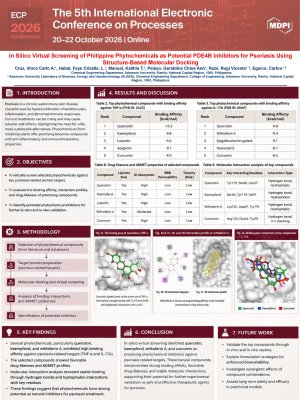
Psoriasis is a chronic immune-mediated skin disorder characterized by persistent inflammation, abnormal keratinocyte proliferation, and erythematous, scaly plaques. Although available treatments can manage its symptoms, long-term use may be limited by cost, adverse effects, variable patient response, and disease recurrence. This study employed a computer-aided drug-discovery workflow to identify potential phosphodiesterase-4B (PDE4B) inhibitors from phytochemicals reported in medicinal plants available in the Philippines. A library of 1,443 phytochemicals obtained from Dr. Duke’s Phytochemical and Ethnobotanical Database and the Indian Medicinal Plants, Phytochemistry and Therapeutics database was screened against PDE4B (PDB ID: 1XLX) using structure-based molecular docking on Lipinski’s Rule of Five. Twenty-two phytochemicals were shortlisted, with predicted binding affinities ranging from −10.3 to −9.0 kcal/mol, compared with −7.6 to −7.3 kcal/mol for the reference psoriasis drugs. Aurochrome obtained the most favorable initial docking score of −10.3 kcal/mol and a predicted dissociation constant of 28.16 nM. The four leading compounds Aurochrome, Friedelin, Kakkanin, and Taraxerone, were subjected to 100-ps molecular dynamics simulations. Friedelin was selected as the leading computational candidate because its third-ranked pose exhibited preliminary RMSD stability, a binding affinity of −9.1 kcal/mol, a predicted dissociation constant of 213.44 nM, 17 van der Waals interactions, and compliance with the study’s Lipinski criterion with one violation. Friedelin is reported in locally available plants, including kataka-taka, tawa-tawa, atis, and maize. These findings identify Friedelin as a preliminary computational hit rather than a confirmed psoriasis treatment. Further ADMET profiling, PDE-isoform selectivity testing, longer molecular dynamics simulations, enzyme-inhibition assays, toxicity assessment, and in vivo validation are required.
Keywords
Molecular Docking
Psoriasis
Friedelin
Phytochemicals
In Silico Screening
Poster
Screening_ECP.pdf
Quantum-Inspired Neural Network Modeling of Uncertain Nonlinear Processes
Data-Driven Modeling, Monitoring, and Process Optimization of Infrared-Convective Drying for Pumpkin Powder Production