Event submissions
Published
This submission belongs to the session S1. Environmental and Green Processes of the event The 5th International Electronic Conference on Processes
Published date
15 Oct, 2026
Academic Editor
'%3e%3cpath%20d='M12.6657%2010.9104C12.4185%2010.325%2012.0599%209.79327%2011.6097%209.34482C11.1609%208.89508%2010.6293%208.5365%2010.0442%208.28888C10.0389%208.28626%2010.0337%208.28495%2010.0285%208.28233C10.8446%207.69279%2011.3752%206.73249%2011.3752%205.64904C11.3752%203.8542%209.92103%202.39999%208.1262%202.39999C6.33136%202.39999%204.87715%203.8542%204.87715%205.64904C4.87715%206.73249%205.40774%207.69279%206.22393%208.28364C6.21869%208.28626%206.21345%208.28757%206.20821%208.29019C5.62129%208.5378%205.09463%208.89284%204.64265%209.34613C4.1929%209.79493%203.83432%2010.3266%203.58671%2010.9117C3.34345%2011.4845%203.21226%2012.0987%203.20023%2012.7209C3.19988%2012.7349%203.20233%2012.7488%203.20744%2012.7619C3.21255%2012.7749%203.22022%2012.7867%203.22998%2012.7968C3.23975%2012.8068%203.25142%2012.8147%203.26431%2012.8202C3.2772%2012.8256%203.29105%2012.8284%203.30504%2012.8284H4.09109C4.14874%2012.8284%204.19459%2012.7825%204.1959%2012.7262C4.2221%2011.7148%204.62823%2010.7676%205.34617%2010.0497C6.08899%209.30683%207.0755%208.89808%208.1262%208.89808C9.17689%208.89808%2010.1634%209.30683%2010.9062%2010.0497C11.6242%2010.7676%2012.0303%2011.7148%2012.0565%2012.7262C12.0578%2012.7838%2012.1037%2012.8284%2012.1613%2012.8284H12.9474C12.9613%2012.8284%2012.9752%2012.8256%2012.9881%2012.8202C13.001%2012.8147%2013.0126%2012.8068%2013.0224%2012.7968C13.0322%2012.7867%2013.0398%2012.7749%2013.0449%2012.7619C13.0501%2012.7488%2013.0525%2012.7349%2013.0522%2012.7209C13.0391%2012.0947%2012.9094%2011.4855%2012.6657%2010.9104ZM8.1262%207.9024C7.52486%207.9024%206.9589%207.6679%206.53312%207.24211C6.10733%206.81633%205.87283%206.25037%205.87283%205.64904C5.87283%205.0477%206.10733%204.48174%206.53312%204.05596C6.9589%203.63018%207.52486%203.39567%208.1262%203.39567C8.72753%203.39567%209.29349%203.63018%209.71927%204.05596C10.1451%204.48174%2010.3796%205.0477%2010.3796%205.64904C10.3796%206.25037%2010.1451%206.81633%209.71927%207.24211C9.29349%207.6679%208.72753%207.9024%208.1262%207.9024Z'%20fill='%235D1EE1'/%3e%3c/g%3e%3c/svg%3e) Juan Francisco García Martín
Juan Francisco García MartínCitation
Konstantin Lopatko, Oksana Zazymko, Volodymyr Nazarenko, Green Electrospark Processing of Metal Nanoparticles for Sustainable Crop Protection and Advanced Materials Applications, in Proceedings of The 5th International Electronic Conference on Processes, 20 October–22 October 2026, MDPI: Basel, Switzerland
Share
Email
Facebook
Twitter
LinkedIn
Green Electrospark Processing of Metal Nanoparticles for Sustainable Crop Protection and Advanced Materials Applications
'%3e%3cpath%20d='M12.6647%2010.9104C12.4176%2010.325%2012.0589%209.7933%2011.6088%209.34485C11.16%208.89511%2010.6283%208.53653%2010.0432%208.28891C10.038%208.28629%2010.0327%208.28498%2010.0275%208.28236C10.8437%207.69282%2011.3743%206.73252%2011.3743%205.64907C11.3743%203.85423%209.92005%202.40002%208.12522%202.40002C6.33038%202.40002%204.87618%203.85423%204.87618%205.64907C4.87618%206.73252%205.40677%207.69282%206.22296%208.28367C6.21772%208.28629%206.21248%208.2876%206.20724%208.29022C5.62031%208.53783%205.09365%208.89287%204.64167%209.34616C4.19192%209.79496%203.83334%2010.3266%203.58573%2010.9117C3.34247%2011.4846%203.21128%2012.0987%203.19925%2012.721C3.1989%2012.735%203.20135%2012.7489%203.20646%2012.7619C3.21157%2012.7749%203.21924%2012.7868%203.22901%2012.7968C3.23877%2012.8068%203.25045%2012.8148%203.26334%2012.8202C3.27623%2012.8256%203.29007%2012.8284%203.30406%2012.8284H4.09012C4.14776%2012.8284%204.19362%2012.7825%204.19493%2012.7262C4.22113%2011.7148%204.62726%2010.7676%205.34519%2010.0497C6.08802%209.30686%207.07452%208.89811%208.12522%208.89811C9.17592%208.89811%2010.1624%209.30686%2010.9052%2010.0497C11.6232%2010.7676%2012.0293%2011.7148%2012.0555%2012.7262C12.0568%2012.7839%2012.1027%2012.8284%2012.1603%2012.8284H12.9464C12.9604%2012.8284%2012.9742%2012.8256%2012.9871%2012.8202C13%2012.8148%2013.0117%2012.8068%2013.0214%2012.7968C13.0312%2012.7868%2013.0389%2012.7749%2013.044%2012.7619C13.0491%2012.7489%2013.0515%2012.735%2013.0512%2012.721C13.0381%2012.0947%2012.9084%2011.4856%2012.6647%2010.9104ZM8.12522%207.90243C7.52388%207.90243%206.95792%207.66793%206.53214%207.24215C6.10636%206.81636%205.87185%206.2504%205.87185%205.64907C5.87185%205.04773%206.10636%204.48177%206.53214%204.05599C6.95792%203.63021%207.52388%203.3957%208.12522%203.3957C8.72655%203.3957%209.29252%203.63021%209.7183%204.05599C10.1441%204.48177%2010.3786%205.04773%2010.3786%205.64907C10.3786%206.2504%2010.1441%206.81636%209.7183%207.24215C9.29252%207.66793%208.72655%207.90243%208.12522%207.90243Z'%20fill='%235D1EE1'/%3e%3c/g%3e%3c/svg%3e)
Konstantin Lopatko 1
Oksana Zazymko 1
Volodymyr Nazarenko 1
1. Department of Computer Systems Networks and Cybersecurity, National University of Life and Environmental Sciences of Ukraine, Kyiv, Ukraine
Abstract
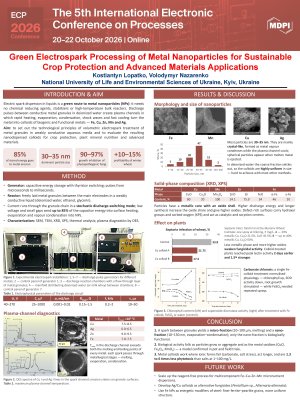
Electric spark dispersion in liquids is a promising green process for producing metal nanoparticles without chemical reducing agents, stabilizers, or high-temperature bulk reactors. This work summarizes the technological principles and applied potential of electrospark treatment of conductive metal granules in weakly conductive aqueous media for the synthesis of environmentally acceptable nanodispersed systems. In the proposed process, discharge pulses generated by a capacitive thyristor system initiate stochastic plasma channels between metal granules immersed in deionized water. Local temperatures of approximately 8000–12,000 °C, rapid heating, evaporation, condensation, shock-wave effects, and high cooling rates produce colloidal particles of biogenic and functional metals, including Fe, Cu, Zn, Mn, and Ag. The process parameters, namely pulse voltage, current amplitude, capacitance, frequency, chamber configuration, and dispersion-medium temperature, determine the redistribution of stored electrical energy between plasma-channel heating, electrode erosion, liquid heating, shock-wave formation, and undesirable microfraction formation. Experimental characterization by SEM, TEM, XRD, XPS, and thermal analysis confirms the presence of nanoscale fractions with complex metal/oxide phase compositions, including CuO/Cu2O, Mn3O4, Zn/ZnO, and α-Fe/γ-Fe/FeO/Fe3O4, with particle sizes ranging from several to tens of nanometers and high structural defect density. The obtained aqueous colloids demonstrate significant applied value. Ag/Cu nanosuspensions inhibited the growth of phytopathogenic micromycetes, including Penicillium sp. and Alternaria alternata, by 90–97% at low metal concentrations, indicating their suitability as alternative fungicidal preparations. Multicomponent Fe–Cu–Zn–Mn trace-element dispersions tested in winter wheat cultivation improved the ecological and economic profile of crop production and increased profitability by 10–15%. Iron-based nanoparticles additionally showed potential as energetic modifiers of steel microstructure, refining ferrite–pearlite grains and increasing structural homogeneity. The results indicate that electrospark processing is a scalable, reagent-free, and process-controllable platform for sustainable nanoparticle production in agriculture, environmental technologies, and advanced materials engineering. Accordingly, the approach contributes to circular resource use.
Keywords
electrospark dispersion
metal nanoparticles
green synthesis
aqueous colloids
sustainable crop protection
nanofungicides
trace-element preparations
process engineering
sustainable agriculture
materials modification
Poster
ECP2026_Poster_Electrospark_Nanoparticles.pdf
IoT-Driven Energy Management and Real-Time Monitoring of a Photovoltaic-Powered Solar Dryer Using an ESP32 Platform
Isolation and characterization of microorganisms with antifungal activity for ecologically sustainable crop production