Event submissions
Published
This submission belongs to the session S1. Environmental and Green Processes of the event The 5th International Electronic Conference on Processes
Published date
15 Oct, 2026
Academic Editor
'%3e%3cpath%20d='M12.6657%2010.9104C12.4185%2010.325%2012.0599%209.79327%2011.6097%209.34482C11.1609%208.89508%2010.6293%208.5365%2010.0442%208.28888C10.0389%208.28626%2010.0337%208.28495%2010.0285%208.28233C10.8446%207.69279%2011.3752%206.73249%2011.3752%205.64904C11.3752%203.8542%209.92103%202.39999%208.1262%202.39999C6.33136%202.39999%204.87715%203.8542%204.87715%205.64904C4.87715%206.73249%205.40774%207.69279%206.22393%208.28364C6.21869%208.28626%206.21345%208.28757%206.20821%208.29019C5.62129%208.5378%205.09463%208.89284%204.64265%209.34613C4.1929%209.79493%203.83432%2010.3266%203.58671%2010.9117C3.34345%2011.4845%203.21226%2012.0987%203.20023%2012.7209C3.19988%2012.7349%203.20233%2012.7488%203.20744%2012.7619C3.21255%2012.7749%203.22022%2012.7867%203.22998%2012.7968C3.23975%2012.8068%203.25142%2012.8147%203.26431%2012.8202C3.2772%2012.8256%203.29105%2012.8284%203.30504%2012.8284H4.09109C4.14874%2012.8284%204.19459%2012.7825%204.1959%2012.7262C4.2221%2011.7148%204.62823%2010.7676%205.34617%2010.0497C6.08899%209.30683%207.0755%208.89808%208.1262%208.89808C9.17689%208.89808%2010.1634%209.30683%2010.9062%2010.0497C11.6242%2010.7676%2012.0303%2011.7148%2012.0565%2012.7262C12.0578%2012.7838%2012.1037%2012.8284%2012.1613%2012.8284H12.9474C12.9613%2012.8284%2012.9752%2012.8256%2012.9881%2012.8202C13.001%2012.8147%2013.0126%2012.8068%2013.0224%2012.7968C13.0322%2012.7867%2013.0398%2012.7749%2013.0449%2012.7619C13.0501%2012.7488%2013.0525%2012.7349%2013.0522%2012.7209C13.0391%2012.0947%2012.9094%2011.4855%2012.6657%2010.9104ZM8.1262%207.9024C7.52486%207.9024%206.9589%207.6679%206.53312%207.24211C6.10733%206.81633%205.87283%206.25037%205.87283%205.64904C5.87283%205.0477%206.10733%204.48174%206.53312%204.05596C6.9589%203.63018%207.52486%203.39567%208.1262%203.39567C8.72753%203.39567%209.29349%203.63018%209.71927%204.05596C10.1451%204.48174%2010.3796%205.0477%2010.3796%205.64904C10.3796%206.25037%2010.1451%206.81633%209.71927%207.24211C9.29349%207.6679%208.72753%207.9024%208.1262%207.9024Z'%20fill='%235D1EE1'/%3e%3c/g%3e%3c/svg%3e) Juan Francisco García Martín
Juan Francisco García MartínCitation
Anastasia Garkavaya, Anastasia Saltevskaya, Isolation and characterization of microorganisms with antifungal activity for ecologically sustainable crop production, in Proceedings of The 5th International Electronic Conference on Processes, 20 October–22 October 2026, MDPI: Basel, Switzerland
Share
Email
Facebook
Twitter
LinkedIn
Isolation and characterization of microorganisms with antifungal activity for ecologically sustainable crop production
'%3e%3cpath%20d='M12.6647%2010.9104C12.4176%2010.325%2012.0589%209.7933%2011.6088%209.34485C11.16%208.89511%2010.6283%208.53653%2010.0432%208.28891C10.038%208.28629%2010.0327%208.28498%2010.0275%208.28236C10.8437%207.69282%2011.3743%206.73252%2011.3743%205.64907C11.3743%203.85423%209.92005%202.40002%208.12522%202.40002C6.33038%202.40002%204.87618%203.85423%204.87618%205.64907C4.87618%206.73252%205.40677%207.69282%206.22296%208.28367C6.21772%208.28629%206.21248%208.2876%206.20724%208.29022C5.62031%208.53783%205.09365%208.89287%204.64167%209.34616C4.19192%209.79496%203.83334%2010.3266%203.58573%2010.9117C3.34247%2011.4846%203.21128%2012.0987%203.19925%2012.721C3.1989%2012.735%203.20135%2012.7489%203.20646%2012.7619C3.21157%2012.7749%203.21924%2012.7868%203.22901%2012.7968C3.23877%2012.8068%203.25045%2012.8148%203.26334%2012.8202C3.27623%2012.8256%203.29007%2012.8284%203.30406%2012.8284H4.09012C4.14776%2012.8284%204.19362%2012.7825%204.19493%2012.7262C4.22113%2011.7148%204.62726%2010.7676%205.34519%2010.0497C6.08802%209.30686%207.07452%208.89811%208.12522%208.89811C9.17592%208.89811%2010.1624%209.30686%2010.9052%2010.0497C11.6232%2010.7676%2012.0293%2011.7148%2012.0555%2012.7262C12.0568%2012.7839%2012.1027%2012.8284%2012.1603%2012.8284H12.9464C12.9604%2012.8284%2012.9742%2012.8256%2012.9871%2012.8202C13%2012.8148%2013.0117%2012.8068%2013.0214%2012.7968C13.0312%2012.7868%2013.0389%2012.7749%2013.044%2012.7619C13.0491%2012.7489%2013.0515%2012.735%2013.0512%2012.721C13.0381%2012.0947%2012.9084%2011.4856%2012.6647%2010.9104ZM8.12522%207.90243C7.52388%207.90243%206.95792%207.66793%206.53214%207.24215C6.10636%206.81636%205.87185%206.2504%205.87185%205.64907C5.87185%205.04773%206.10636%204.48177%206.53214%204.05599C6.95792%203.63021%207.52388%203.3957%208.12522%203.3957C8.72655%203.3957%209.29252%203.63021%209.7183%204.05599C10.1441%204.48177%2010.3786%205.04773%2010.3786%205.64907C10.3786%206.2504%2010.1441%206.81636%209.7183%207.24215C9.29252%207.66793%208.72655%207.90243%208.12522%207.90243Z'%20fill='%235D1EE1'/%3e%3c/g%3e%3c/svg%3e)
Anastasia Garkavaya 1
Anastasia Saltevskaya 1
1. Biological Educational and Research Complex "Innovative Solutions", Belgorod State National Research University (Belgorod, Russia)
Abstract
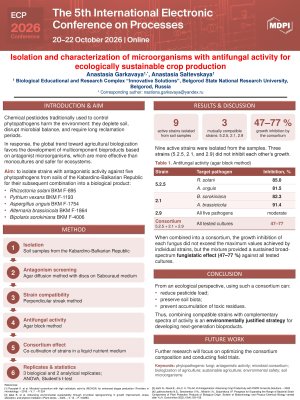
Chemical pesticides traditionally used to control phytopathogens harm the environment: they deplete soil, disrupt microbial balance, and require long reclamation periods. In response, the global trend toward agricultural biologization favors the development of multicomponent bioproducts based on antagonist microorganisms, which are more effective than monocultures and safer for ecosystems.
The aim of this work was to isolate strains with antagonistic activity against five phytopathogens (Rhizoctonia solani BKM F‑895, Pythium vexans BKM F‑1193, Aspergillus unguis BKM F‑1754, Alternaria brassicicola BKM F‑1864, Bipolaris sorokiniana BKM F‑4006) from soils of the Kabardino‑Balkarian Republic for their subsequent combination into a biological product against phytopathogens.
Nine active strains were isolated from the samples. All experiments were carried out in 3 biological and 2 analytical replicates. Antagonism was assessed using the agar diffusion method with discs on Sabouraud medium, and compatibility was assessed using the perpendicular streak method. Three strains (5.2.5, 2.1, and 2.9) did not inhibit each other’s growth. The antifungal activity was assessed using the agar block method: strain 5.2.5 was most effective against R. solani (85.0%) and A. unguis (81.5%); strain 2.1 was most effective against B. sorokiniana (82.3%) and A. brassicicola (91.4%); strain 2.9 showed moderate activity against all pathogens. The results were statistically processed (ANOVA), and the significance was assessed using the Student’s t‑test. To assess the effect of the consortium on phytopathogens, the strains were co‑cultivated in a liquid nutrient medium. When combined into a consortium, the growth inhibition of each fungus did not exceed the maximum values achieved by individual strains, but the mixture provided a sustained broad‑spectrum fungistatic effect (47–77 %) against all tested cultures.
From an ecological perspective, using such a consortium can reduce pesticide load, preserve soil biota, and prevent accumulation of toxic residues. Thus, combining compatible strains with complementary spectra of activity is an environmentally justified strategy for developing next‑generation bioproducts. Further research will focus on optimizing the consortium composition and conducting field trials
Keywords
phytopathogenic fungi
antagonistic activity
microbial consortium
biologization of agriculture
sustainable agriculture
environmental safety
soil microorganisms
Poster
ECP2026_poster_Garkavaya.pdf
Green Electrospark Processing of Metal Nanoparticles for Sustainable Crop Protection and Advanced Materials Applications
Effect of actinobacterial metabolites on root growth of cereal crops in the context of environmentally safe technologies